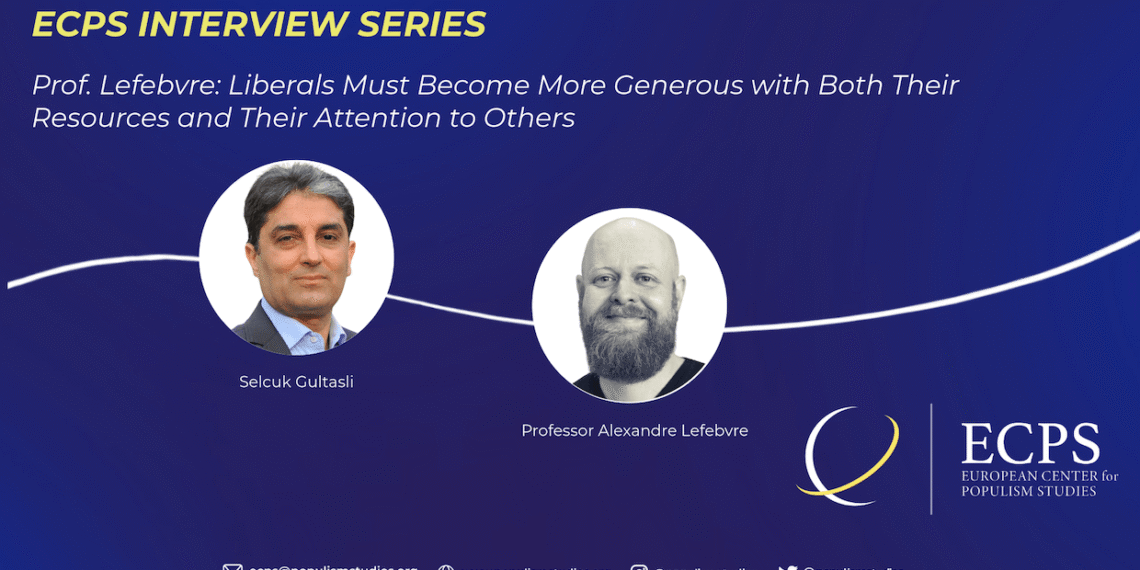
In this ECPS interview, Professor Alexandre Lefebvre of The University of Sydney argues that liberalism’s crisis is not merely institutional but also ethical and existential. Against populist and post-liberal portrayals of liberalism as morally hollow, elitist, and radically individualistic, Professor Lefebvre insists that liberalism historically rested on “freedom and generosity, liberty and liberality.” Yet neoliberalism, he argues, “forgot one half of this tradition,” narrowing liberalism into a doctrine of individual freedom, market rationality, and procedural neutrality. For Professor Lefebvre, liberal renewal requires recovering liberalism as a “way of life” grounded in fairness, reciprocity, moral self-reflection, and generosity. His remedy is clear: liberals must become “more generous with their resources and more generous in the attention they give to others.”
Interview by Selcuk Gultasli
At a moment when liberal democracy is confronting intensifying pressures—from populist radical-right mobilization and democratic backsliding to widening distrust in institutions and deepening social fragmentation—the future of liberalism has become one of the defining political and philosophical questions of our time. Across much of the contemporary world, liberalism is increasingly portrayed as morally exhausted, technocratic, elitist, and detached from the existential concerns of ordinary citizens. In political discourse, it is frequently reduced either to market orthodoxy or procedural neutrality, stripped of any deeper ethical or cultural substance. Against this backdrop, the work of Professor Alexandre Lefebvre offers a strikingly different interpretation of the liberal tradition.
In this wide-ranging interview with the European Center for Populism Studies (ECPS), Professor Lefebvre—Professor of Politics and Philosophy and Chair of Discipline, Philosophy at the Faculty of Arts and Social Sciences at The University of Sydney—argues that liberalism cannot survive as a purely procedural doctrine. Rather, it must recover its ethical, existential, and even spiritual dimensions if it is to respond effectively to the global rise of illiberalism and populism. Central to his argument is the claim that liberalism historically contained not only a commitment to freedom, but also to generosity. As he puts it, liberalism originally rested on “two fundamental values at its core,” namely “freedom and generosity, liberty and liberality.” Yet, according to Professor Lefebvre, neoliberalism emerged when liberal societies “forgot one half of this tradition” and elevated freedom while neglecting generosity, solidarity, and fairness.
Throughout the interview, Professor Lefebvre challenges widespread assumptions about liberalism’s moral emptiness. While acknowledging that many populist critiques rely on “an unfair and highly reductive interpretation of what liberalism actually stands for,” he nevertheless argues that liberals themselves have often “invited this criticism by effectively performing the role of the caricature.” Liberalism’s retreat into technocracy, proceduralism, and elite self-management, he contends, has weakened its emotional and moral appeal while intensifying public perceptions of inequality and exclusion. “Liberalism,” he warns, “has to rediscover generosity and solidarity through institutions rooted in justice and fairness.”
Drawing on thinkers ranging from John Rawls and Henri Bergson to Aristotle and John Stuart Mill, Professor Lefebvre develops a conception of liberalism not simply as a political arrangement, but as a “way of life” shaping everyday practices, relationships, and moral sensibilities. He argues that liberal democracies are facing not merely an institutional crisis, but “an existential crisis” rooted in the erosion of meaning, belonging, and ethical orientation.
Perhaps most strikingly, Professor Lefebvre insists that the renewal of liberal democracy depends less on technocratic management than on moral reconstruction. Liberalism, he argues, must once again become capable of inspiring attachment, solidarity, and self-reflection without succumbing to authoritarian perfectionism. In his concluding remarks, he summarizes this challenge with remarkable clarity: “If I had two wishes for liberalism, they would be these: that liberals become more generous with their resources and more generous in the attention they give to others.”