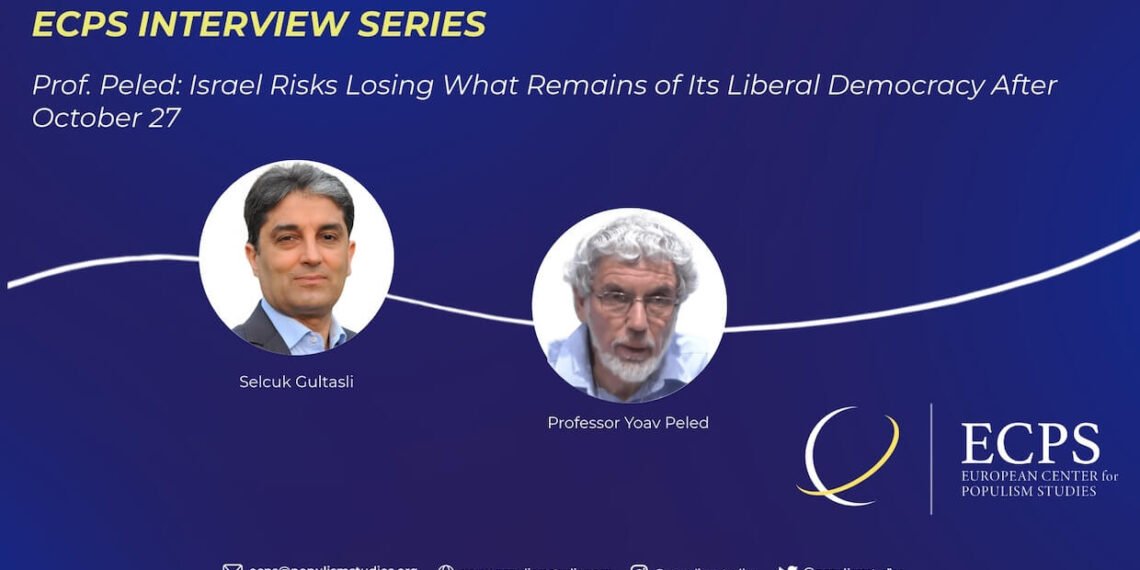
In an in-depth interview with the ECPS, Professor Yoav Peled, Professor Emeritus of Political Science at Tel Aviv University, warns that Israel’s October 27 elections could accelerate the erosion of liberal democracy rather than reverse it. Examining Netanyahu’s enduring populist appeal, the growing influence of religious nationalism, and the weakening of judicial independence, Professor Peled describes Israel’s transition from “a sort of semi-liberal democracy to a majoritarian democracy.” He argues that the opposition’s reluctance to cooperate with Palestinian parties and its unwillingness to address Palestinian statehood severely constrain prospects for democratic renewal. Warning that “any remaining resemblance to a liberal democracy is going to be erased,” Professor Peled maintains that without addressing Palestinian rights, “Israeli democracy cannot be sustained.”
Interview by Selcuk Gultasli
As Israel approaches its October 27 elections, the country faces profound political and societal divisions shaped by the aftermath of October 7, the devastating war in Gaza, intensifying religious nationalism, and persistent challenges to democratic institutions. Prime Minister Benjamin Netanyahu’s political resilience, the growing influence of the radical right, and the opposition’s uncertain alternatives raise fundamental questions about Israel’s democratic future and its relationship with Palestinians. Against this backdrop, Professor Yoav Peled, Professor Emeritus of Political Science at Tel Aviv University, offers a sobering assessment of Israel’s democratic trajectory, warning that “any remaining resemblance to a liberal democracy is going to be erased.”
In an extensive interview with the European Center for Populism Studies (ECPS), Professor Peled situates Israel’s democratic deterioration within the longer historical evolution of ethno-national populism, religious Zionism, and differentiated citizenship. Drawing on his influential scholarship, he argues that Netanyahu’s political resilience cannot be understood solely through electoral competition or governmental performance. Rather, it reflects deeply embedded ethno-class resentments, particularly among segments of the Mizrahi population, and an emotional identification with populist leadership that transcends conventional assessments of political accountability.
Central to Professor Peled’s analysis is the erosion of the institutional foundations of liberal democracy. He characterizes Netanyahu’s judicial reform initiative as “really a regime coup against the system that prevailed until then,” describing a transition from “a sort of semi-liberal democracy to a majoritarian democracy.” In his interpretation, the systematic weakening of judicial independence and other institutional checks threatens the constitutional limitations that protect individual and minority rights against unrestricted majority rule.
Yet Professor Peled emphasizes that Israel’s democratic crisis extends beyond institutional restructuring. He identifies the unresolved Palestinian question as a fundamental contradiction within the country’s political order. Reflecting on his earlier scholarship with Gershon Shafir, he acknowledges that their previous optimism regarding the reconciliation of Zionism and democracy proved “completely unwarranted.” For Professor Peled, continued occupation, settlement expansion, and Palestinian political marginalization make democratic renewal increasingly difficult.
The interview also examines the growing influence of religious nationalism, the transformation of the West Bank under Bezalel Smotrich, and the consequences of October 7 for Israeli political culture. Professor Peled argues that the opposition’s reluctance to cooperate with Palestinian parties, combined with its limited commitment to Palestinian statehood, demonstrates the narrow ideological boundaries of electoral competition.
Moreover, Peled presents the October 27 elections not as an opportunity for democratic restoration but as a potential accelerator of existing transformations. Warning that Israel is moving toward what he calls a “religious-nationalist state,”he maintains that without fundamentally addressing Palestinian equality and self-determination, “Israeli democracy cannot be sustained.” His assessment raises a broader question about whether electoral competition can preserve democratic institutions when the underlying structures of ethnonational exclusion remain largely uncontested.