Session 11 of the ECPS Virtual Workshop Series examined the tension between democratic inclusion as a normative promise and inclusion as an everyday institutional practice. Bringing together interdisciplinary perspectives, the panel explored how belonging is constructed, experienced, and contested across administrative, participatory, historical, and theoretical domains. Contributions highlighted how exclusion often operates through subtle mechanisms—bureaucratic encounters, identity-based narratives, digital mobilization, and post-revolutionary boundary drawing—rather than overt denial. Across cases from the United States, Sub-Saharan Africa, Iran, and liberal democracies more broadly, the session underscored that democratic legitimacy today depends on both representation and effective, fair governance. Collectively, the discussions illuminated why gaps between democratic ideals and lived experiences continue to fuel distrust, polarization, and populist mobilization.
Reported by ECPS Staff
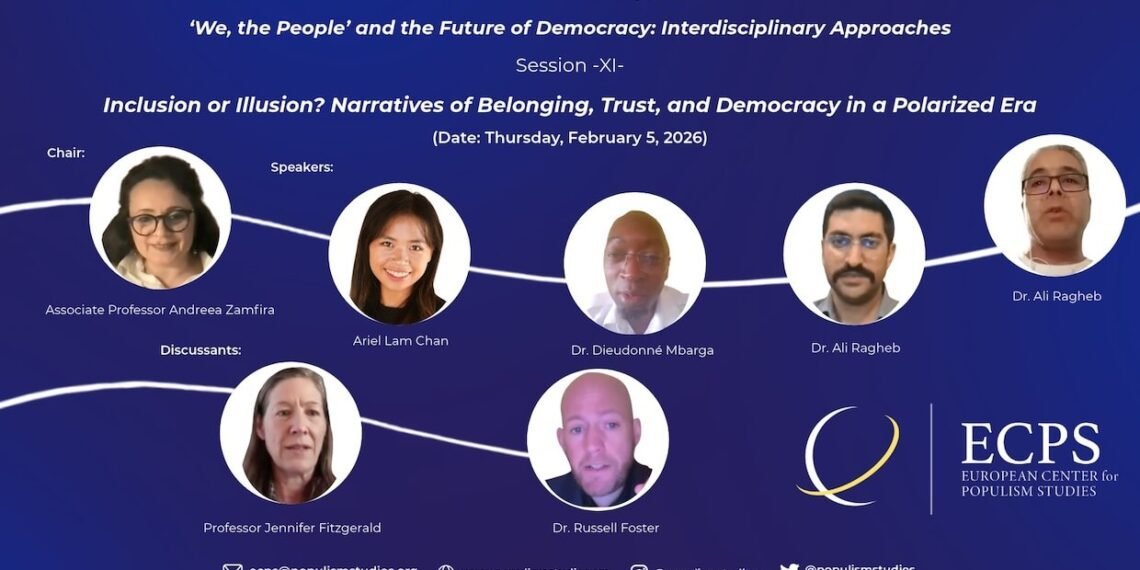
On Thursday, February 5, 2026, the European Center for Populism Studies (ECPS) convened Session 11 of its Virtual Workshop Series, “We, the People” and the Future of Democracy: Interdisciplinary Approaches, under the theme “Inclusion or Illusion? Narratives of Belonging, Trust, and Democracy in a Polarized Era.” The session brought together scholars working across political theory, political sociology, comparative politics, and historical analysis to examine a central tension of contemporary democracy: the growing disjuncture between formal promises of inclusion and the everyday experiences and institutional practices through which belonging is granted, denied, or conditionally recognized.
The workshop opened with welcoming and framing remarks by ECPS intern Stella Schade, who situated the panel within the broader aims of the series: to scrutinize how invocations of “the people” can function both as a democratic claim-making device and as a mechanism of boundary drawing that facilitates exclusionary politics.
Associate Professor Andreea Zamfira (University of Bucharest) chaired and moderated the session, providing an interpretive frame that foregrounded the duality between the “defined” and the “definers.” Her introduction emphasized that inclusion operates simultaneously as an affective, lived experience of belonging and as a political-institutional process through which elites, parties, bureaucracies, and other authorities define legitimate membership in the demos. This perspective oriented the panel toward subtle mechanisms—discursive, administrative, legal, and historical—through which democratic inclusion may become performative, selective, or strategically narrowed.
The papers collectively illuminated how legitimacy and exclusion are produced at multiple levels of governance and across distinct contexts. PhD candidate Ariel Lam Chan (Stanford University) examined citizen engagement with the administrative state through a conjoint experimental design that tested how procedural and performance cues shape “approach intention” toward public-facing agencies.
Dr. Dieudonné Mbarga (Independent Researcher) brought a comparative Global South perspective to democratic resilience, analyzing how active citizenship and participatory governance can strengthen accountability while also risking polarization and instrumentalization—particularly in digitally mediated political environments.
Dr. Ali Ragheb (University of Tehran) offered a historically grounded account of the Iranian Constitutional Revolution (1905–1906), arguing that democratic breakdown followed from the post-victory narrowing of “the people,” especially through the exclusion of women and minorities.
Complementing these empirical interventions, PhD candidate Saeid Yarmohammadi (University of Montreal) developed a theoretical argument about how identity politics and contested procedures of social justice can unintentionally intensify populist dynamics by deepening “us/them” boundaries within liberal democracies.
The session’s discussion was enriched by interventions from Professor Jennifer Fitzgerald (University of Colorado) and Dr. Russell Foster (King’s College London), whose feedback linked the presentations to wider debates on legitimacy, polarization, civic participation, and the variable meanings of “the people.”
Taken together, Session 11 offered a cohesive and analytically layered exploration of how contemporary democracies confront not only the challenge of governing effectively, but also the deeper question of who is recognized as belonging—and on what terms—in an increasingly polarized political age.