
Please cite as:
ECPS Staff. (2025). “Virtual Workshop Series — Session 6: Populism and the Crisis of Representation –Reimagining Democracy in Theory and Practice.” European Center for Populism Studies (ECPS). November 13, 2025. https://doi.org/10.55271/rp00118
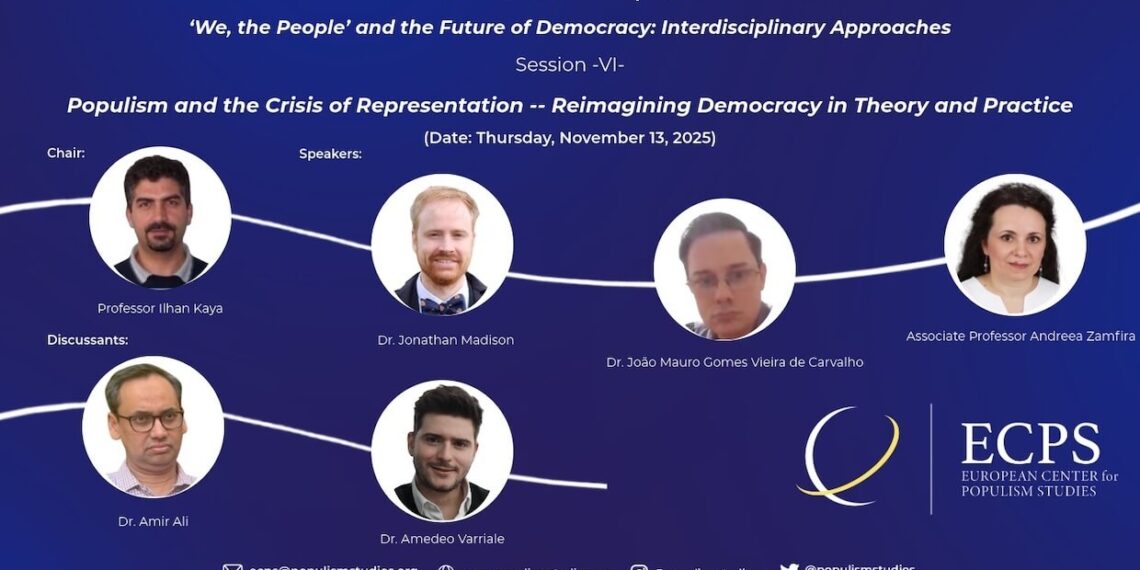
On November 13, 2025, the ECPS, in collaboration with Oxford University, held the sixth session of its Virtual Workshop Series, “We, the People” and the Future of Democracy: Interdisciplinary Approaches. Under the skillful moderation of Professor Ilhan Kaya (Wilfrid Laurier University, Canada), the session featured Dr. Jonathan Madison, Dr. João Mauro Gomes Vieira de Carvalho, and Associate Professor Andreea Zamfira, who examined how populism both mirrors and magnifies democracy’s crisis of representation. Their analyses, complemented by insightful discussant interventions from Dr. Amir Ali and Dr. Amedeo Varriale, generated a vibrant dialogue on institutional resilience, digital disruption, and the reconfiguration of democratic legitimacy in an age of populist contention.
Reported by ECPS Staff
On November 13, 2025, the European Center for Populism Studies (ECPS), in collaboration with Oxford University, convened Session 6 of its ongoing Virtual Workshop Series, “We, the People” and the Future of Democracy: Interdisciplinary Approaches. This session, titled “Populism and the Crisis of Representation: Reimagining Democracy in Theory and Practice,” brought together a distinguished group of scholars from political science, sociology, and democratic theory to examine one of the defining questions of our age—how populism both reflects and reshapes the crisis of democratic representation.
Under the capable and engaging chairmanship of Professor Ilhan Kaya (Visiting Professor at Wilfrid Laurier University, Canada; formerly of Yildiz Technical University, Turkey), the session unfolded with remarkable intellectual rigor and fluidity. Professor Kaya’s moderation ensured a balanced and inclusive dialogue among the presenters, discussants, and participants, fostering an atmosphere of critical reflection and open exchange.
The session featured three compelling presentations. Dr. Jonathan Madison (Governance Fellow, R Street Institute) opened with “De-Exceptionalizing Democracy: Rethinking Established and Emerging Democracies in a Changing World.” His paper challenged conventional hierarchies between “established” and “emerging” democracies, arguing that institutional resilience—particularly the robustness of liberal institutions—rather than wealth or longevity, determines a democracy’s ability to withstand populist pressures.
Next, Dr. João Mauro Gomes Vieira de Carvalho (LabPol/Unesp and GEP Critical Theory, Brazil) presented “Mobilizing for Disruption: A Sociological Interpretation of the Role of Populism in the Crisis of Democracy.” His intervention explored populism as a sociological manifestation of democracy’s structural contradictions, emphasizing the interplay of economic inequality, charismatic leadership, and digital communication in the destabilization of representative institutions.
Finally, Associate Professor Andreea Zamfira (University of Bucharest) delivered “Daniel Barbu’s and Peter Mair’s Theoretical Perspectives on Post-Politics and Post-Democracy.” She advanced a sophisticated conceptual framework distinguishing between democratic and strategic populisms and called for reclaiming political science’s critical vocation amid the hollowing of democratic politics in the neoliberal era.
The presentations were followed by incisive discussant interventions from Dr. Amir Ali (Jawaharlal Nehru University, New Delhi) and Dr. Amedeo Varriale (University of East London) whose reflections broadened the theoretical and comparative scope of the session. Their critiques and elaborations inspired an engaging debate that continued into the Q&A session, where Professor Kaya adeptly guided a lively, cross-regional discussion on the transnational diffusion of populism and the institutional responses to democratic backsliding.
In sum, Session 6 stood out as an exemplary exercise in interdisciplinary dialogue—anchored by Professor Kaya’s thoughtful moderation and enriched by a diverse array of perspectives that collectively illuminated the multifaceted relationship between populism, representation, and the evolving fate of democracy in the twenty-first century.
