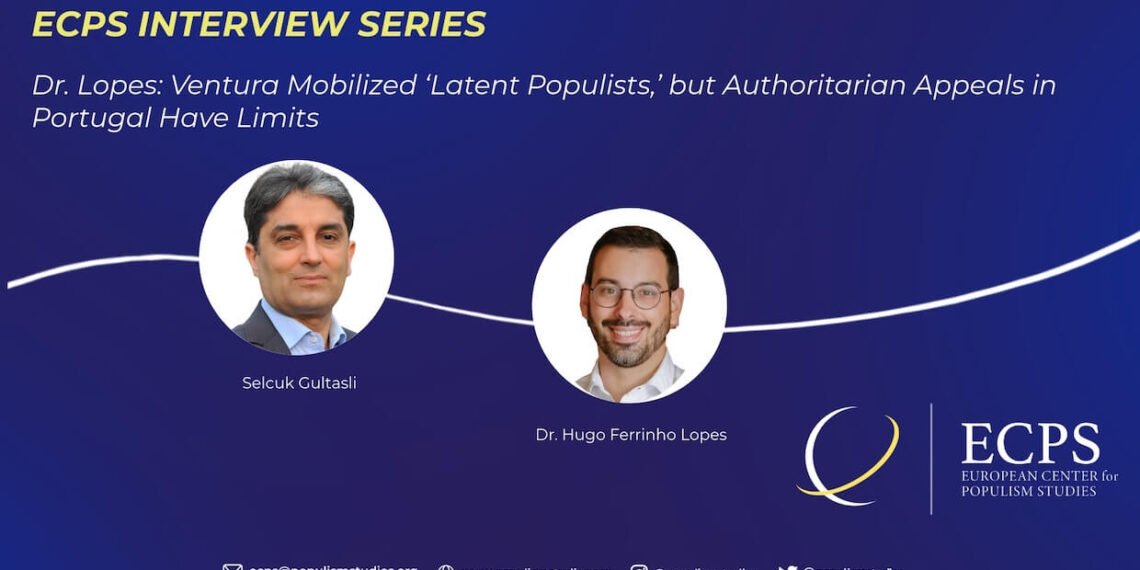
André Ventura’s qualification for the presidential runoff marks a critical moment in Portuguese politics, long viewed as resistant to far-right breakthroughs. In this interview with the ECPS, Dr. Hugo Ferrinho Lopes (EEG-UMinho & Iscte-IUL; ICS-ULisbon) argues that Ventura’s advance is “less a sudden presidential earthquake than a clear manifestation” of an ongoing party-system shift—deepened by fragmentation on the mainstream right and declining abstention. Dr. Lopes explains how Chega mobilized “latent populists” once a viable radical-right option emerged, while also stressing the limits of authoritarian and nativist appeals in a second-round contest that requires broader legitimacy. The result, he suggests, is a normalized but still constrained radical right: agenda-setting and organizationally consolidated, yet facing ceilings shaped by elite incentives, affective polarization, and presidential norms of moderation.
Interview by Selcuk Gultasli
The qualification of André Ventura, leader of the populist radical right party Chega, for the presidential runoff marks a watershed moment in contemporary Portuguese politics. Long regarded as an exception within Southern Europe for its resistance to far-right breakthroughs, Portugal now finds itself grappling with a transformed party system, declining abstention, and the normalization of a radical right actor at the highest symbolic level of the state. In this wide-ranging interview with the European Center for Populism Studies (ECPS), Dr. Hugo Ferrinho Lopes, an invited assistant professor at EEG-UMinho and Iscte-IUL, and an associate researcher at ICS-ULisbon, offers a nuanced and empirically grounded analysis of what Ventura’s rise does—and does not—signify for the future of Portuguese democracy.
At the core of Dr. Lopes’s argument is a rejection of the idea that Ventura’s presidential advance represents a sudden rupture. Instead, he situates it within a longer trajectory of party-system transformation. As he notes, Ventura’s runoff presence is “less a sudden presidential earthquake than a clear manifestation of a party-system shift that has already been underway,” one that began with Chega’s parliamentary breakthrough and was accelerated by fragmentation on the mainstream right. In Sartorian terms, Portugal is experiencing increasing ideological distance and fragmentation, dynamics that presidential elections—through personalization and strategic voting—tend to amplify.
A central theme running through the interview is the role of political supply. Dr. Lopes emphasizes that Chega did not emerge because Portuguese voters suddenly radicalized, but because a long-standing gap on the cultural and conservative dimension of party competition was left unfilled. This allowed Ventura, an experienced political communicator with extensive media exposure, to capture what Dr. Lopes describes as “latent populists who were activated once a viable alternative became available.” Importantly, this mobilization was facilitated by institutional conditions—such as a lower effective electoral threshold in 2019—and by Chega’s rapid transition from entrepreneurial project to organizationally consolidated party.
Yet the interview also highlights the limits of Ventura’s appeal. Despite declining abstention disproportionately benefiting Chega, Dr. Lopes stresses that Ventura’s electorate remains strikingly stable rather than expansive. “Ventura is competing against himself,” he observes, as voters from eliminated candidates increasingly coalesce behind his opponent in the runoff. This pattern reflects what he characterizes as a de facto cordon sanitaire driven less by formal elite coordination than by affective polarization and voter hostility toward the far right.
Perhaps most importantly, Dr. Lopes cautions against overestimating the governing potential of authoritarian rhetoric in Portugal. While Chega has successfully imposed issues such as immigration and security on the national agenda, “relying solely on authoritarian and nativist appeals is insufficient” in a second-round presidential contest that demands broader democratic legitimacy. The interview thus paints a picture of a radical right that is normalized, agenda-setting, and organizationally entrenched—but still constrained by institutional structures, elite incentives, and the enduring appeal of moderation in Portuguese presidential politics.
Together, these insights offer a sober prognosis: Chega has reshaped the political landscape, but its path toward governing viability remains uncertain, contested, and far from inevitable.