
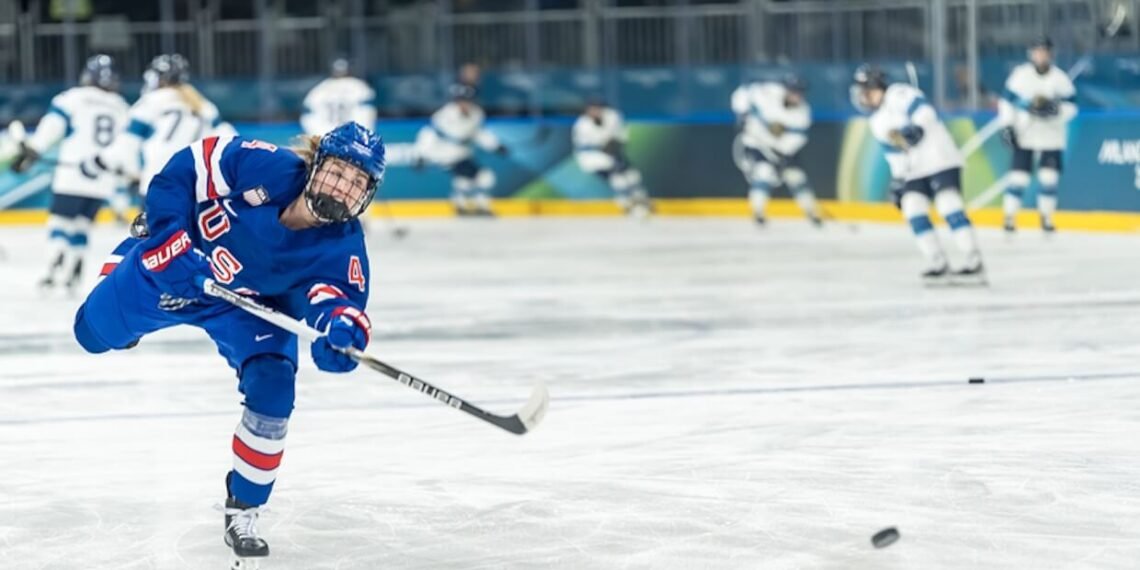
In this reflective Voice of Youth (VoY) commentary for International Women’s Day, Emmanouela Papapavlou examines how gender hierarchy persists not only through overt exclusion but through the subtle normalization of unequal recognition. Using the contrasting reactions to the US men’s and women’s hockey gold medals at the 2026 Winter Olympics, she argues that women’s athletic success is still too often treated as supplementary rather than self-evidently equal. The issue, she suggests, lies less in explicit insult than in the quiet cultural codes that frame male achievement as the default and female achievement as the exception. By focusing on laughter, tone, and seemingly minor acts of dismissal, Papapavlou offers a sharp critique of how misogyny survives in normalized everyday reactions, revealing the distance that still separates formal equality from genuine social recognition.
By Emmanouela Papapavlou*
At the 2026 Winter Olympic Games, the United States won two gold medals in hockey. One by the men’s team. One by the women’s team. Same sport, same flag on the chest, same summit. A few hours later, in a conversation with the President of the United States, it is announced that the men’s team will be invited to the White House to be honored for their victory. And in the flow of the conversation, comes the phrase, “we have to invite the women too.” The players burst into laughter. A spontaneous, collective, light laugh.
It was not an insult. It was not an attack. Nothing explicitly degrading or offensive was said. And yet, in those few seconds, something deeper was revealed. Because the women’s victory entered the sentence as a footnote. As a reminder. As something that “also” happened.
A gold medal has no gender. The flag is raised the same way, the anthem sounds the same, while on paper, in official statements, in medal tables, the two achievements are absolutely equal. And yet, in our collective reaction, they are not. The men’s category is considered the default version of sport. The women’s is the special category. The men’s is the prototype, while the women’s is treated as its variation.
And this was not born in that room. It did not begin with a joke. It is the product of a culture that has learned to treat male success as a given and female success as an exception. As something worthy of congratulations, but not of the same unquestioned recognition. As something that “it would be good to honor as well.”
We live in 2026 and sport remains deeply male-dominated. Not only in terms of funding and visibility, but in symbolism. The hero, the captain, the leader, the warrior. Think about it. The images that accompany these words are still male. When a woman wins, we often describe her journey as “inspiring,” her endurance as “moving,” her presence as a “role model.” When a man wins, we speak of dominance, power, greatness. One victory moves us. The other confirms expectations.
What is most troubling, however, is not the difference in adjectives. It is that the laughter caused no discomfort. There was no pause. No split second of silence suggesting something was off. It felt natural. And that sense of naturalness is the problem. So why did it feel so natural in the first place?
Misogynistic mentality today rarely appears through shouting. It does not openly declare that “women are worth less.” It shows up in subtle tones. In inflections. In glances. In “jokes” that pass unnoticed. In the familiar “come on, don’t take it so seriously.” In an invitation framed like an obligation. In an achievement treated as an addition rather than as an unquestioned equal.
These small things, which seem insignificant, are what sustain the larger structure. As with every form of gender inequality, the root does not lie only in extreme incidents. It lies in what we have learned to consider normal. In the fact that unequal treatment no longer surprises us. In the fact that it does not bother us enough to react. In the fact that we laugh too or remain silent.
That is how hierarchy is built without ever naming it. Through small concessions. Through subtle diminishments. Through a society that speaks of equality on paper, yet in practice continues to place the male experience at the center and the female one at the margins. If the medal is equal, why isn’t the reaction?
And today, on International Women’s Day, we will once again speak about rights, achievements, and struggles that were fought to get us here. We will honor the women who fought to stand on fields that did not want them, in competitions that did not count them, in societies that preferred them silent. For every woman who spent countless hours training, who endured doubt, mockery, less funding, less coverage, less recognition. For every woman who reached the top knowing that even there she would have to prove her worth all over again, only for the very country she represented to remind her, the next day, with a laugh, that her effort and her victory were not quite as important.
This is not about oversensitivity. It is not about “political correctness.” It is about value. If a woman’s success requires a reminder in order to be acknowledged, then it is not considered self-evident. If inclusion provokes laughter, then equality has not taken root. It has merely been legislated.
So the question is not whether someone had bad intentions. The question is why diminishment fits so easily inside a joke. Why the idea that “we have to invite the women too” sounds like an add-on rather than an obvious part of the sentence. Why, even today, female success requires clarification.
Perhaps because our sense of normal has not changed as much as we think. Perhaps because the equality we proclaim has not yet moved from law into consciousness. And until it does, we will continue to encounter misogyny not only in the loud and blatant moments, but in the small, smiling ones.
The issue is not to stop laughing. The issue is to start asking ourselves what exactly we find funny.
(*) Emmanouela Papapavlou is a high school student from Thessaloniki, Greece, deeply passionate about social and political issues. She has actively participated in Model United Nations and other youth forums, serving as a chairperson in multiple conferences and winning awards in Greek debate competitions. Writing is her greatest passion, and she loves using it to explore democracy, civic engagement, and human rights. Her dream is to share her ideas, inspire action, and amplify the voices of young people who want to make a difference. Email: emmanpapapavlou@gmail.com
