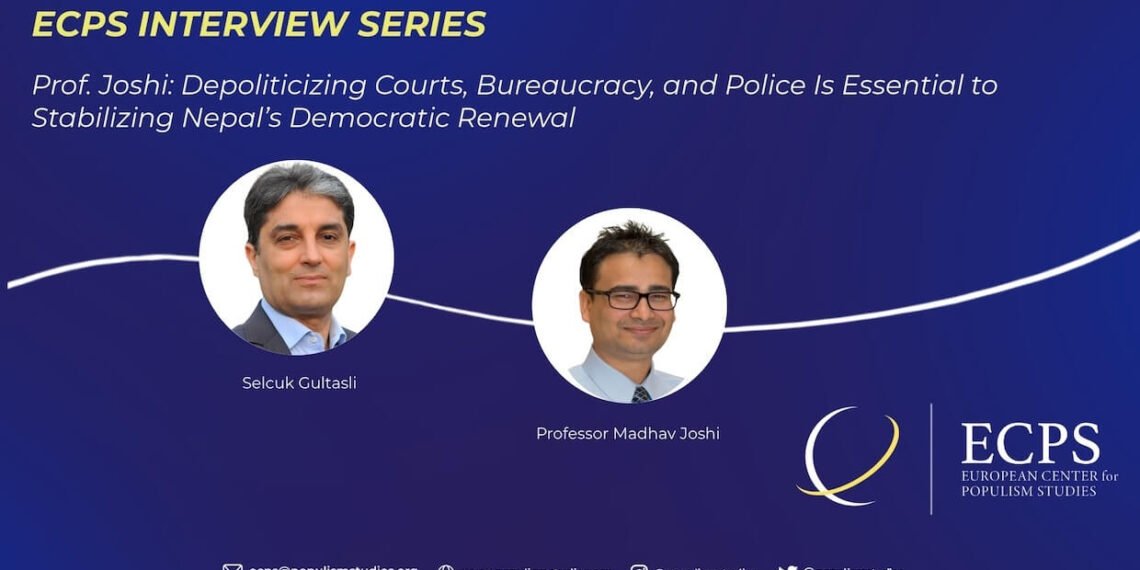
Professor Madhav Joshi argues that Nepal’s recent political upheaval reflects both “anti-elite” mobilization and “a form of generational democratic renewal,” but also warns that the country’s deeper institutional crisis remains unresolved. In his interview with the ECPS, Professor Joshi situates the rise of Balendra “Balen” Shah and the Rastriya Swatantra Party within Nepal’s longer history of structural inequality, elite capture, and democratic frustration. He underscores that legitimacy must be earned through trust in public institutions, not merely through electoral victory. Stressing the centrality of institutional reform, Professor Joshi contends that “depoliticizing the courts, bureaucracy, and police is essential to stabilizing Nepal’s democratic renewal.” Whether this hopeful moment yields durable transformation, he suggests, depends on translating electoral momentum into credible governance.
Interview by Selcuk Gultasli
Giving an interview to the European Center for Populism Studies (ECPS), Professor Madhav Joshi—a Research Professor and Associate Director of the Peace Accords Matrix at the Kroc Institute for International Peace Studies, University of Notre Dame’s Keough School of Global Affairs—offers a deeply grounded and empirically informed analysis of Nepal’s unfolding political transformation in the aftermath of the landmark electoral victory of Balendra “Balen” Shah and the Rastriya Swatantra Party (RSP). Anchored in his extensive scholarship on civil conflict, institutional legitimacy, and post-war transitions, Professor Joshi situates the current moment within Nepal’s longer trajectory of democratic struggle, elite capture, and unresolved structural inequalities.
At the heart of his diagnosis lies a stark assessment of continuity amid apparent rupture. While the recent election signals what he terms both “anti-elite” mobilization and “a form of generational democratic renewal,” it is equally, in his view, “a manifestation of unresolved structural grievances within Nepal’s political economy.” Drawing on his research on the Maoist insurgency, Professor Joshi underscores how patterns of exclusion, patron–client networks, and elite domination have persisted despite formal democratic transitions, leaving large segments of the population—especially youth—disillusioned and economically marginalized.
The interview foregrounds a central theme encapsulated in his headline assertion: “Depoliticizing the courts, bureaucracy, and police is essential to stabilizing Nepal’s democratic renewal.” For Professor Joshi, the current legitimacy crisis is not merely electoral but institutional. He cautions that “legitimacy is not something one possesses simply by being in government; rather, it is earned through trust in public institutions,” a trust that has been severely eroded by systemic corruption and partisan infiltration of state apparatuses. The electoral success of Shah, therefore, reflects not consolidated legitimacy but what Professor Joshi calls an “electoral mandate… to build it by fulfilling promises.”
At the same time, Professor Joshi highlights the transformative role of youth-driven and digitally mediated mobilization. The Gen Z movement, he argues, represents a shift away from traditional party structures toward more fluid, networked forms of political engagement, where “parties with a strong social media presence… are better positioned to gain public backing.” Yet, he remains cautious about overestimating rupture, noting that entrenched institutional networks and political patronage systems may continue to constrain reform efforts from within.
Importantly, Professor Joshi frames the current conjuncture as both an opportunity and a risk. The unprecedented parliamentary majority enjoyed by the RSP creates conditions for meaningful reform, but failure to deliver—particularly in areas such as job creation, governance, and institutional accountability—could accelerate “democratic backsliding,” given the “high level of public expectation placed on this government.”
Ultimately, the interview presents Nepal as a critical case in comparative politics: a post-conflict democracy where populist energies, generational change, and institutional fragilities intersect. Whether this moment evolves into durable democratic transformation or reproduces cycles of instability, Professor Joshi suggests, will depend on the state’s capacity to translate electoral momentum into credible, institutionalized reform.