In this timely and deeply analytical essay, Professor Ibrahim Ozturk examines how Turkey is moving beyond competitive authoritarianism toward what he terms a system of “managed permanence,” in which elections formally survive while meaningful democratic alternation becomes increasingly constrained. Focusing on the judicial intervention into the CHP, the encirclement of opposition municipalities, media capture, and the erosion of institutional autonomy, Professor Ozturk argues that the Erdoğan regime is no longer merely repressing opposition actors, but actively re-engineering the political field itself. The essay further explores how lawfare, economic fragility, transactional geopolitics, and institutional decay have become mutually reinforcing dynamics. Ultimately, the piece warns that Turkey’s crisis is no longer only democratic or economic, but fundamentally a crisis of institutional credibility and constitutional uncertainty.
By Ibrahim Ozturk
When Hungary’s 2026 elections produced an early wave of enthusiasm around the idea that “dictators, too, can be defeated,” the reaction was understandable but premature. In a recent ECPS long-read commentary on Péter Magyar and Hungary’s hybrid-authoritarian rupture, I warned against romanticizing Orbán’s defeat as automatic democratic restoration, and stressed that comparative analogies travel badly: what may be cooking in the neighbor’s house does not necessarily fall onto our plate — Turkey is not Hungary, and each authoritarian case rests on its own institutional, geopolitical, social, and economic architecture.
Turkey has now confirmed that warning with brutal speed. Before the optimism generated by Hungary’s rupture could settle into a broader democratic lesson, Ankara moved in the opposite direction: the main opposition was judicially destabilized, municipal autonomy was further encircled, a major university’s operating license was revoked, and the already fragile boundary between competitive authoritarianism and managed permanence narrowed even further. The message is unmistakable: authoritarian regimes may sometimes lose elections, but they do not necessarily accept political contingency — and in Turkey’s case, the regime appears determined to prevent meaningful alternation before it can happen.
Thus, Turkey has entered a new and more dangerous phase of competitive authoritarianism. The issue is no longer confined to the imprisonment of opposition figures, the removal of elected mayors, or the selective deployment of criminal investigations. The deeper transformation now concerns the legal and institutional re-engineering of the opposition itself. The court decision annulling the Republican People’s Party (CHP)’s 2023 congress—effectively removing Özgür Özel and reinstating Kemal Kılıçdaroğlu as party leader—marks a qualitative escalation: the judiciary is no longer merely disciplining opposition actors from the outside; it is intervening directly in the internal sovereignty of the main opposition party. Reuters reported that the ruling annulled the CHP’s 2023 leadership election, suspended Özel and the party executive, and reinstated Kılıçdaroğlu, while the CHP’s elected executives denounced the decision as a judicial coup.
In Turkish legal terminology, the concept of “absolute nullity” may appear technical. Politically, however, it functions as a mechanism of retroactive delegitimation. A past party congress is declared void; the current leadership is suspended; a former leadership is restored; and the organizational continuity of the opposition is plunged into legal uncertainty. The outcome is not merely a leadership change. It is the construction of a “lame-duck opposition”: formally present and electorally significant on paper, yet institutionally constrained, internally fragmented, and increasingly vulnerable to judicial veto.
From Electoral Defeat to Judicial Containment
The turning point came with the local elections of March 31, 2024. In those elections, the CHP delivered President Erdoğan and the AKP their most significant electoral defeat in decades, while retaining Istanbul and Ankara—long regarded as key opposition strongholds—and achieving major gains across the country. CHP secured approximately 37 percent of the nationwide vote, narrowly surpassing the AKP, and won municipalities in 36 of Turkey’s 81 provinces. The outcome was Erdoğan’s biggest electoral setback and Ekrem İmamoğlu had emerged as his “default nemesis.”
The result fundamentally altered the regime’s threat perception. The opposition was no longer merely a parliamentary minority or a symbolic protest bloc. It had acquired administrative capacity, access to local budgets, service-delivery networks, public visibility, and presidential contenders with nationwide appeal. İmamoğlu, Mansur Yavaş, and the renewed CHP leadership under Özgür Özel represented not only electoral competition, but the emergence of an alternative governing infrastructure.
The regime’s response has followed a recognizable authoritarian playbook: do not abolish elections outright; hollow them out. Do not ban the opposition; fragment, criminalize, and bureaucratically paralyze it. Do not formally dissolve local governments; restrict their fiscal instruments, remove or prosecute their elected leaders, and make every municipal decision vulnerable to criminalization. In this sense, the CHP ruling should not be read as an isolated party-law dispute. It is part of a strategy to convert the main opposition from an electoral threat into a controlled, divided, and procedurally disabled actor.
Lawfare and the Collapse of Rule of Law
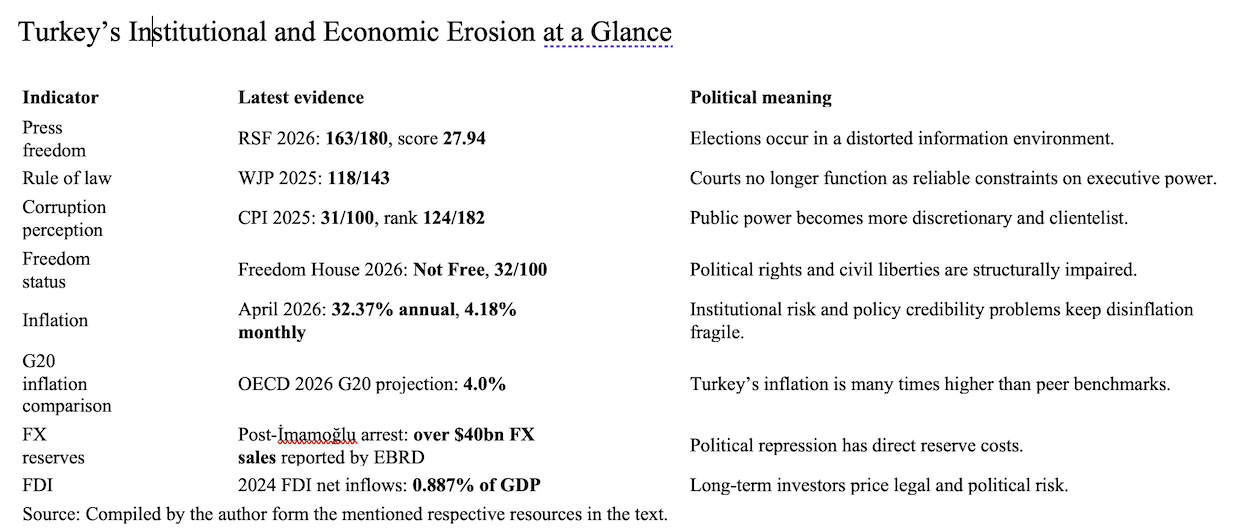
The CHP case sits inside a wider pattern of lawfare against opposition mayors, party officials, journalists, lawyers, academics, and civil society actors. Freedom House’s 2026 assessment classifies Turkey as “Not Free,” with a score of 32 out of 100, including 16/40 for political rights and 16/60 for civil liberties. This is not a marginal decline. It signals a political system in which elections continue, but the freedoms necessary for meaningful electoral competition are structurally impaired.
The rule-of-law picture is equally severe. The World Justice Project’s 2025 Rule of Law Index places Turkey 118th out of 143 countries. Turkey also ranks near the bottom of its region and among upper-middle-income countries. The index measures constraints on government powers, absence of corruption, open government, fundamental rights, regulatory enforcement, civil justice, and criminal justice — precisely the institutional foundations now under stress in Turkey’s opposition cases.
This matters because authoritarianism in Turkey does not operate primarily through overt illegality. More often, it functions through excessive legality: sprawling investigations, procedural ambiguities, retroactive annulments, prolonged pre-trial detention, anonymous witnesses, and charges that are difficult to contest because the process itself becomes the punishment. In such a system, the courts do not need to formally ban the opposition as a political force. They can exhaust it, fragment it, delegitimize it, and keep it in a permanent state of defensiveness.
The logic is as coercive as it is punitive. Opposition figures are pressured through detention, threats to personal assets, indictments, reputational attacks, and the prospect of escalating sentences. Where evidentiary standards are weak or politically contested, mechanisms such as anonymous witnesses and “effective remorse” provisions can become instruments of narrative production: lower-level actors are pressured to implicate higher-ranking opposition figures, while refusal may expose both them and their families to further legal vulnerability. This is not merely prosecution; it is political extraction through criminal procedure.
Of course, the authoritarian acceleration did not begin with the most recent CHP case. It was dramatically intensified after the failed coup attempt of July 15, 2016, which the government used to consolidate emergency rule, neutralize the unresolved political consequences of the December17–25, 2013 corruption allegations, and restructure the judiciary, bureaucracy, media, and civil society under executive command. Many opposition actors, including the CHP, underestimated or tolerated the early stages of this process; today, as thousands of cases reach the European Court of Human Rights (ECtHR) under Article 7 and Article 3 concerns, the same emergency-state machinery has expanded from alleged Gülenists to Kurds, socialists, liberals, journalists, mayors, academics, and now the main opposition itself.
Capturing the Public Sphere
Judicial pressure becomes far more effective when it operates inside a captured information environment. Turkey’s media landscape is already deeply distorted. In the 2026 World Press Freedom Index, Reporters Without Borders (RSF) ranks Turkey 163rd out of 180 countries, with a score of 27.94. RSF’s country profile places Turkey in the “very serious” category and notes that media pluralism remains under severe pressure.
Media repression in Turkey has evolved beyond the traditional closure or capture of media outlets into a hybrid authoritarian system of digital censorship, where online news links and social media content are removed without effective judicial review on elastic grounds such as national security, public order, religious or family values, and the unity of the state, while those who escape imprisonment may still be silenced through account suspensions and platform-level restrictions.
This means that electoral competition is distorted not only through courts, prosecutions, and candidate bans, but also through unequal access to information. When opposition leaders are criminalized, government-aligned media amplify the accusations, while independent journalism operates under conditions of fear, fines, arrests, ownership pressure, and regulatory intimidation. Elections may still take place, but voters encounter the opposition through a public sphere heavily structured by executive power.
This is the contemporary version of “open voting, secret counting.” Today, the mechanisms are more sophisticated. The ballot may remain secret, and the counting process may remain formally observable, yet the media landscape, judiciary, party autonomy, local government capacity, candidate eligibility, and financial environment are all subjected to sustained political pressure. Elections survive as ritualized procedures; democratic alternation is rendered increasingly improbable.
Municipal Counter-Power and Administrative Encirclement
The The attack on the CHP is inseparable from the broader assault on opposition-run municipalities. After the 2024 local elections, Istanbul, Ankara, and other major cities represented not merely electoral victories, but alternative centers of political legitimacy. Municipal governments possessed the capacity to deliver services, develop their own patronage networks, expose failures of the central government, and cultivate presidential contenders with executive credibility.
This is why the restriction of municipal autonomy has become so consequential. Turkish media reports indicate that recent legal changes now require presidential approval for municipalities and their affiliated entities to establish companies, acquire shares, or join cooperatives. Opposition critics argue that these measures transform local economic initiative into a permission regime ultimately controlled by the presidency.
The corruption data help explain why this matters. Transparency International’s 2025 Corruption Perceptions Index (CPI) gives Turkey a score of 31/100, ranking it 124th out of 182 countries. The CPI is not simply about bribery; it is about discretionary public power, weak accountability, and the erosion of impartial administration. In Turkey’s case, this means that municipal resources, public tenders, regulatory approvals, media licensing, universities, and courts increasingly operate within a political economy of executive discretion.
The closure of Istanbul Bilgi University on the same political night adds another layer to this broader pattern. The Erdoğan regime revoked the university’s operational license, effectively forcing it to shut down, after the institution had already been seized by the state through a criminal investigation the previous year. Under Decree-Law No. 667, 15 private and foundation universities were closed in July 2016. This pattern later continued with the closure of İstanbul Şehir University in 2020 and the revocation of İstanbul Bilgi University’s operating license on May 21, 2026, effectively bringing another major academic institution to an end.
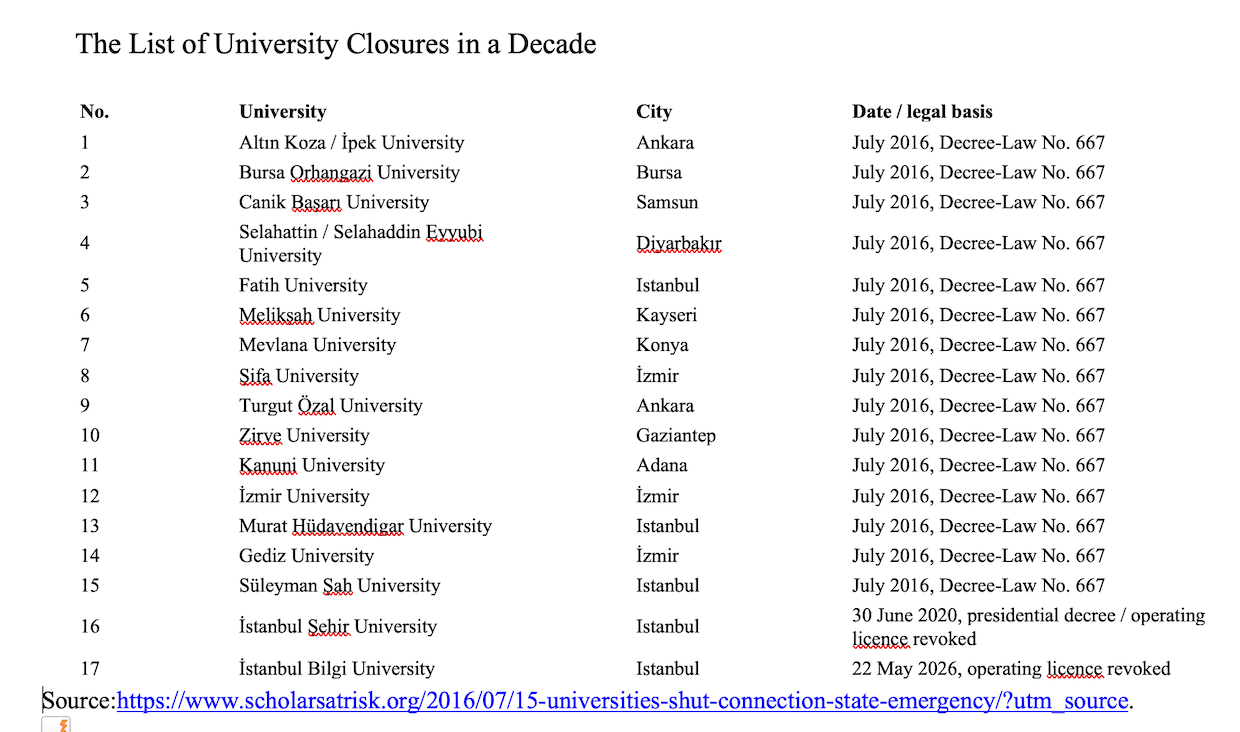
This pattern demonstrates that university autonomy—like municipal autonomy, media autonomy, and party autonomy—has increasingly become conditional on executive tolerance rather than protected by constitutional guarantees. Universities, municipalities, opposition parties, media outlets, and civil society organizations all represent potential alternative centers of legitimacy. The current trajectory seeks not necessarily to abolish all of them outright, but to render their survival contingent upon executive tolerance.
The Constitutional Horizon: Erdoğan’s Problem of Time
The deeper strategic horizon concerns the presidency itself. Erdoğan’s rule faces a constitutional time problem. Current constitutional provisions limit the presidency to two terms, although scenarios involving early elections and constitutional reinterpretations have long been debated. Erdoğan’s coalition partner, Devlet Bahçeli, has already floated the possibility of a constitutional amendment that would allow Erdoğan to extend his tenure beyond the existing limits. In 2024, Bahçeli openly proposed such an amendment, while also acknowledging that Erdoğan would otherwise be serving his final term unless early elections were called.
This is precisely why the organizational integrity of the opposition matters so much. A unified CHP under Özgür Özel, with Ekrem İmamoğlu or Mansur Yavaş as credible national contenders, would constitute a serious obstacle to any attempt to redesign the constitutional calendar. By contrast, a fragmented CHP operating under sustained judicial pressure provides the ruling bloc with greater room for maneuver. Under such conditions, the government can call early elections when the opposition is weakened, pursue constitutional changes within an asymmetric political environment, or manufacture the appearance of pluralist consent through a domesticated opposition.
The objective is not necessarily to abolish elections altogether. It is to eliminate uncertainty. Turkey is increasingly moving toward a model of managed permanence: the ballot box remains, but the possibility of democratic alternation becomes structurally disabled.
External Complicity: Europe’s Dependency and Trumpian Transactionalism
The external environment has facilitated this authoritarian acceleration in Turkey. The European Union remains rhetorically committed to democracy and the rule of law, yet its leverage over Turkey has steadily weakened. The European Commission continues to define Turkey as a candidate country and an essential partner on issues such as climate policy, migration management, security, counterterrorism, and trade. CEPS has similarly arguedthat EU–Turkey relations increasingly expose the limits of transactionalism, noting that bilateral engagement now extends across energy security, foreign and security policy, trade, counterterrorism, and defense connectivity amid growing uncertainty in transatlantic relations.
This dependence produces a familiar European dilemma: democratic values are invoked rhetorically, but meaningful conditionality remains weak. The EU may express concern, but concern alone does not impose political cost. Turkey’s strategic role in migration control, NATO, Russia policy, Black Sea security, Middle Eastern diplomacy, and regional energy corridors has created an external environment that is increasingly permissive of democratic backsliding.
The United States under Trump adds another layer of transactional permissiveness to this environment. This does not necessarily mean that Washington explicitly endorses every domestic crackdown carried out by the Erdoğan government. It does, however, suggest that Erdoğan is increasingly able to exchange geopolitical utility for international normalization. The German Marshall Fund cited remarks by US Ambassador Tom Barrack in 2025 indicating that Trump wanted to give Erdoğan what he needed — “legitimacy” — within the framework of a more transactional and deal-oriented bilateral relationship.
This pattern is hardly new in American foreign policy. Across the Middle East and Latin America, Washington has often found authoritarian partners easier to manage than democratic societies. The rhetoric of democracy promotion has frequently coexisted with the practical support of rulers who provide security cooperation, military access, migration control, energy stability, or regional alignment. Turkey now appears to be increasingly drawn into this older geopolitical pattern: a strategically useful authoritarian partner whose domestic repression is treated as secondary to broader strategic bargaining.
The Political Economy of Repression
Authoritarian continuity also carries mounting economic costs. Every major judicial or administrative intervention against the opposition produces immediate financial repercussions. Following Ekrem İmamoğlu’s arrest in March 2025, the Turkish central bank reportedly sold roughly $50 billion in reserves and subsequently raised interest rates to 46 percent amid severe market turbulence. The EBRD similarly stated that the central bank sold more than $40 billion in foreign exchange during the weeks after İmamoğlu’s detention, reducing net reserves excluding swaps from above $60 billion to below $20 billion.
A similar pattern re-emerged following the CHP ruling. BIST 100 index fell sharply, while the Turkish lira reached a record low near 45.74 against the US dollar. Analysts warned that renewed political instability was once again undermining the currency at an already fragile moment. JPMorgan further projected that the central bank could be forced to raise interest rates from 37 percent to 40 percent in an attempt to stabilize the lira.
Inflation remains the clearest macroeconomic symptom of collapsing credibility. In April 2026, Turkey’s monthly inflation rate surged to 4.18 percent, while annual inflation reached 32.37 percent. By comparison, the OECD projects average headline inflation across the G20 at approximately 4.0 percent in 2026. Turkey’s inflation is therefore not merely above target; it stands several times higher than the broader G20 benchmark.
These cumulative distortions are also visible in Turkey’s growing decoupling from comparable emerging-market economies. Both inflation and the interest-rate premium required to sustain lira-denominated assets have risen far above emerging-market averages, making borrowing costs one of the clearest macroeconomic expressions of authoritarian-risk pricing.
Foreign direct investment also reflects the cost of institutional erosion. World Bank-based data show Turkey’s FDI net inflows at only 0.887 percent of GDP in 2024. For a G20-sized economy that claims to be a regional hub for production, logistics, energy, and finance, this is strikingly weak. Investors may still buy high-yield bonds or short-term assets, but a durable, productive investment requires legal predictability, property-rights protection, judicial neutrality, and confidence that political shocks will not suddenly destroy the investment environment
There are also signs that Turkey’s liquid external buffers have come under mounting pressure. Reporting based on US Treasury data indicated that Turkey’s holdings of US Treasury securities fell sharply in March 2026 as authorities sought to defend the lira, although such figures should be treated cautiously, since holdings are often routed through custodians and third countries.
The broader point, however, is unmistakable: political repression carries significant balance-sheet costs. It necessitates reserve sales, interest-rate hikes, credibility-restoration measures, and repeated interventions aimed at containing market panic. Turkey is therefore not experiencing a conventional emerging-market volatility cycle. It is paying a compounded authoritarian-risk premium.
Repression undermines confidence; weakened confidence places pressure on the lira; pressure on the lira forces reserve depletion or higher interest rates; elevated rates suppress growth and investment; deteriorating economic performance intensifies political anxiety; and that anxiety, in turn, generates further repression. This is the circular political economy of authoritarianism.
Conclusion: The Cost of Managed Permanence
Turkey’s crisis is no longer merely a crisis of democracy, nor solely a crisis of macroeconomic management. It has become a crisis of institutional credibility. The same political system that imprisons rivals, captures media institutions, weakens municipalities, subordinates the judiciary, and intimidates universities also generates persistent inflation, currency fragility, reserve depletion, heightened corruption risk, and declining long-term investment confidence.
The CHP ruling is therefore not simply a procedural dispute within a political party. It is a constitutional event. It signals that the regime is prepared to intervene directly in the organizational structure of the main opposition party in order to reshape the political field ahead of the next presidential contest. The intended outcome is increasingly clear: Erdoğan should not confront a united, administratively capable, and electorally confident opposition at the precise moment when his own constitutional future becomes uncertain.
The irony is that this strategy may stabilize the regime in the short term while simultaneously deepening Turkey’s long-term fragility. No country can indefinitely finance authoritarian control through reserve depletion, high interest rates, coercive legality, and transactional diplomacy. The more the regime suppresses political competition, the more costly economic stabilization becomes. The more it seeks external legitimacy, the more sovereignty it implicitly trades away. And the more it attempts to manufacture a controlled opposition, the more clearly it reveals that genuine electoral competition has become the central threat to its survival.
Turkey’s crisis, therefore, is not only about Erdoğan, the CHP, İmamoğlu, Özel, Kılıçdaroğlu, or even the 2028 election itself. It is about whether a country with a long electoral tradition will gradually be reduced to a system of formal voting without meaningful democratic alternation. The answer will depend not only on domestic resistance, but also on whether Europe and the United States continue treating Turkey’s authoritarian consolidation as an acceptable price for strategic convenience.

Turkey’s Managed Permanence: Lawfare, Institutional Capture, and the End of Democratic Uncertainty
In this timely and deeply analytical essay, Professor Ibrahim Ozturk examines how Turkey is moving beyond competitive authoritarianism toward what he terms a system of “managed permanence,” in which elections formally survive while meaningful democratic alternation becomes increasingly constrained. Focusing on the judicial intervention into the CHP, the encirclement of opposition municipalities, media capture, and the erosion of institutional autonomy, Professor Ozturk argues that the Erdoğan regime is no longer merely repressing opposition actors, but actively re-engineering the political field itself. The essay further explores how lawfare, economic fragility, transactional geopolitics, and institutional decay have become mutually reinforcing dynamics. Ultimately, the piece warns that Turkey’s crisis is no longer only democratic or economic, but fundamentally a crisis of institutional credibility and constitutional uncertainty.
By Ibrahim Ozturk
When Hungary’s 2026 elections produced an early wave of enthusiasm around the idea that “dictators, too, can be defeated,” the reaction was understandable but premature. In a recent ECPS long-read commentary on Péter Magyar and Hungary’s hybrid-authoritarian rupture, I warned against romanticizing Orbán’s defeat as automatic democratic restoration, and stressed that comparative analogies travel badly: what may be cooking in the neighbor’s house does not necessarily fall onto our plate — Turkey is not Hungary, and each authoritarian case rests on its own institutional, geopolitical, social, and economic architecture.
Turkey has now confirmed that warning with brutal speed. Before the optimism generated by Hungary’s rupture could settle into a broader democratic lesson, Ankara moved in the opposite direction: the main opposition was judicially destabilized, municipal autonomy was further encircled, a major university’s operating license was revoked, and the already fragile boundary between competitive authoritarianism and managed permanence narrowed even further. The message is unmistakable: authoritarian regimes may sometimes lose elections, but they do not necessarily accept political contingency — and in Turkey’s case, the regime appears determined to prevent meaningful alternation before it can happen.
Thus, Turkey has entered a new and more dangerous phase of competitive authoritarianism. The issue is no longer confined to the imprisonment of opposition figures, the removal of elected mayors, or the selective deployment of criminal investigations. The deeper transformation now concerns the legal and institutional re-engineering of the opposition itself. The court decision annulling the Republican People’s Party (CHP)’s 2023 congress—effectively removing Özgür Özel and reinstating Kemal Kılıçdaroğlu as party leader—marks a qualitative escalation: the judiciary is no longer merely disciplining opposition actors from the outside; it is intervening directly in the internal sovereignty of the main opposition party. Reuters reported that the ruling annulled the CHP’s 2023 leadership election, suspended Özel and the party executive, and reinstated Kılıçdaroğlu, while the CHP’s elected executives denounced the decision as a judicial coup.
In Turkish legal terminology, the concept of “absolute nullity” may appear technical. Politically, however, it functions as a mechanism of retroactive delegitimation. A past party congress is declared void; the current leadership is suspended; a former leadership is restored; and the organizational continuity of the opposition is plunged into legal uncertainty. The outcome is not merely a leadership change. It is the construction of a “lame-duck opposition”: formally present and electorally significant on paper, yet institutionally constrained, internally fragmented, and increasingly vulnerable to judicial veto.
From Electoral Defeat to Judicial Containment
The turning point came with the local elections of March 31, 2024. In those elections, the CHP delivered President Erdoğan and the AKP their most significant electoral defeat in decades, while retaining Istanbul and Ankara—long regarded as key opposition strongholds—and achieving major gains across the country. CHP secured approximately 37 percent of the nationwide vote, narrowly surpassing the AKP, and won municipalities in 36 of Turkey’s 81 provinces. The outcome was Erdoğan’s biggest electoral setback and Ekrem İmamoğlu had emerged as his “default nemesis.”
The result fundamentally altered the regime’s threat perception. The opposition was no longer merely a parliamentary minority or a symbolic protest bloc. It had acquired administrative capacity, access to local budgets, service-delivery networks, public visibility, and presidential contenders with nationwide appeal. İmamoğlu, Mansur Yavaş, and the renewed CHP leadership under Özgür Özel represented not only electoral competition, but the emergence of an alternative governing infrastructure.
The regime’s response has followed a recognizable authoritarian playbook: do not abolish elections outright; hollow them out. Do not ban the opposition; fragment, criminalize, and bureaucratically paralyze it. Do not formally dissolve local governments; restrict their fiscal instruments, remove or prosecute their elected leaders, and make every municipal decision vulnerable to criminalization. In this sense, the CHP ruling should not be read as an isolated party-law dispute. It is part of a strategy to convert the main opposition from an electoral threat into a controlled, divided, and procedurally disabled actor.
Lawfare and the Collapse of Rule of Law
The CHP case sits inside a wider pattern of lawfare against opposition mayors, party officials, journalists, lawyers, academics, and civil society actors. Freedom House’s 2026 assessment classifies Turkey as “Not Free,” with a score of 32 out of 100, including 16/40 for political rights and 16/60 for civil liberties. This is not a marginal decline. It signals a political system in which elections continue, but the freedoms necessary for meaningful electoral competition are structurally impaired.
The rule-of-law picture is equally severe. The World Justice Project’s 2025 Rule of Law Index places Turkey 118th out of 143 countries. Turkey also ranks near the bottom of its region and among upper-middle-income countries. The index measures constraints on government powers, absence of corruption, open government, fundamental rights, regulatory enforcement, civil justice, and criminal justice — precisely the institutional foundations now under stress in Turkey’s opposition cases.
This matters because authoritarianism in Turkey does not operate primarily through overt illegality. More often, it functions through excessive legality: sprawling investigations, procedural ambiguities, retroactive annulments, prolonged pre-trial detention, anonymous witnesses, and charges that are difficult to contest because the process itself becomes the punishment. In such a system, the courts do not need to formally ban the opposition as a political force. They can exhaust it, fragment it, delegitimize it, and keep it in a permanent state of defensiveness.
The logic is as coercive as it is punitive. Opposition figures are pressured through detention, threats to personal assets, indictments, reputational attacks, and the prospect of escalating sentences. Where evidentiary standards are weak or politically contested, mechanisms such as anonymous witnesses and “effective remorse” provisions can become instruments of narrative production: lower-level actors are pressured to implicate higher-ranking opposition figures, while refusal may expose both them and their families to further legal vulnerability. This is not merely prosecution; it is political extraction through criminal procedure.
Of course, the authoritarian acceleration did not begin with the most recent CHP case. It was dramatically intensified after the failed coup attempt of July 15, 2016, which the government used to consolidate emergency rule, neutralize the unresolved political consequences of the December17–25, 2013 corruption allegations, and restructure the judiciary, bureaucracy, media, and civil society under executive command. Many opposition actors, including the CHP, underestimated or tolerated the early stages of this process; today, as thousands of cases reach the European Court of Human Rights (ECtHR) under Article 7 and Article 3 concerns, the same emergency-state machinery has expanded from alleged Gülenists to Kurds, socialists, liberals, journalists, mayors, academics, and now the main opposition itself.
Capturing the Public Sphere
Judicial pressure becomes far more effective when it operates inside a captured information environment. Turkey’s media landscape is already deeply distorted. In the 2026 World Press Freedom Index, Reporters Without Borders (RSF) ranks Turkey 163rd out of 180 countries, with a score of 27.94. RSF’s country profile places Turkey in the “very serious” category and notes that media pluralism remains under severe pressure.
Media repression in Turkey has evolved beyond the traditional closure or capture of media outlets into a hybrid authoritarian system of digital censorship, where online news links and social media content are removed without effective judicial review on elastic grounds such as national security, public order, religious or family values, and the unity of the state, while those who escape imprisonment may still be silenced through account suspensions and platform-level restrictions.
This means that electoral competition is distorted not only through courts, prosecutions, and candidate bans, but also through unequal access to information. When opposition leaders are criminalized, government-aligned media amplify the accusations, while independent journalism operates under conditions of fear, fines, arrests, ownership pressure, and regulatory intimidation. Elections may still take place, but voters encounter the opposition through a public sphere heavily structured by executive power.
This is the contemporary version of “open voting, secret counting.” Today, the mechanisms are more sophisticated. The ballot may remain secret, and the counting process may remain formally observable, yet the media landscape, judiciary, party autonomy, local government capacity, candidate eligibility, and financial environment are all subjected to sustained political pressure. Elections survive as ritualized procedures; democratic alternation is rendered increasingly improbable.
Municipal Counter-Power and Administrative Encirclement
The The attack on the CHP is inseparable from the broader assault on opposition-run municipalities. After the 2024 local elections, Istanbul, Ankara, and other major cities represented not merely electoral victories, but alternative centers of political legitimacy. Municipal governments possessed the capacity to deliver services, develop their own patronage networks, expose failures of the central government, and cultivate presidential contenders with executive credibility.
This is why the restriction of municipal autonomy has become so consequential. Turkish media reports indicate that recent legal changes now require presidential approval for municipalities and their affiliated entities to establish companies, acquire shares, or join cooperatives. Opposition critics argue that these measures transform local economic initiative into a permission regime ultimately controlled by the presidency.
The corruption data help explain why this matters. Transparency International’s 2025 Corruption Perceptions Index (CPI) gives Turkey a score of 31/100, ranking it 124th out of 182 countries. The CPI is not simply about bribery; it is about discretionary public power, weak accountability, and the erosion of impartial administration. In Turkey’s case, this means that municipal resources, public tenders, regulatory approvals, media licensing, universities, and courts increasingly operate within a political economy of executive discretion.
The closure of Istanbul Bilgi University on the same political night adds another layer to this broader pattern. The Erdoğan regime revoked the university’s operational license, effectively forcing it to shut down, after the institution had already been seized by the state through a criminal investigation the previous year. Under Decree-Law No. 667, 15 private and foundation universities were closed in July 2016. This pattern later continued with the closure of İstanbul Şehir University in 2020 and the revocation of İstanbul Bilgi University’s operating license on May 21, 2026, effectively bringing another major academic institution to an end.
This pattern demonstrates that university autonomy—like municipal autonomy, media autonomy, and party autonomy—has increasingly become conditional on executive tolerance rather than protected by constitutional guarantees. Universities, municipalities, opposition parties, media outlets, and civil society organizations all represent potential alternative centers of legitimacy. The current trajectory seeks not necessarily to abolish all of them outright, but to render their survival contingent upon executive tolerance.
The Constitutional Horizon: Erdoğan’s Problem of Time
The deeper strategic horizon concerns the presidency itself. Erdoğan’s rule faces a constitutional time problem. Current constitutional provisions limit the presidency to two terms, although scenarios involving early elections and constitutional reinterpretations have long been debated. Erdoğan’s coalition partner, Devlet Bahçeli, has already floated the possibility of a constitutional amendment that would allow Erdoğan to extend his tenure beyond the existing limits. In 2024, Bahçeli openly proposed such an amendment, while also acknowledging that Erdoğan would otherwise be serving his final term unless early elections were called.
This is precisely why the organizational integrity of the opposition matters so much. A unified CHP under Özgür Özel, with Ekrem İmamoğlu or Mansur Yavaş as credible national contenders, would constitute a serious obstacle to any attempt to redesign the constitutional calendar. By contrast, a fragmented CHP operating under sustained judicial pressure provides the ruling bloc with greater room for maneuver. Under such conditions, the government can call early elections when the opposition is weakened, pursue constitutional changes within an asymmetric political environment, or manufacture the appearance of pluralist consent through a domesticated opposition.
The objective is not necessarily to abolish elections altogether. It is to eliminate uncertainty. Turkey is increasingly moving toward a model of managed permanence: the ballot box remains, but the possibility of democratic alternation becomes structurally disabled.
External Complicity: Europe’s Dependency and Trumpian Transactionalism
The external environment has facilitated this authoritarian acceleration in Turkey. The European Union remains rhetorically committed to democracy and the rule of law, yet its leverage over Turkey has steadily weakened. The European Commission continues to define Turkey as a candidate country and an essential partner on issues such as climate policy, migration management, security, counterterrorism, and trade. CEPS has similarly arguedthat EU–Turkey relations increasingly expose the limits of transactionalism, noting that bilateral engagement now extends across energy security, foreign and security policy, trade, counterterrorism, and defense connectivity amid growing uncertainty in transatlantic relations.
This dependence produces a familiar European dilemma: democratic values are invoked rhetorically, but meaningful conditionality remains weak. The EU may express concern, but concern alone does not impose political cost. Turkey’s strategic role in migration control, NATO, Russia policy, Black Sea security, Middle Eastern diplomacy, and regional energy corridors has created an external environment that is increasingly permissive of democratic backsliding.
The United States under Trump adds another layer of transactional permissiveness to this environment. This does not necessarily mean that Washington explicitly endorses every domestic crackdown carried out by the Erdoğan government. It does, however, suggest that Erdoğan is increasingly able to exchange geopolitical utility for international normalization. The German Marshall Fund cited remarks by US Ambassador Tom Barrack in 2025 indicating that Trump wanted to give Erdoğan what he needed — “legitimacy” — within the framework of a more transactional and deal-oriented bilateral relationship.
This pattern is hardly new in American foreign policy. Across the Middle East and Latin America, Washington has often found authoritarian partners easier to manage than democratic societies. The rhetoric of democracy promotion has frequently coexisted with the practical support of rulers who provide security cooperation, military access, migration control, energy stability, or regional alignment. Turkey now appears to be increasingly drawn into this older geopolitical pattern: a strategically useful authoritarian partner whose domestic repression is treated as secondary to broader strategic bargaining.
The Political Economy of Repression
Authoritarian continuity also carries mounting economic costs. Every major judicial or administrative intervention against the opposition produces immediate financial repercussions. Following Ekrem İmamoğlu’s arrest in March 2025, the Turkish central bank reportedly sold roughly $50 billion in reserves and subsequently raised interest rates to 46 percent amid severe market turbulence. The EBRD similarly stated that the central bank sold more than $40 billion in foreign exchange during the weeks after İmamoğlu’s detention, reducing net reserves excluding swaps from above $60 billion to below $20 billion.
A similar pattern re-emerged following the CHP ruling. BIST 100 index fell sharply, while the Turkish lira reached a record low near 45.74 against the US dollar. Analysts warned that renewed political instability was once again undermining the currency at an already fragile moment. JPMorgan further projected that the central bank could be forced to raise interest rates from 37 percent to 40 percent in an attempt to stabilize the lira.
Inflation remains the clearest macroeconomic symptom of collapsing credibility. In April 2026, Turkey’s monthly inflation rate surged to 4.18 percent, while annual inflation reached 32.37 percent. By comparison, the OECD projects average headline inflation across the G20 at approximately 4.0 percent in 2026. Turkey’s inflation is therefore not merely above target; it stands several times higher than the broader G20 benchmark.
These cumulative distortions are also visible in Turkey’s growing decoupling from comparable emerging-market economies. Both inflation and the interest-rate premium required to sustain lira-denominated assets have risen far above emerging-market averages, making borrowing costs one of the clearest macroeconomic expressions of authoritarian-risk pricing.
Foreign direct investment also reflects the cost of institutional erosion. World Bank-based data show Turkey’s FDI net inflows at only 0.887 percent of GDP in 2024. For a G20-sized economy that claims to be a regional hub for production, logistics, energy, and finance, this is strikingly weak. Investors may still buy high-yield bonds or short-term assets, but a durable, productive investment requires legal predictability, property-rights protection, judicial neutrality, and confidence that political shocks will not suddenly destroy the investment environment
There are also signs that Turkey’s liquid external buffers have come under mounting pressure. Reporting based on US Treasury data indicated that Turkey’s holdings of US Treasury securities fell sharply in March 2026 as authorities sought to defend the lira, although such figures should be treated cautiously, since holdings are often routed through custodians and third countries.
The broader point, however, is unmistakable: political repression carries significant balance-sheet costs. It necessitates reserve sales, interest-rate hikes, credibility-restoration measures, and repeated interventions aimed at containing market panic. Turkey is therefore not experiencing a conventional emerging-market volatility cycle. It is paying a compounded authoritarian-risk premium.
Repression undermines confidence; weakened confidence places pressure on the lira; pressure on the lira forces reserve depletion or higher interest rates; elevated rates suppress growth and investment; deteriorating economic performance intensifies political anxiety; and that anxiety, in turn, generates further repression. This is the circular political economy of authoritarianism.
Conclusion: The Cost of Managed Permanence
Turkey’s crisis is no longer merely a crisis of democracy, nor solely a crisis of macroeconomic management. It has become a crisis of institutional credibility. The same political system that imprisons rivals, captures media institutions, weakens municipalities, subordinates the judiciary, and intimidates universities also generates persistent inflation, currency fragility, reserve depletion, heightened corruption risk, and declining long-term investment confidence.
The CHP ruling is therefore not simply a procedural dispute within a political party. It is a constitutional event. It signals that the regime is prepared to intervene directly in the organizational structure of the main opposition party in order to reshape the political field ahead of the next presidential contest. The intended outcome is increasingly clear: Erdoğan should not confront a united, administratively capable, and electorally confident opposition at the precise moment when his own constitutional future becomes uncertain.
The irony is that this strategy may stabilize the regime in the short term while simultaneously deepening Turkey’s long-term fragility. No country can indefinitely finance authoritarian control through reserve depletion, high interest rates, coercive legality, and transactional diplomacy. The more the regime suppresses political competition, the more costly economic stabilization becomes. The more it seeks external legitimacy, the more sovereignty it implicitly trades away. And the more it attempts to manufacture a controlled opposition, the more clearly it reveals that genuine electoral competition has become the central threat to its survival.
Turkey’s crisis, therefore, is not only about Erdoğan, the CHP, İmamoğlu, Özel, Kılıçdaroğlu, or even the 2028 election itself. It is about whether a country with a long electoral tradition will gradually be reduced to a system of formal voting without meaningful democratic alternation. The answer will depend not only on domestic resistance, but also on whether Europe and the United States continue treating Turkey’s authoritarian consolidation as an acceptable price for strategic convenience.
Latest News
Leader-Centrism and Polarization: Tracing the Determinants of Youth Voting Behavior
Prof. Rennó: Brazil Faces Unusual Democratic Backsliding Through Legislative Authoritarianism
Prof. Reed: The Structural Contradictions That Gave Rise to Trumpism Remain Unresolved
MEP Gedin: The EU Is Losing Its Voice When It Comes to Upholding International Law
Prof. Rennó: Brazil Faces Unusual Democratic Backsliding Through Legislative Authoritarianism
Leader-Centrism and Polarization: Tracing the Determinants of Youth Voting Behavior
Prof. Rennó: Brazil Faces Unusual Democratic Backsliding Through Legislative Authoritarianism
Prof. Reed: The Structural Contradictions That Gave Rise to Trumpism Remain Unresolved
Category
Leader-Centrism and Polarization: Tracing the Determinants of Youth Voting Behavior
Prof. Rennó: Brazil Faces Unusual Democratic Backsliding Through Legislative Authoritarianism
Prof. Reed: The Structural Contradictions That Gave Rise to Trumpism Remain Unresolved
MEP Gedin: The EU Is Losing Its Voice When It Comes to Upholding International Law
Prof. Rennó: Brazil Faces Unusual Democratic Backsliding Through Legislative Authoritarianism
MEP Benifei: An Alliance of Interests Between the Extreme Right and Techno-Oligarchs Threatens Our Democracies