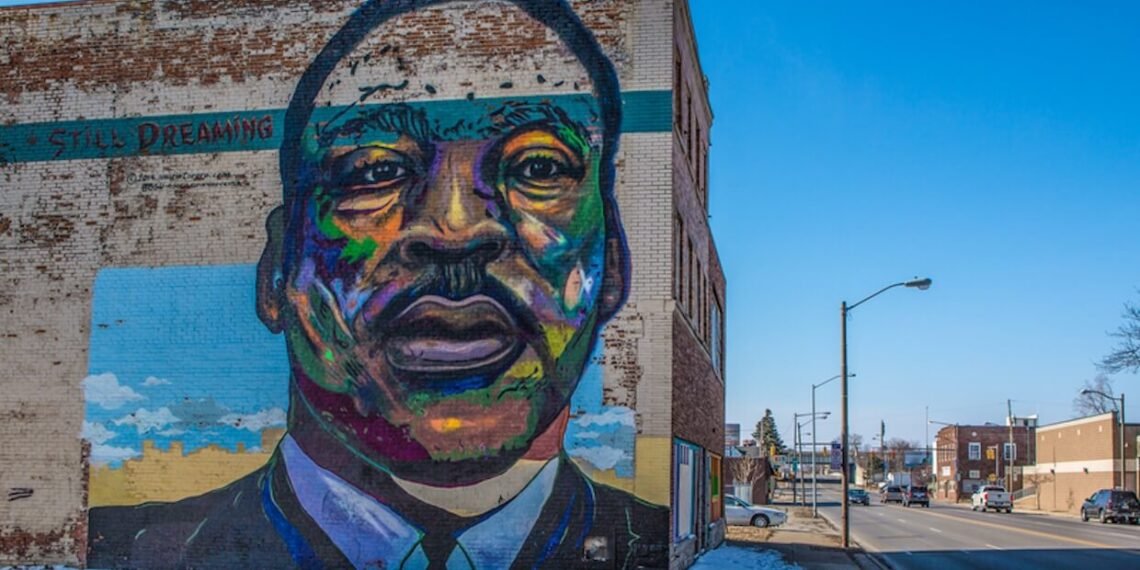
In this compelling Voice of Youth (VoY) contribution, Emmanouela Papapavlou revisits the enduring moral and political legacy of Martin Luther King Jr. in an age of populist authoritarianism, reflecting on the contemporary erosion of empathy, solidarity, and human dignity. Blending personal reflection with normative critique, the piece interrogates how exclusionary attitudes and everyday discrimination have become normalized across societies. It calls for renewed civic courage, emphasizing the role of individuals—especially youth—in resisting injustice and sustaining democratic values. Framed as both a reflection and a call to action, the article underscores that transformative change often begins with principled minorities who refuse to accept injustice as the status quo.
By Emmanouela Papapavlou*
Decades ago, a man stood behind a podium and spoke to a world that was not ready to hear him. He spoke about justice in a time when injustice was normal. He spoke about love in a time when hatred had become routine. He spoke about equality in a society that had learned to live with division. And yet, he spoke anyway. He spoke with a vision that was bigger than the world in front of him.
“I have a dream. I have a dream today.
A dream of freedom, a dream of peace, a dream of people walking together, without fear, without hate, without walls in between them.
I have a dream that one day, no one will be judged by the color of their skin, but by the kindness in their heart.
I have a dream that every child, black or white, rich or poor, will have the same chance to grow, to learn, to dream.
I have a dream that love will speak louder than anger, that truth will shine brighter than lies, that hope will be stronger than fear.
This dream is not mine. It belongs to everyone who still believes that tomorrow can be better than today.
I know the road is long, I know the fight is hard, but I also know that justice always rises, even after the darkest night.
So I will keep walking, I will keep believing, I will keep dreaming.
These dreams are the beginning of change, and change is the proof that hope is alive.
I have a dream, and I will not stop until that dream becomes real.”
Martin Luther King stood on that podium delivering a speech to a world that had grown comfortable with cruelty, a world that had learned to live with hate instead of love.
He knew all those things.
And yet he stood there anyway, standing up for what he believed every person is entitled to: freedom, equality, acceptance, and love, no matter the circumstances.
If you feel something when reading those words, you belong to a community of humans who have risen above the noise of propaganda, power, and profit. You belong to the quiet but powerful group of people who still believe that human rights are not negotiable.
You belong to a community that believes that color, sexuality, ethnicity, or religion do not determine whether a person deserves to be heard, to be accepted, or to be treated as equal.
And let me tell you something, as someone who belongs to that community: it has become incredibly rare.
Today, it is rare to openly stand up for every human being, even the ones you do not know, even when there is nothing to gain from doing so. It is rare to refuse to laugh at the joke made about a woman. Rare to speak up when someone mocks a person of color. Rare to challenge the comment made about someone’s religion, their sexuality, or where they come from.
Somehow, it has become normal to mock people for the very things that make them human. The way they look. The place they were born. The language they speak. The beliefs they hold. And because this behavior has become normal, the people who refuse to participate suddenly appear unusual.
So if you are reading this, and you are someone who stands up for people, even when it is uncomfortable, even when it makes you stand out, then yes, I am talking to you.
You who refuse to shrink your values just to fit in with your age group.
You who speak up even when it would be easier to stay quiet.
You who defend someone even when it brings you no reward.
You are not naive. You are not unrealistic. You are necessary.
You are part of the reason the world is still capable of changing. Because change has never started with the majority. It has always started with the few people who were willing to look at injustice and say: this is not normal.
People will call you idealistic.
They will call you naive.
They will call you unrealistic.
But those words are often used by people who have simply grown comfortable with a world that should never have been acceptable in the first place.
Believing in human dignity should not make someone stand out. Defending someone’s humanity should not be controversial. Speaking up for fairness should not be considered radical.
And yet, here we are. So maybe my dream is not just about equality or justice. Maybe my dream is about reaching a world where basic decency is no longer extraordinary. A world where standing up for another human being is not brave, it is simply the standard.
Until that day arrives, the dream still belongs to all of us. And as long as there are people willing to believe in it, to speak for it, and to live by it, hope is still alive.
(*) Emmanouela Papapavlou is a high school student from Thessaloniki, Greece, deeply passionate about social and political issues. She has actively participated in Model United Nations and other youth forums, serving as a chairperson in multiple conferences and winning awards in Greek debate competitions. Writing is her greatest passion, and she loves using it to explore democracy, civic engagement, and human rights. Her dream is to share her ideas, inspire action, and amplify the voices of young people who want to make a difference. Email: emmanpapapavlou@gmail.com