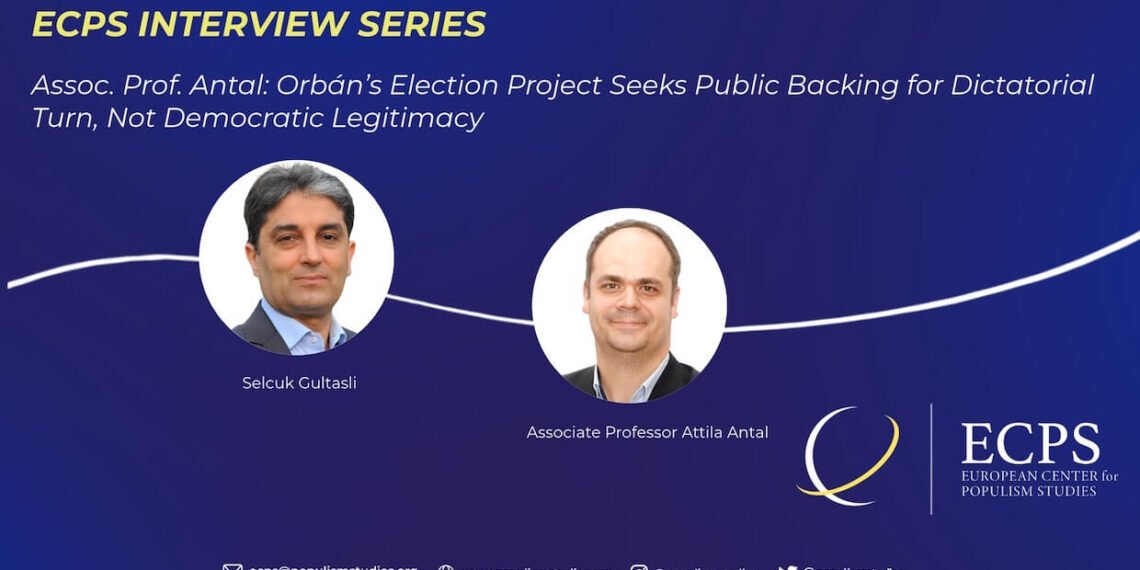
As Hungary approaches the April 12 elections, Viktor Orbán’s long-standing rule faces a critical test shaped by both domestic discontent and geopolitical realignments. In this interview, Associate Professor Attila Antal characterizes the regime as a “constitutional dictatorship,” arguing that the election is not about democratic legitimacy but about securing “public support for its own dictatorial turn.” He highlights how authoritarian legality, sustained through a “dual state” and permanent emergency governance, has hollowed out democratic competition. At the same time, the rise of Péter Magyar and mounting generational and material grievances signal growing resistance. Situated within broader transnational authoritarian networks, Hungary’s election emerges as both a domestic referendum and a geopolitical fault line for European democracy.
Interview by Selcuk Gultasli
As Hungary approaches its pivotal parliamentary elections on April 12, 2026, the country stands at a defining juncture in the trajectory of European populism. After more than a decade and a half of rule by Viktor Orbán, the electoral contest no longer centers merely on party competition, but on whether an entrenched authoritarian-populist regime—characterized by institutional asymmetries, constitutional engineering, and the continuous production of political enemies—can still be meaningfully challenged through democratic means. At the same time, the emergence of Péter Magyar and the Tisza Party has introduced new uncertainty into a system long sustained by what Attila Antal describes as a “hegemonic power bloc,” raising the stakes of what increasingly resembles a systemic referendum.
In this context, Attila Antal, Associate Professor at Eötvös Loránd University, offers a sobering interpretation of the current moment. In his view, the Orbán regime has evolved beyond conventional electoral authoritarianism into what he terms a “constitutional dictatorship,” where formal legality coexists with substantive domination. Most strikingly, Assoc. Prof. Antal argues that “the Orbán regime is not seeking democratic legitimacy in the 2026 elections, but rather public support for its own dictatorial turn.” This diagnosis reframes the election not as a mechanism of accountability, but as a plebiscitary instrument designed to consolidate power under conditions of managed legality.
Crucially, Assoc. Prof. Antal situates Hungary’s electoral moment within a broader geopolitical reconfiguration. He underscores that Orbán has increasingly treated foreign and European policy “as a kind of geopolitical playing field,” cultivating alliances with both Eastern and Western authoritarian actors. The alignment with figures such as Donald Trump and Vladimir Putin reflects not only ideological affinity but also strategic positioning within an emerging transnational authoritarian network. As Assoc. Prof. Antal notes, Hungary has come to function as a “Trojan horse” for Putinist influence within the European Union, transforming the election into “a European and Western geopolitical issue and interest.” This external dimension is mirrored internally by a deepening social cleavage, as segments of Hungarian society remain firmly oriented toward the West while the regime consolidates a pro-Russian political base.
This external dimension intersects with internal tensions, including growing social discontent and a generational divide that reflects what Assoc. Prof. Antal describes as “a very strong generational revolt against Orbán’s authoritarian populism.”
At the core of Assoc. Prof. Antal’s analysis is the concept of authoritarian law and the “dual state,” where a formally normative legal order coexists with a politically driven prerogative structure. Under prolonged states of emergency and rule by decree, Hungary has become, in his words, “a contemporary example of dual state,” raising profound questions about whether elections can still function as instruments of democratic alternation. The opposition’s strategy of contesting the regime “by its own rules” thus reflects a deeper dilemma: whether authoritarian systems can be dismantled through participation in the very institutional frameworks they have reshaped.
Assoc. Prof. Antal’s assessment is stark. The durability of Orbánism, he suggests, lies in its capacity to adapt, radicalize, and survive through escalating authoritarianism. As he warns, the regime “can only survive by becoming increasingly dictatorial,” a trajectory that poses not only a domestic challenge but “a grave danger to both Hungarian and European societies as a whole.”