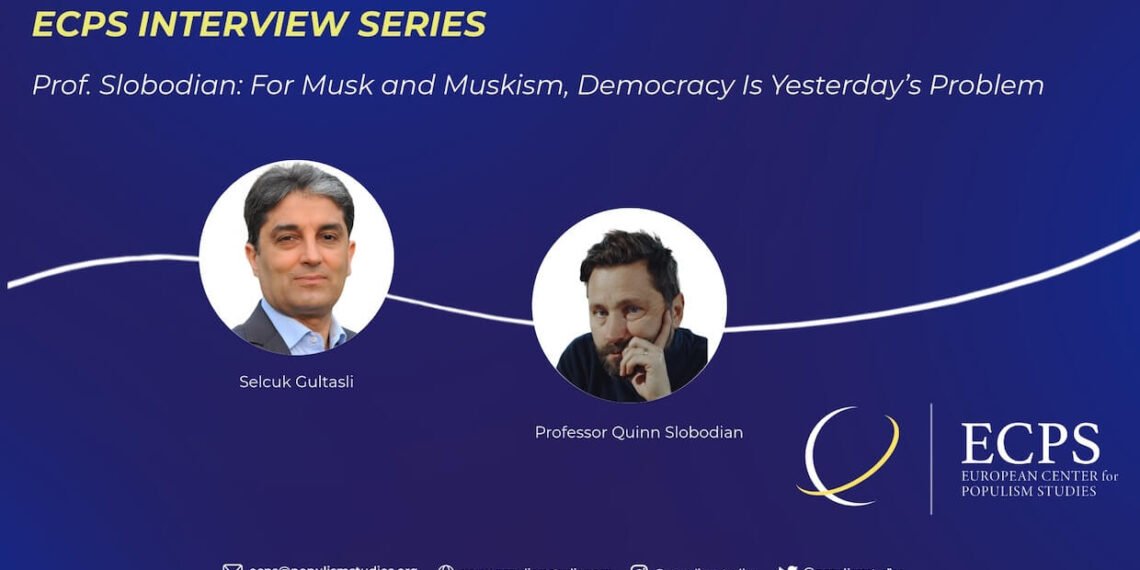
Professor Quinn Slobodian, Professor of International History at Boston University and one of the leading scholars of neoliberalism and the contemporary far right, argues that “Muskism” represents a profound transformation in the relationship between capitalism, technology, and democracy. In an interview with the ECPS, Professor Slobodian contends that Elon Musk embodies a new political-economic order grounded not in liberal individualism but in “a cybernetic understanding of human society” shaped by digital networks, AI, and technocratic management. According to Professor Slobodian, Musk no longer treats democracy as a meaningful political ideal: “For Musk, democracy almost appears to be yesterday’s problem.” The interview explores neoliberalism, authoritarianism, Silicon Valley’s “state symbiosis,” digital sovereignty, and the growing convergence between platform capitalism and far-right populism.
Interview by Selcuk Gultasli
Giving an interview to the European Center for Populism Studies (ECPS), Professor Quinn Slobodian, Professor of International History at Boston University, argues that “Muskism” marks a profound shift in the relationship between capitalism, technology, and democracy. In his view, Elon Musk should not be understood merely as an eccentric billionaire, but as the embodiment of a new political-economic formation built on the infrastructures of platform capitalism, artificial intelligence, military technology, and state dependency.
For Professor Slobodian, Muskism cannot be separated from neoliberalism. “It’s impossible to understand how we arrive at Muskism without considering the effects of neoliberalism,” he explains. Decades of neoliberal policy helped create the conditions under which private actors could assume functions once performed by public institutions. Yet Muskism also departs from classical neoliberalism. Rather than beginning with “consumer sovereignty” or “individual freedom,” it rests on “a kind of cybernetic understanding of human society,” imagining society as “a networked totality that must be engineered and managed to produce optimized outcomes.”
This is where the headline of the interview becomes central. According to Professor Slobodian, Muskism radicalizes neoliberal efforts to constrain democracy, but goes further by treating democracy as increasingly obsolete. While earlier neoliberal thinkers such as Friedrich Hayek and Milton Friedman remained deeply concerned with democracy as a social force, Musk, he argues, does not even “offer lip service to traditional political ideas such as civil society, deliberation, or representation.” For Musk, these concepts belong to “an outdated era of social and political life” supposedly surpassed by “technological acceleration, digital connectivity, and new forms of mediated decision-making.” As Professor Slobodian puts it starkly: “For Musk, democracy almost appears to be yesterday’s problem.”
The interview also explores Professor Slobodian’s concept of “state symbiosis.” Contrary to the familiar image of Silicon Valley elites as anti-state libertarians, he argues that today’s tech oligarchs increasingly seek not to escape the state but to merge with it. Muskism, in this sense, is not about “withering away the state,” but about selling “sovereignty as a service”—from orbital launches and satellite connectivity to AI tools for state administration.
Professor Slobodian further warns that Muskism represents “a radical departure from the liberal tradition,” replacing ideas of human dignity, agency, and representation with optimization, efficiency, and programmable social systems. At the same time, he situates Muskism within broader far-right and populist transformations, arguing that many contemporary right-wing movements are not simply anti-neoliberal reactions, but “the bastard offspring of neoliberalism itself.”