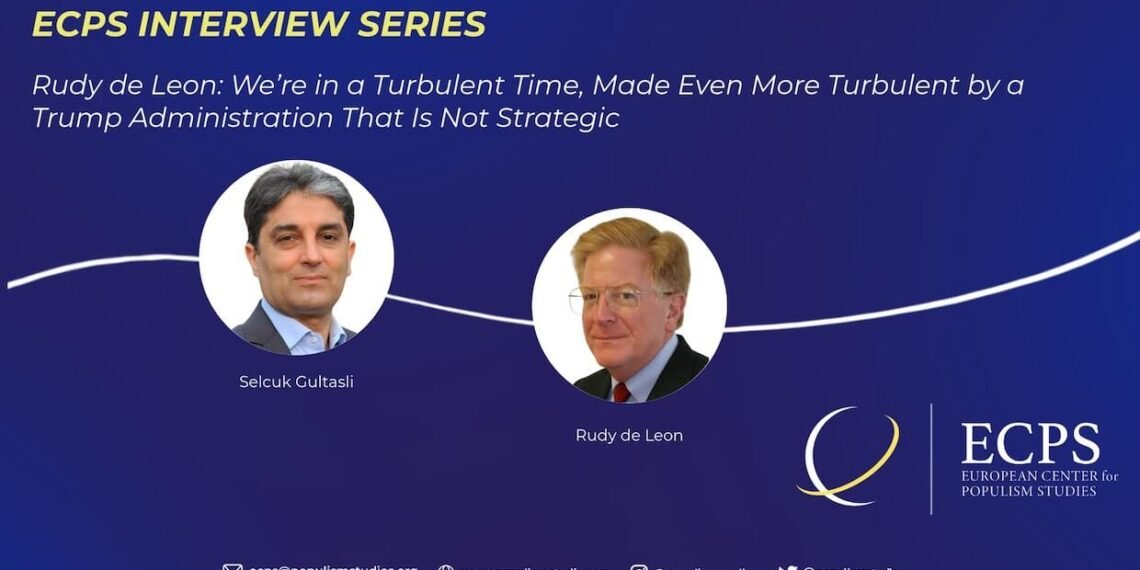
In this timely ECPS interview, Rudy deLeon—former US Deputy Secretary of Defense and Senior Vice President for National Security and International Policy at the Center for American Progress (CAP)—offers a far-reaching assessment of the mounting challenges confronting the liberal international order. Drawing on decades of experience in national security and alliance management, de Leon argues that the world is entering a period of profound uncertainty marked by geopolitical rivalry, democratic strain, technological disruption, and a vacuum of strategic leadership. Criticizing what he describes as an increasingly unpredictable and insular US foreign policy, he warns that “what America says on Monday is not what it says on Thursday.” The interview explores NATO’s future, transatlantic relations, US–China competition, populism, artificial intelligence, migration, and the strategic dilemmas shaping global governance in the twenty-first century.
Interview by Selcuk Gultasli
At a moment when the liberal international order faces mounting pressures from geopolitical rivalry, democratic backsliding, technological disruption, and the resurgence of authoritarian power, questions about the future of American leadership have acquired renewed urgency. In this wide-ranging interview with the European Center for PopulismStudies (ECPS), Rudy deLeon—former US Deputy Secretary of Defense and Senior Vice President for National Security and International Policy at the Center for American Progress (CAP)—offers a sobering assessment of the strategic challenges confronting the United States and its allies in an increasingly fragmented world.
Drawing on decades of experience in defense policy, alliance management, and international security, de Leon, as one of Washington’s most experienced national security practitioners, argues that the world is entering a period of profound transition marked by uncertainty and the absence of strategic leadership. While emphasizing that the post-1945 order helped prevent great-power war, preserve peace in Europe, and facilitate the rise of global economic integration, he warns that many of the assumptions underpinning that order are now under strain. As he puts it, “all these things are in play,”from climate change and migration to artificial intelligence, shifting demographics, and renewed geopolitical competition. Yet, he contends, the situation has been aggravated by “a president and an administration that are not strategic, that are not diplomatic, and that are very insular.”
Throughout the interview, deLeon repeatedly returns to the importance of long-term strategic thinking. Contrasting the institution-building vision of Franklin D. Roosevelt, Harry Truman, and Dwight Eisenhower with contemporary policymaking, he argues that today’s American leadership often operates without a coherent strategic framework. “What America says on Monday is not what it says on Thursday,” he remarks, describing a pattern of unpredictability that has generated anxiety among allies and weakened confidence in US commitments.
The discussion examines a wide range of contemporary issues, including NATO’s future, transatlantic relations, the rise of China, the implications of populism for international cooperation, and the evolving relationship between democracy and globalization. De Leon also explores how technological transformations, particularly artificial intelligence, may reshape labor markets, democratic governance, and international competition. In his view, policymakers remain overly distracted by ongoing military conflicts while neglecting the strategic questions that will define the coming decades. “The most pressing issue right now,” he argues, “is to figure out what the rules are for artificial intelligence and what that means for the nature of work.”
Ultimately, this interview is not simply an assessment of American foreign policy under Donald Trump. It is a broader reflection on leadership, institutions, and the future of international order in an era when, as de Leon suggests, the questions confronting policymakers may be more consequential than the answers currently available.