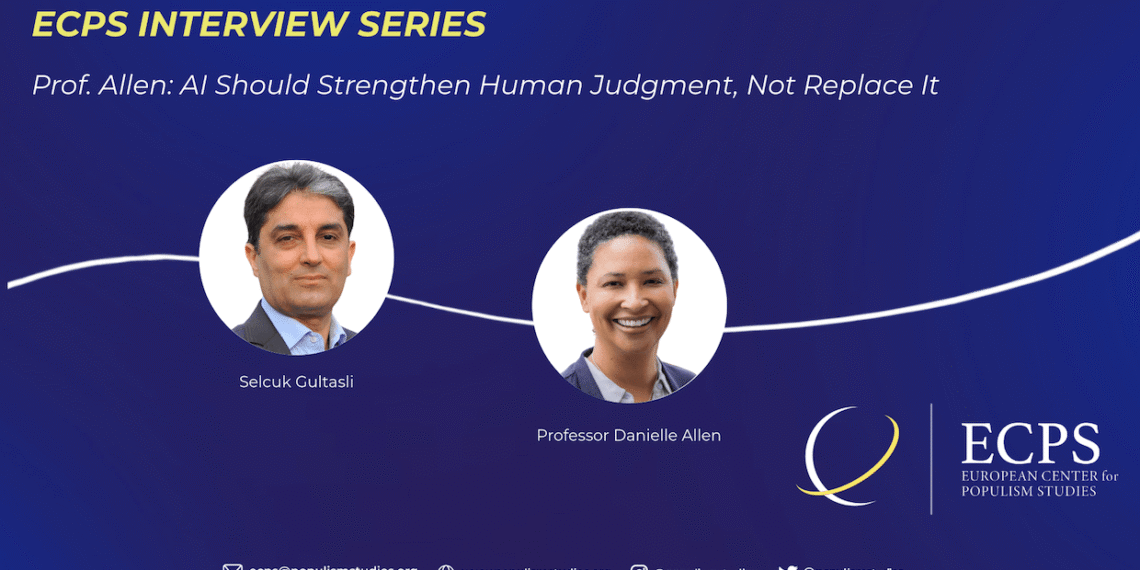
Artificial intelligence (AI) is transforming far more than information ecosystems—it is reshaping the constitutional foundations of democracy itself. In this interview with the ECPS, Professor Danielle Allen argues that the central challenge of AI is not merely technological but constitutional, requiring democratic societies to rethink representation, political power, and civic agency. Rejecting technological determinism, she contends that democratic institutions can still shape AI’s trajectory, provided they strengthen rather than diminish human judgment. Discussing populism, democratic backsliding, surveillance, intermediary institutions, digital citizenship, and constitutional reform, Professor Allen presents a compelling vision of democratic renewal grounded in one core principle: artificial intelligence should complement human capacities—not replace the judgment upon which liberal democracy ultimately depends.
Interview by Selcuk Gultasli
Artificial intelligence is rapidly transforming the institutional architecture of democratic politics. While much public debate has focused on misinformation, deepfakes, automation, and employment, a growing body of scholarship suggests that the more profound implications of generative AI lie elsewhere: in its capacity to reshape political authority, democratic representation, and the constitutional foundations of liberal self-government. As AI systems increasingly mediate public discourse, organize information, influence political preferences, and concentrate unprecedented forms of economic and computational power, the central question is no longer simply how societies should regulate a new technology, but how constitutional democracies themselves must adapt to preserve political equality, civic agency, and democratic accountability.
Few scholars are better positioned to address these challenges than Professor Danielle Allen, James Bryant Conant University Professor at Harvard University, Director of the Allen Lab for Democracy Renovation and the Democratic Knowledge Project, and one of the world’s leading political philosophers working at the intersection of constitutional democracy, citizenship, technology, and democratic renewal. In her widely discussed Journal of Democracy essay, “The Real Dangers of Generative AI,” Professor Allen argues that contemporary debates have fundamentally misidentified the nature of the challenge. Rather than treating AI as merely a technological disruption, she contends that it represents a constitutional turning point requiring a fundamental rethinking of democratic institutions themselves.
In this wide-ranging interview with the European Center for Populism Studies (ECPS), Professor Allen offers a remarkably expansive framework for understanding how AI intersects with democratic governance. Rejecting the conventional separation between technology and constitutional politics, she argues that “political institutions are themselves technologies" and therefore cannot be understood independently of technological transformation. From this perspective, AI is not simply another digital innovation but a force capable of altering the institutional mechanisms through which democratic societies organize representation, distribute political power, and preserve constitutional order.
Throughout the conversation, Professor Allen explores the twin dangers confronting liberal democracies: democratic collapse, produced by the erosion of trustworthy informational infrastructures, and democratic singularity, arising from unprecedented concentrations of computational, informational, and economic power. At the same time, she rejects technological determinism. Instead, she insists that democratic societies retain the capacity to shape AI’s trajectory through institutional reform, constitutional safeguards, and renewed democratic participation.
A recurring theme throughout the interview is the centrality of human agency. Professor Allen argues that democratic renewal ultimately depends not upon resisting technological innovation but upon designing institutions that preserve civic judgment and constitutional self-government. As she puts it, "technology always develops out of a moral vision," making AI fundamentally a political rather than merely technical question. Consequently, she maintains that the essential democratic task is not simply regulating machines but ensuring that "AI should strengthen human judgment, not replace it." That principle ultimately serves as the interview’s normative anchor, connecting questions of constitutional design, democratic education, AI governance, intermediary institutions, populism, surveillance, and the future of liberal democracy into a single coherent vision of democratic resilience in the age of artificial intelligence.