
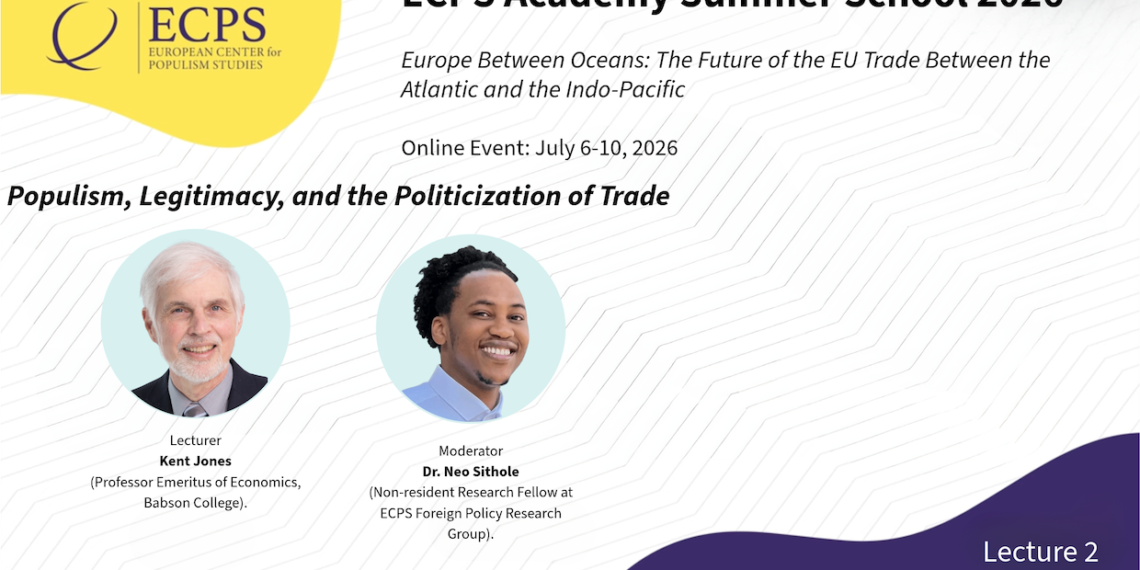
As international trade becomes increasingly entangled with geopolitical rivalry, democratic legitimacy, and populist politics, understanding the future of the rules-based trading order has never been more urgent. In his lecture at the ECPS Academy Summer School 2026, “Europe Between Oceans: The EU in the Age of Geoeconomics, Populism, and Strategic Competition,” Professor Kent Jones examines how the resurgence of populism—particularly under Donald Trump’s second presidency—is reshaping the World Trade Organization (WTO) and challenging the legitimacy of multilateral trade governance. Moderated by Dr. Neo Sithole, the session combines international economics, institutional theory, and political economy to explore why the future of global trade depends not only on markets and tariffs but also on trust, shared norms, and the political foundations of international cooperation.
Reported by ECPS Staff
The accelerating politicization of international trade has emerged as one of the defining features of the contemporary global political economy. Once regarded primarily as a technocratic domain governed by multilateral rules, reciprocal market access, and the pursuit of economic efficiency, international trade has increasingly become an arena where questions of national sovereignty, democratic legitimacy, geopolitical rivalry, and populist mobilization converge. Rising protectionism, strategic competition among major powers, disruptions to global supply chains, and the growing tendency of governments to weaponize economic interdependence have fundamentally challenged the assumptions underpinning the post-war liberal trading order. Understanding contemporary trade politics therefore requires moving beyond conventional economic analysis to examine its broader political, institutional, and ideological foundations.
These themes were at the heart of the ECPS Academy Summer School 2026, held under the title “Europe Between Oceans: The EU in the Age of Geoeconomics, Populism, and Strategic Competition.” Bringing together leading scholars and participants from across the globe, the programme explored how geoeconomic rivalry, democratic backsliding, populism, and the erosion of the liberal international order are reshaping both European integration and global governance. Within this broader intellectual framework, Professor Kent Jones‘s lecture, “Populism, Legitimacy, and the Politicization of Trade,” offered a timely and theoretically rich examination of the profound political transformation currently affecting international trade governance.
The session was thoughtfully moderated by Dr. Neo Sithole, Non-resident Research Fellow at the ECPS Foreign Policy Research Group, whose introduction effectively situated Professor Jones’s lecture within the broader objectives of the Summer School. By highlighting Professor Jones’s distinguished scholarship on international trade, globalization, and the political economy of multilateral institutions, Dr. Sithole prepared participants to engage with the lecture’s central themes while emphasizing the growing importance of examining trade through the interconnected lenses of populism, democratic legitimacy, and international governance.
Drawing on international economics, political economy, institutional theory, and constructivism, Professor Jones argued that the contemporary crisis confronting the World Trade Organization (WTO) extends far beyond disputes over tariffs or market access. Instead, it reflects the gradual erosion of the shared political commitment that has historically sustained the rules-based trading system. By connecting the resurgence of populism to the weakening of institutional legitimacy and the fragmentation of multilateral cooperation, the lecture provided participants with a sophisticated analytical framework for understanding one of the most consequential transformations in the contemporary international political economy.