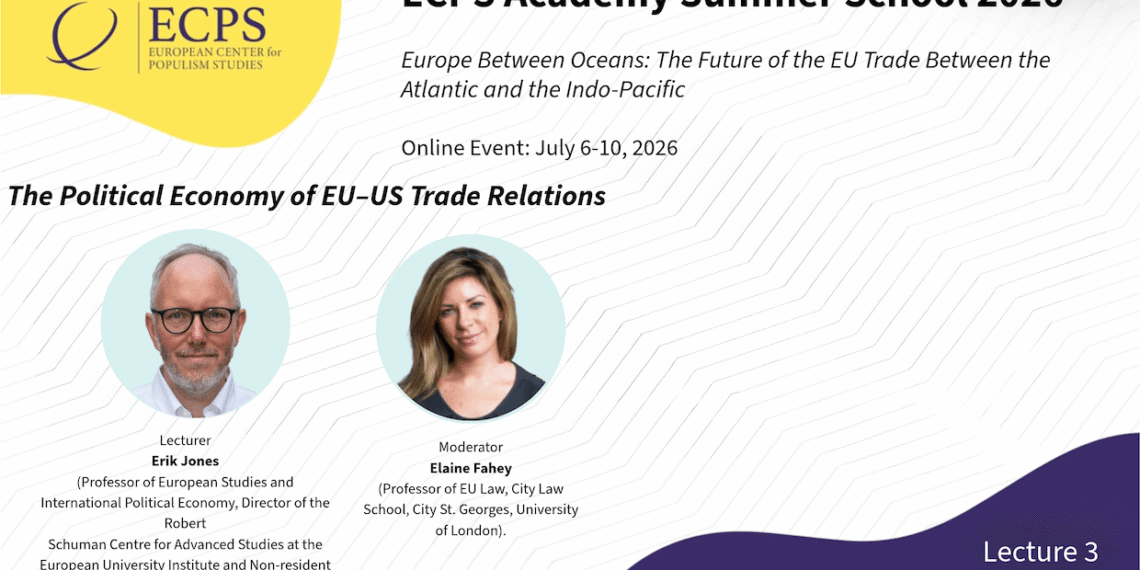
What happens when the political foundations of the transatlantic partnership begin to erode? In his lecture at the ECPS Academy Summer School 2026, “Europe Between Oceans: The EU in the Age of Geoeconomics, Populism, and Strategic Competition,” Professor Erik Jones argues that Europe is entering a “post-Atlantic” era in which the assumptions that sustained EU–US cooperation since the Second World War are being fundamentally reconfigured. Moderated by Professor Elaine Fahey, the session examines how globalization, democratic polarization, populism, and geopolitical rivalry are reshaping transatlantic trade relations, European strategic autonomy, and the liberal international order. Combining historical perspective with political economy, the lecture offers a compelling framework for understanding Europe’s changing role in an increasingly fragmented world.
Reported by ECPS Staff
The rapid transformation of the transatlantic relationship has become one of the defining developments of the contemporary international political economy. For much of the post-war period, the partnership between Europe and the United States rested upon a remarkably durable combination of shared democratic values, expanding economic integration, multilateral cooperation, and common strategic interests. While periodic disagreements over security, trade, and foreign policy repeatedly tested the alliance, they rarely challenged its underlying political foundations. Today, however, intensifying geopolitical rivalry, democratic polarization, the uneven consequences of globalization, and the resurgence of populism have fundamentally altered the assumptions that long sustained the Atlantic order. As questions of economic security, industrial policy, strategic autonomy, and democratic resilience increasingly intersect, understanding the future of EU–US relations requires moving beyond traditional analyses of trade disputes or diplomatic disagreements to examine the deeper structural transformations reshaping both societies and the international system.
These questions stood at the center of the ECPS Academy Summer School 2026, held under the title “Europe Between Oceans: The EU in the Age of Geoeconomics, Populism, and Strategic Competition.” Bringing together leading scholars and participants from across the world, the programme explored how geopolitical competition, economic fragmentation, democratic backsliding, and the changing architecture of globalization are redefining Europe’s place in an increasingly contested international order. Within this broader intellectual framework, Professor Erik Jones delivered a thought-provoking lecture, “The Political Economy of EU–US Trade Relations,” in which he challenged conventional understandings of the contemporary transatlantic partnership. Rather than interpreting recent tensions as merely another cyclical crisis in EU–US relations, Professor Jones argued that Europe is entering what he described as a “post-Atlantic”era, in which many of the political, economic, and strategic assumptions underpinning the post-war transatlantic relationship are being fundamentally reconfigured. Combining historical analysis, international political economy, European integration studies, and comparative politics, he demonstrated that the current rupture extends far beyond disagreements over tariffs, NATO burden-sharing, or trade negotiations, reflecting instead a deeper erosion of domestic political solidarity, institutional trust, and the liberal consensus that historically sustained transatlantic cooperation.
The session was expertly moderated by Professor Elaine Fahey, Professor of EU Law at City Law School, City St George’s, University of London, whose distinguished scholarship on European Union external relations, international economic governance, cybersecurity, and transatlantic legal cooperation provided an ideal intellectual setting for the discussion. Her own research, situated at the intersection of European law and global governance, closely complements many of the themes explored throughout Professor Jones’s lecture, particularly the evolving legal and institutional architecture of EU–US relations.
Opening the session, Professor Fahey warmly welcomed participants and underscored Professor Jones’s long-standing contributions to the study of European politics, international political economy, and transatlantic relations. She highlighted his extensive body of scholarship, noting that his work has profoundly shaped contemporary understanding of European integration, economic governance, and the changing dynamics of the Atlantic partnership. Describing his research portfolio as both extensive and intellectually influential, she emphasized that his lecture would offer participants a valuable opportunity to engage with one of the foremost scholars examining Europe’s evolving international position. Her moderation helped situate the discussion within the broader challenges confronting Europe as it navigates an era of geoeconomic rivalry, democratic uncertainty, and strategic realignment.
Drawing on decades of research into European integration, globalization, and international political economy, Professor Jones argued that the future of transatlantic relations will depend less on repairing individual policy disagreements than on rebuilding the domestic political foundations that have historically enabled international cooperation. His lecture offered participants not only a penetrating reinterpretation of EU–US trade relations but also a broader analytical framework for understanding how globalization, democracy, strategic autonomy, and geopolitical competition collectively reshaping Europe’s role in the twenty-first-century international order are.