
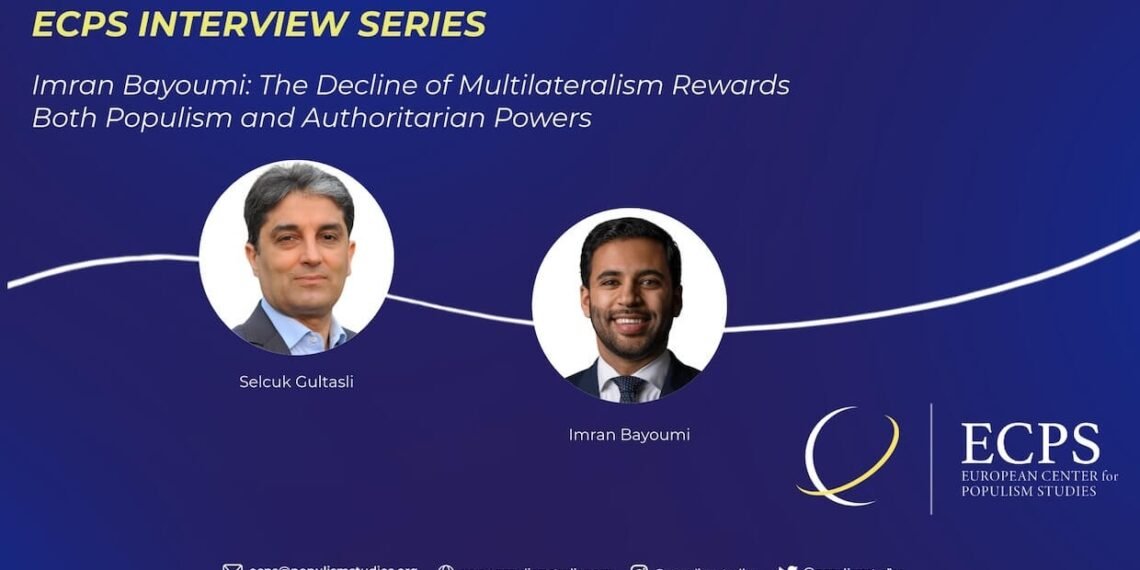
In this interview, Imran Bayoumi examines how the weakening of multilateral institutions and the rise of transactional diplomacy are reshaping global power in ways that often favor authoritarian and populist governments. He argues that authoritarian middle powers benefit from greater flexibility to hedge between competing blocs, while democracies remain constrained by alliances, institutions, and domestic accountability. Turkey under President Recep Tayyip Erdogan emerges as a key example: Ankara has “managed to play and interact with both realms at the same time,” using populist nationalism to present strategic balancing as the defense of national interests. Bayoumi also warns that weakening Western cohesion benefits revisionist powers, while calling for a “retooled American leadership” capable of rebuilding democratic cooperation in a more fragmented international order.
Interview by Selcuk Gultasli
In an era of intensifying geopolitical fragmentation, weakening multilateral institutions, and increasingly transactional diplomacy, authoritarian and populist governments may find themselves unusually well positioned to exploit the emerging international disorder. In this wide-ranging interview with the European Center for Populism Studies (ECPS), Imran Bayoumi, Deputy Director and Resident Fellow with the GeoStrategy Initiative at the Atlantic Council’s Scowcroft Center for Strategy and Security, examines how the erosion of the rules-based international order is altering the balance between democratic constraints and authoritarian flexibility. His central argument is not that autocracies are inherently stronger, but that a fragmented system can reward governments able to hedge between competing powers, bypass institutional constraints, and personalize foreign policy. As Bayoumi puts it, authoritarian middle powers “have experience with hedging” and are less constrained by the institutions and alliances that shape the choices of democratic states.
The decline of multilateralism is particularly consequential because it lowers the costs of defying established rules. According to Bayoumi, states increasingly feel comfortable “bypassing multilateral bodies,” ignoring treaties and challenging norms because the prospect of meaningful punishment has diminished. Yet he cautions against reducing this transformation simply to populism: “It’s a mix of both things: populism and power.” At the same time, the personalization of diplomacy associated with contemporary populist politics is becoming increasingly significant, as foreign policy becomes more closely tied to leaders themselves rather than institutions and professional bureaucracies.
Turkey provides one of the interview’s clearest illustrations of this emerging geopolitical flexibility. Still embedded in NATO and Western institutions, Turkey under President Recep Tayyip Erdogan has simultaneously cultivated relations across competing geopolitical blocs. Bayoumi describes Turkey as a country that has “managed to play and interact with both realms at the same time.” Populist nationalism, he argues, has been crucial to legitimizing this strategy domestically: “Erdogan has been able to sell this balancing strategy as a way of being able to secure Turkey’s interests first.” The willingness to purchase Russian air-defense systems while remaining within NATO exemplifies how Ankara combines alliance membership with strategic hedging.
More broadly, Bayoumi warns that weakening Western alliances and institutional cohesion ultimately benefits revisionist authoritarian powers. “Every action that undermines the strong ties between the United States and its allies is a benefit for them,” he argues, pointing to the growing cooperation among Russia, China, Iran, and North Korea. Yet he rejects the idea that authoritarian ascendancy is inevitable. Instead, he calls for “some sort of retooled American leadership” capable of accommodating the growing autonomy of middle powers while rebuilding institutions and democratic cooperation. The challenge, therefore, is not simply to restore the old international order, but to construct a more resilient one capable of reconciling democratic values, strategic power, and an increasingly multipolar world.