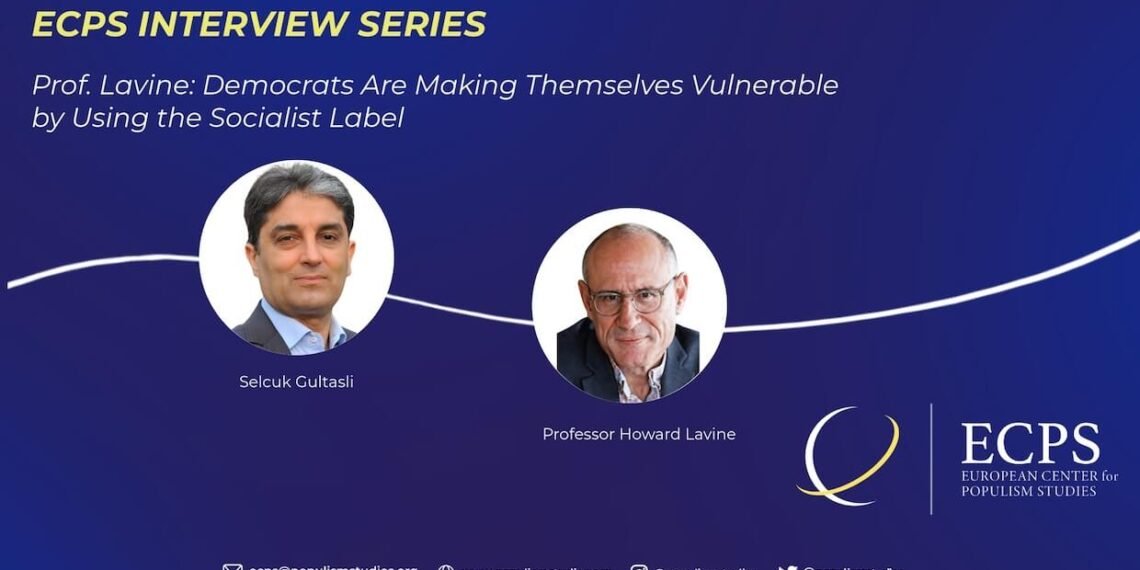
Professor Howard Lavine argues that the Democratic Party’s path to renewal lies less in ideological repositioning than in economic populism, political energy, and credible material outcomes. While MAGA remains rooted in status threat and a revanchist politics of cultural restoration, Professor Lavine sees greater opportunity for Democrats in focusing on affordability, wages, healthcare, and economic security. He cautions that the “socialist” label may create unnecessary electoral vulnerability, even as the Sanders–AOC–Mamdani current helps reorient the party toward working-class concerns. For Professor Lavine, most voters are not moved primarily by ideological sophistication but by whether political leaders deliver tangible improvements. The strategic imperative is therefore clear: Democrats should “pivot purely to economics” and demonstrate what they can concretely achieve for working-class voters.
Interview by Selcuk Gultasli
In an interview with the European Center for Populism Studies (ECPS), Professor Howard Lavine, Professor of Political Science at the University of Minnesota and former Director of the Center for the Study of Political Psychology, argues that the Democratic Party’s central challenge is less one of ideological definition than of political branding, economic credibility, and mobilizational energy. His assessment is particularly relevant ahead of the 2026 US midterm elections, as Democrats confront both a weakened but still deeply entrenched Trumpism and the growing influence of figures associated with democratic socialist and economic-populist politics. For Professor Lavine, however, the label itself may be more liability than asset: “The Democrats are making themselves vulnerable to some degree by using the socialist label.”
Professor Lavine draws a sharp distinction between the cultural politics underpinning MAGA and the economic terrain on which Democrats may have greater room to rebuild. MAGA, he argues, remains rooted in status threat and “a revanchist impulse to restore the prior order in which white Christian men feel comfortable in their dominant status.” Yet he does not believe racial and cultural identities necessarily foreclose an economic realignment. Swing voters, he stresses, are generally not those most deeply embedded in MAGA ideology. For Democrats, the crucial question is whether they can translate economic-populist appeals into tangible results: “What matters is the economic outcomes.” Policies themselves are comparatively less important because “most people aren’t going to understand what you say. They’re going to understand what’s happening on the ground.”
This emphasis on economics also shapes Professor Lavine’s interpretation of the Sanders–AOC–Mamdani current. He resists treating it primarily as an ideological socialist project, describing it instead as an effort to rebrand Democrats as more clearly aligned with working-class interests. Indeed, he argues that “the energy is in economic populism. It’s nowhere else.” At the same time, he warns that invoking socialism risks obscuring that advantage: “Too many people don’t like it; it’s not helping Democrats.”
More broadly, Profesor Lavine questions whether ideology itself is what moves most voters. “It’s really not about ideology,” he says of progressive candidates’ recent appeal; what voters are responding to is energy, anger, and a clearer sense of political purpose. In his view, Democrats should therefore move away from cultural issues that animate the academic left and “pivot purely to economics.” The strategic lesson is straightforward: “The more it focuses on economics, the better.” But electoral success ultimately requires more than rhetoric or branding. Once in power, Democrats must demonstrate “what they can do,” and, crucially, “what they can do specifically for the white working class.”
Here is our interview with Professor Howard Lavine, edited lightly to enhance clarity, readability, and overall flow for publication.