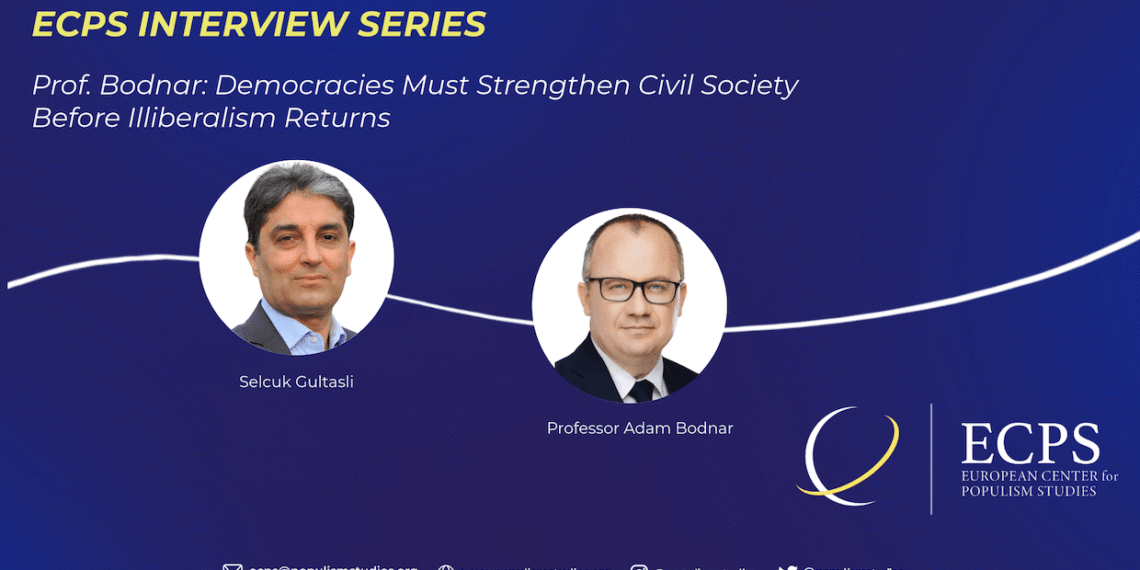
In an interview with the ECPS, Professor Adam Bodnar, Poland’s Minister of Justice from 2023 to 2025, reflects on Poland’s experience of democratic backsliding and rule-of-law recovery, arguing that electoral victory alone cannot reverse years of institutional capture. He stresses that democratic resilience depends on protecting independent institutions while strengthening civil society, civic education, professional associations, media, and academia before illiberal pressures intensify. Poland’s experience, he notes, showed that democratic forces had won “only partial power within the state” after 2023 and that restoration must proceed within constitutional constraints. For Professor Bodnar, civil society proved indispensable: “We would not have been able to win the elections in 2023 without civil society.” His broader lesson for Europe is preventive — democracies must build durable institutional and civic safeguards before the next crisis arrives.
Interview by Selcuk Gultasli
Giving an interview to the European Center for Populism Studies (ECPS), Professor Adam Bodnar, a constitutional lawyer, human rights scholar and Senator of the Republic of Poland who served as Poland’s Minister of Justice from 2023 to 2025 and previously as Commissioner for Human Rights from 2015 to 2021, argues that the durability of democracy ultimately depends not only on constitutional design, courts, or European enforcement mechanisms, but also on the strength of civil society before an illiberal challenge emerges. His work has placed him at the center of both resistance to democratic backsliding and the difficult process of rule-of-law recovery. In this interview, we examine what Poland got right and wrong after the defeat of the Law and Justice Party (PiS), the dilemmas of restoring captured institutions, and the broader lessons for liberal democracy in Europe. We also discuss Hungary, Germany, EU enforcement, judicial independence, accountability, civil society, and democratic resilience.
Drawing on Poland’s experience of democratic backsliding and subsequent rule-of-law recovery, Professor Bodnar presents democratic resilience as an ecosystem in which independent institutions, civic organizations, professional associations, public-interest lawyers, judges, media, and citizens reinforce one another.
A central lesson of Poland’s experience, he stresses, is that electoral victory does not automatically translate into institutional control or democratic restoration. Looking back at the 2023 election, Professor Bodnar recalls that the democratic camp treated the result “as more or less a total victory,” only to discover that it had won “only partial power within the state.” The deeper difficulty was that eight years of PiS rule had transformed not only laws but also institutional personnel, incentives, and expectations. State capture, he explains, involved “filling institutions with people who are loyal to you” and producing “a chilling effect” on those seeking to remain independent.
For Professor Bodnar, however, the answer cannot lie solely in redesigning constitutional safeguards. His strongest emphasis is preventive: democracies must cultivate civic resilience before institutions come under sustained pressure. “Protecting ourselves against illiberal democracy also requires strengthening civic education and civil society,” he argues, adding that civil society actors must possess the capacity to protest, monitor governments, and make institutional capture more difficult. Poland’s own experience reinforces that conclusion. “We would not have been able to win the elections in 2023 without civil society,” Professor Bodnar says, recalling periods when civic organizations continued protesting even as political parties were preoccupied with political competition.
This leads to the interview’s broader argument: democratic resilience should be treated as a permanent institutional and societal investment rather than an emergency response. Professor Bodnar describes government support for civil society as “a form of insurance for unknown times to come.” His concluding principle is equally clear: following Timothy Snyder’s injunction to “protect institutions,” democracies must preserve as many independent strongholds of the rule of law as possible, while ensuring that civil society, professional associations, media, academia, and local institutions retain sufficient autonomy to sustain political pluralism.
The interview therefore moves beyond the question of how democracy can recover after capture. It asks a more fundamental question: how can democratic societies build enough institutional and civic resilience that, when illiberal actors return, the state is no longer so easy to capture?