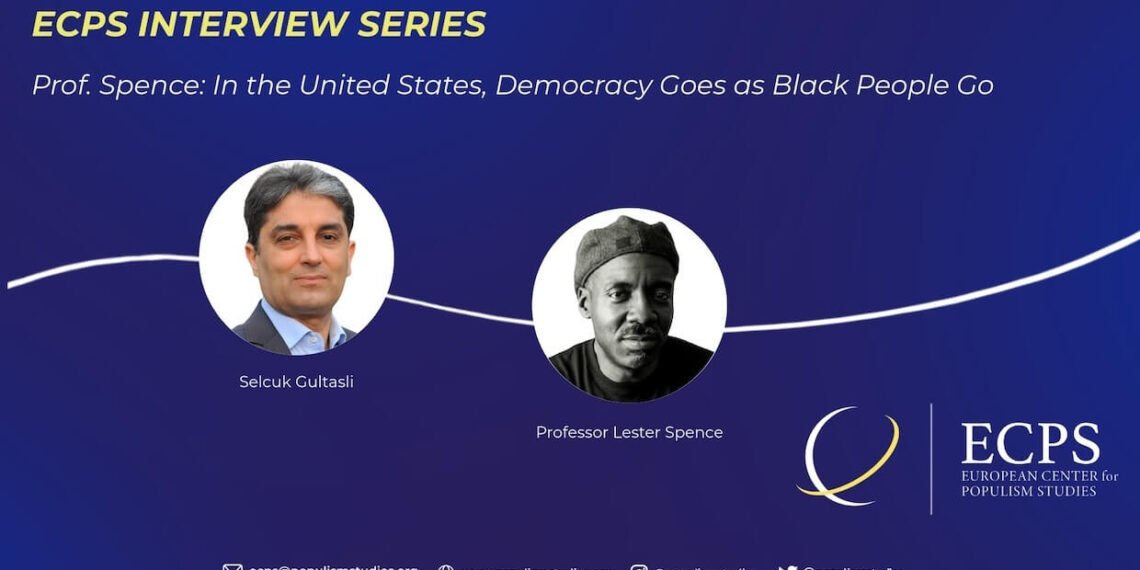
In an in-depth interview with the ECPS ahead of the November 3 US midterm elections, Professor Lester Spence of Johns Hopkins University argues that the fate of American democracy is inseparable from Black political rights: “In the United States, democracy goes as Black people go.” Examining Trumpism, racialized political hierarchies, democratic backsliding, and the weakening of the Voting Rights Act, Professor Spence emphasizes that restrictions on Black political participation undermine democracy more broadly. Drawing on Reconstruction, the Civil Rights Movement, and contemporary Black activism, he explores the relationship between racial domination and political economy while highlighting the democratic potential of cross-racial solidarity, progressive coalitions, and institutional transformation beyond electoral representation to secure substantive empowerment for working-class communities.
Interview by Selcuk Gultasli
As the United States approaches the November 3, 2026, midterm elections, political competition is increasingly shaped by Trumpism, racial polarization, economic inequality, and conflicts over voting rights and democratic institutions. Beyond the struggle for congressional control, these developments raise fundamental questions about racialized political power, the resilience of American democracy, and the prospects for substantive Black political empowerment. At the heart of these debates lies a crucial question: Can American democracy remain viable when the political rights of historically marginalized communities are increasingly contested?
In an in-depth interview with the European Center for Populism Studies (ECPS), Professor Lester Spence, Professor of Political Science and Africana Studies at Johns Hopkins University, offers a historically grounded analysis of the relationship between racial domination, political economy, and democratic backsliding. His central argument is captured in a striking formulation: “In the United States, democracy goes as Black people go.” For Professor Spence, the trajectory of American democracy cannot be understood independently of the political struggles, institutional protections, and democratic participation of Black Americans.
Drawing on the historical experiences of Reconstruction, Jim Crow, the Civil Rights Movement, and contemporary struggles over voting rights, Professor Spence argues that racial exclusion has consequences extending far beyond its immediate targets. As he emphasizes, “It’s not simply that democratic harms inflicted on Black people affect only Black people.” Rather, “for historical reasons, Black people are at the center.” Consequently, “what happens to Black people ultimately ends up hurting everybody.”
This interpretation challenges approaches that treat racial inequality as peripheral to democratic decline. Professor Spence insists that “racial politics are essential to understanding democratic backsliding in the United States,” identifying two competing historical traditions: one that expands democratic participation and another that constrains political representation and governmental responsiveness. He further observes that “the anti-democratizing or de-democratizing tendency has always been associated with forces that have practiced white supremacy.”
Against this historical background, the contemporary weakening of voting rights acquires broader institutional significance. Discussing the Voting Rights Act, Professor Spence warns: “When you weaken or effectively neutralize the Voting Rights Act, you’re not just undermining its protections for Black people; you’re essentially undermining those protections for everybody.” He similarly anticipates that, without electoral reform, “Black political representation” will decline dramatically, particularly in the American South.
Yet Professor Spence’s analysis extends beyond democratic erosion to the possibilities of political renewal. Reflecting on Black Lives Matter, Occupy Wall Street, and emerging progressive coalitions, he argues that “political movements themselves create openings, and institutions then emerge to fill those gaps.” Ultimately, he maintains, meaningful democratic transformation requires more than electoral victories: “It’s not just about electing people; it’s about creating a new model” capable of protecting political participation while generating progressive change and substantive material benefits for working-class communities.