
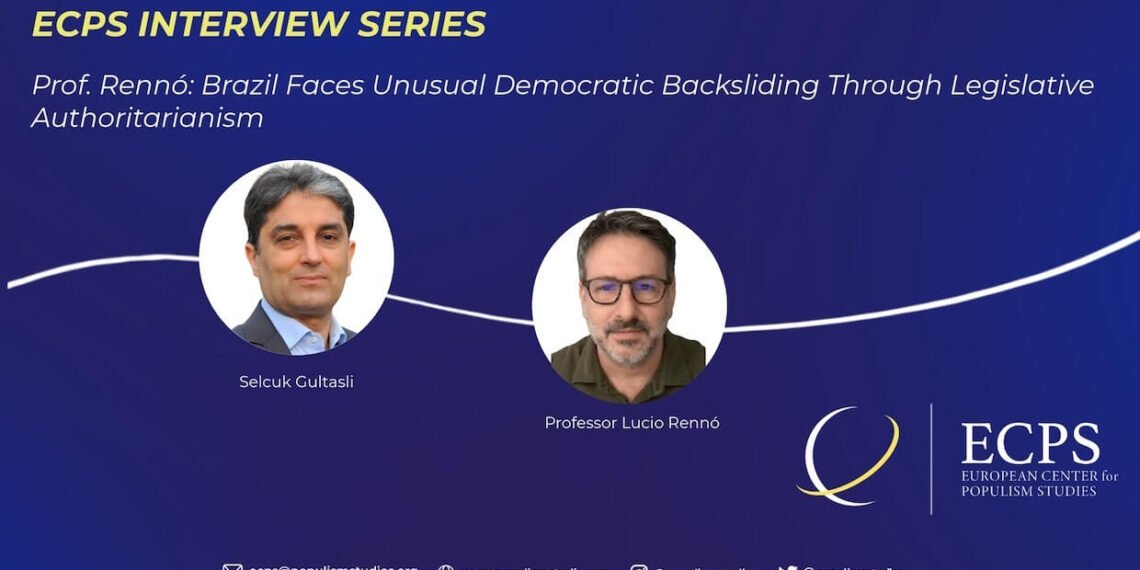
As Brazil approaches its October 25 presidential runoff, Professor Lucio Rennó of the University of Brasília warns of an unusual trajectory of democratic backsliding driven primarily by Congress rather than the presidency. In this ECPS interview, Professor Rennó examines the institutionalization of Bolsonarismo, the consolidation of political polarization, and the persistence of authoritarian enclaves inherited from military rule. Drawing parallels with what scholars call legislative authoritarianism, he cautions that congressional power-grabbing could weaken the Supreme Court and institutions of horizontal accountability. As Professor Rennó observes, “We can identify elements of that same logic in Brazil.” Yet he also emphasizes democratic resilience, highlighting the role of civil society, judicial institutions, and political opposition in resisting institutional erosion and preserving constitutional democracy.
Interview by Selcuk Gultasli
As Brazil approaches the decisive October 25 presidential runoff, the country’s political trajectory raises questions extending far beyond the contest between President Luiz Inácio Lula da Silva and Flávio Bolsonaro. In the October 4 first round, Flávio Bolsonaro secured 47.03 percent of the vote against Lula’s 45.16 percent, while the broader Bolsonarist camp strengthened its congressional presence. ForProfessor Lucio Rennó, Professor at the Political Science Institute of the University of Brasília, these developments illuminate not only the institutionalization of Bolsonarismo but also an unusual transformation in the mechanisms of Brazilian democratic backsliding.
In this wide-ranging interview with the European Center for Populism Studies (ECPS), Professor Rennó, whose research examines populism, authoritarian attitudes, electoral realignment, and democratic resilience, argues that Brazil is witnessing a distinctive concentration of political power. Unlike conventional patterns of democratic erosion, where executives progressively dismantle constitutional constraints, the Brazilian process is increasingly driven by the legislature. As he observes, “What we’re witnessing in Brazil today is a rather unusual process of democratic backsliding, in which power-grabbing and the centralization of power are occurring primarily within Congress rather than the executive branch.”
Drawing on The Crisis of Democracy in Brazil, co-authored with Leonardo Avritzer, Professor Rennó situates this development within the country’s enduring institutional vulnerabilities, particularly the “authoritarian enclaves” inherited from military rule. He identifies a Congress dominated by a pragmatic, clientelistic coalition with conservative policy orientations as a potential vehicle for weakening constitutional checks. Comparing this trajectory with developments in Peru, where scholars have identified legislative authoritarianism, Professor Rennó warns: “We can identify elements of that same logic in Brazil.”
The implications extend directly to judicial independence and horizontal accountability. Professor Rennó anticipates congressional efforts to restrict the Supreme Court’s authority and potentially weaken institutions such as the Public Prosecutor’s Office, the Federal Police, and the Tribunal de Contas. Under a Flávio Bolsonaro presidency, he cautions, executive-legislative alignment could accelerate these developments, weakening oversight institutions “primarily to the benefit of Congress rather than the presidency.”
Yet Professor Rennó’s analysis also emphasizes the resilience of Brazilian democracy. He underscores the constitutional role of the Supreme Court, the mobilizing capacity of civil society, and the potential resistance of the Workers’ Party and congressional opposition.
Ultimately, the interview situates these institutional struggles within a broader political realignment: the consolidation of Bolsonarismo and Petismo as competing national identities. As Professor Rennó explains, Brazil is witnessing “the construction of political identities that transcend politics and increasingly affect our daily lives.” The October runoff therefore represents not merely a presidential contest but a critical moment in the continuing struggle over institutional power, democratic accountability, and Brazil’s political future.
