
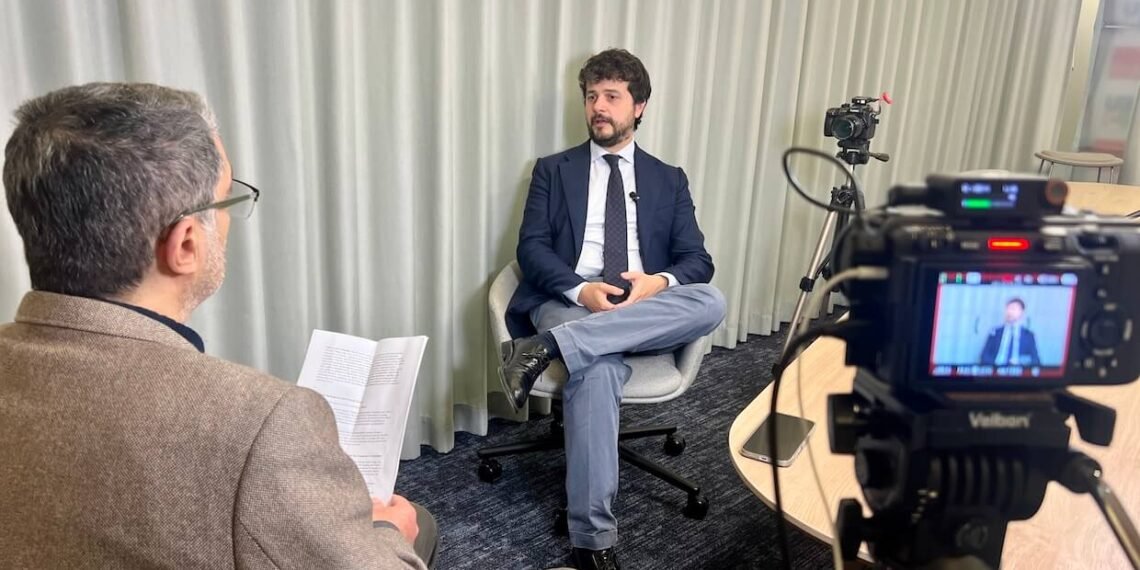
MEP Brando Benifei warns that Europe’s struggle for technological sovereignty is inseparable from the defense of democracy. In this ECPS interview, he argues that the EU must strengthen its technological capacity while preserving its regulatory autonomy against external pressure and concentrated corporate power. Benifei stresses that “regulations are decided in Europe, by Europeans, for Europeans” and warns that the extreme right has moved closer to “techno-oligarchs,” forging “a form of alliance and mutual support.” He describes this convergence as “an alliance of interests that is threatening our democracies.” Beyond regulation, Benifei calls for “a democratic reaction” and a “new social contract” capable of making European societies “more equal and freer.”
Interview by Selcuk Gultasli
In an era in which technological power, geopolitical rivalry, and democratic vulnerability are increasingly intertwined, the European Union faces a double challenge: strengthening its strategic autonomy while defending the institutional and normative foundations of liberal democracy. Few policy areas illustrate this convergence more clearly than artificial intelligence, digital regulation, platform governance, and transatlantic relations. In this wide-ranging interview with the European Center for Populism Studies (ECPS), MEP Brando Benifei, Chair of the European Parliament’s Delegation for Relations with the United States and a central parliamentary figure in the development of the EU Artificial Intelligence Act, reflects on Europe’s technological dependencies, regulatory sovereignty, Big Tech power, disinformation, and the growing political relationship between digital oligarchies and the popuplist radical right.
At the center of Benifei’s analysis is the argument that Europe’s struggle for sovereignty cannot be reduced to economic competitiveness or technological capacity alone. It also concerns who has the power to establish the rules governing digital societies. He insists that Europe must develop its own technological capabilities while preserving its regulatory autonomy, arguing that “regulations are decided in Europe, by Europeans, for Europeans” and describing this principle as “an absolute red line.” At the same time, he warns that Europe cannot remain merely a regulatory power without developing the technological infrastructure necessary to sustain that role. As he puts it, the EU “can’t remain a regulatory reference if it doesn’t also develop the technological power that is needed today.”
The interview becomes particularly significant when Benifei turns to the political consequences of concentrated technological power. He argues that the rise of the extreme right is increasingly connected to powerful actors within the technology sector. “The extreme right has been getting closer and closer to these techno-oligarchs,” he says, adding that they have “forged a form of alliance and mutual support.” For Benifei, this convergence now constitutes “an alliance of interests that is threatening our democracies.”
His response is not limited to regulation. Benifei calls for what he describes as “a democratic reaction” and “the proposal of a new social contract” capable of making societies “more equal and freer.” In his account, inequality and declining freedoms can provide “fertile ground” for an alliance between the extreme right and techno-oligarchs and for what he characterizes as a “hateful and democracy-demolishing approach.”
Against this backdrop, the conversation explores the broader implications of AI governance, algorithmic amplification, digital enforcement, disinformation, transatlantic pressure, and European sovereignty. Benifei’s remarks ultimately frame the contemporary digital struggle not merely as a debate over innovation or regulation, but as a deeper contest over democratic authority, economic power, and the institutional capacity of Europe to determine its own political and technological future.