
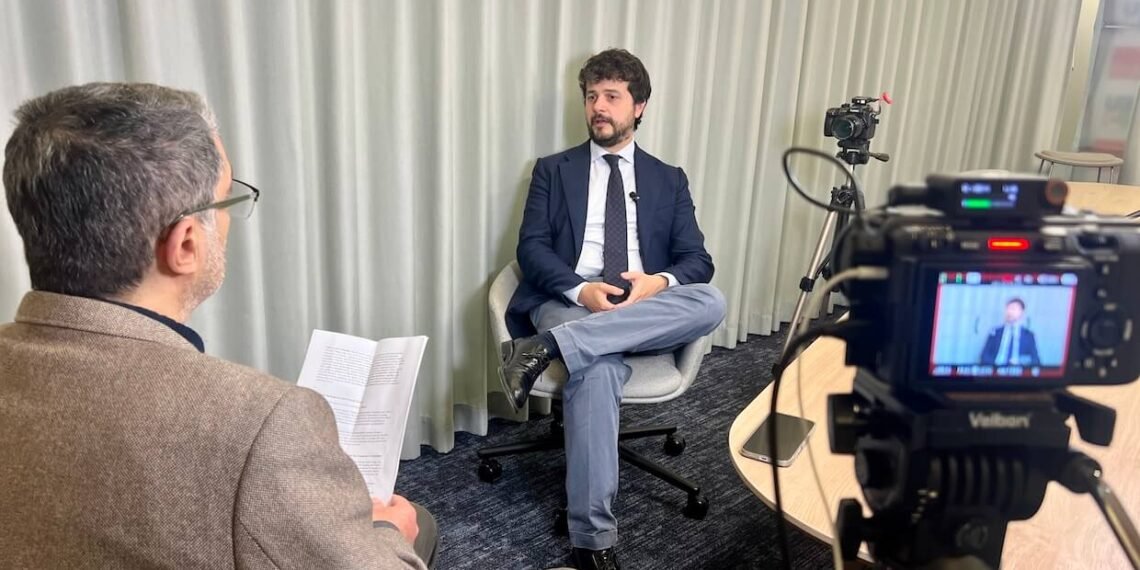
MEP Brando Benifei warns that Europe’s struggle for technological sovereignty is inseparable from the defense of democracy. In this ECPS interview, he argues that the EU must strengthen its technological capacity while preserving its regulatory autonomy against external pressure and concentrated corporate power. Benifei stresses that “regulations are decided in Europe, by Europeans, for Europeans” and warns that the extreme right has moved closer to “techno-oligarchs,” forging “a form of alliance and mutual support.” He describes this convergence as “an alliance of interests that is threatening our democracies.” Beyond regulation, Benifei calls for “a democratic reaction” and a “new social contract” capable of making European societies “more equal and freer.”
Interview by Selcuk Gultasli
In an era in which technological power, geopolitical rivalry, and democratic vulnerability are increasingly intertwined, the European Union faces a double challenge: strengthening its strategic autonomy while defending the institutional and normative foundations of liberal democracy. Few policy areas illustrate this convergence more clearly than artificial intelligence, digital regulation, platform governance, and transatlantic relations. In this wide-ranging interview with the European Center for Populism Studies (ECPS), MEP Brando Benifei, Chair of the European Parliament’s Delegation for Relations with the United States and a central parliamentary figure in the development of the EU Artificial Intelligence Act, reflects on Europe’s technological dependencies, regulatory sovereignty, Big Tech power, disinformation, and the growing political relationship between digital oligarchies and the popuplist radical right.
At the center of Benifei’s analysis is the argument that Europe’s struggle for sovereignty cannot be reduced to economic competitiveness or technological capacity alone. It also concerns who has the power to establish the rules governing digital societies. He insists that Europe must develop its own technological capabilities while preserving its regulatory autonomy, arguing that “regulations are decided in Europe, by Europeans, for Europeans” and describing this principle as “an absolute red line.” At the same time, he warns that Europe cannot remain merely a regulatory power without developing the technological infrastructure necessary to sustain that role. As he puts it, the EU “can’t remain a regulatory reference if it doesn’t also develop the technological power that is needed today.”
The interview becomes particularly significant when Benifei turns to the political consequences of concentrated technological power. He argues that the rise of the extreme right is increasingly connected to powerful actors within the technology sector. “The extreme right has been getting closer and closer to these techno-oligarchs,” he says, adding that they have “forged a form of alliance and mutual support.” For Benifei, this convergence now constitutes “an alliance of interests that is threatening our democracies.”
His response is not limited to regulation. Benifei calls for what he describes as “a democratic reaction” and “the proposal of a new social contract” capable of making societies “more equal and freer.” In his account, inequality and declining freedoms can provide “fertile ground” for an alliance between the extreme right and techno-oligarchs and for what he characterizes as a “hateful and democracy-demolishing approach.”
Against this backdrop, the conversation explores the broader implications of AI governance, algorithmic amplification, digital enforcement, disinformation, transatlantic pressure, and European sovereignty. Benifei’s remarks ultimately frame the contemporary digital struggle not merely as a debate over innovation or regulation, but as a deeper contest over democratic authority, economic power, and the institutional capacity of Europe to determine its own political and technological future.

Here is our interview with MEP Brando Benifei, edited lightly to enhance clarity, readability, and overall flow for publication.
Europe Needs to Have a More United Voice
Brando Benifei, welcome! As Chair of the European Parliament’s Delegation for Relations with the United States, you have repeatedly defended a strong transatlantic relationship, while also arguing that Europe must become more capable of defending its own interests. Following renewed US pressure on trade, technology, defense, and digital regulation, has the transatlantic relationship entered a fundamentally more transactional phase? And what would a genuinely more sovereign—but still cooperative—European approach to the United States looks like?
MEP Brando Benifei: I think it’s important to consider that the relationship between the European Union and the United States is based on strong economic integration that has been developing over decades, but also on security, cultural exchange, and social interconnections. In fact, the economic interchange is the biggest between two areas of the world. The EU and the US have not only trade, but also a direct economic presence of EU companies in the US and US companies in the EU. That goes beyond any other similar comparison we could make between the EU and other parts of the world, or the US and other parts of the world, even compared with neighboring South America.
So, this transatlantic relationship is rooted in values and history, but also in economic interests at the moment. We always need to consider that when we look at what has been happening in these last months, where objectively the European Union has been pushed by the US administration to accept certain conditions, for example on trade, based on pressure and on profiting from the fact that the EU is not very united.
The truth is that the European Union is made up of countries that have been divided on issues such as different economic interests. So, the US was able to profit from these divisions to actually push for a relatively punitive regime for trade, which, in the end, was stabilized and ameliorated. It’s not, in the end, what was initially foreseen by President Trump, and it’s something that is viable today, but it’s the result of these pressures. We have also seen pressures regarding environmental legislation and digital legislation.
My point is very clear: we need this relationship. It’s very important that we work in the transatlantic context for various reasons. I tried to mention a few, but we need to demand respect. We need to have a more united voice. The United States doesn’t speak with the voices of its various individual states; it speaks with the federal voice of the United States, the federal administration. The EU should find its own voice, which today is not there.
This is crucial to having a healthier transatlantic relationship, based on respect and equal footing, which today is being put under pressure and called into question by the attitude of President Trump toward the Europeans.
The So-Called Kill Switch Has Already Been Pressed
You have argued that US restrictions on advanced AI chips amount to a direct challenge to Europe’s economic resilience and technological sovereignty, and that dependence on semiconductors, cloud infrastructure, computing power, and critical raw materials can become geopolitical leverage. Does Europe now need to treat AI infrastructure in much the same way it treats energy or defense—as a strategic capability that cannot safely remain overwhelmingly dependent on external powers?
MEP Brando Benifei: It’s crucial that we build more sovereignty on these topics because we have already seen that the so-called kill switch has already been pressed. In fact, the US has restricted the use of advanced models for cybersecurity objectives to the European Union from one day to another, and this was a clear challenge to our sovereignty and our capabilities because we were depending on systems that revealed themselves to be in the hands of another political actor that could really stop us from using them at any moment.
So, today technological sovereignty is one of the crucial points in how we can build a more autonomous EU, which can guarantee the future of its citizens in terms of security and economic prosperity. But this also means using resources today to develop this capability, which means deciding to devote some expenditure to it.
That’s why I support the idea of having a common plan of investment like the one we had after Covid. That’s also the idea in the Draghi report that has not been picked up by the member states, but that’s a very big mistake because we need that leverage today to invest in accelerating innovation for sovereignty and to guarantee that the EU has its own alternatives.
This doesn’t mean we need autarky or protectionism. It means we need the European Union to always be able to have alternatives when it becomes unviable to continue with the existing technological solutions.

Europe Can’t Remain a Regulatory Reference Without Technological Power
In your 2026 report on AI and EU trade, you argue that Europe must combine competitiveness, openness, and strategic autonomy rather than relying on regulation alone. Yet the EU still trails the United States and China in computing capacity, investment, cloud infrastructure, and AI scale. Can Europe realistically remain a global regulatory power if it does not also become a substantially stronger technological and industrial power?
MEP Brando Benifei: My opinion is that it can’t. It can’t remain a regulatory reference if it doesn’t also develop the technological power that is needed today, and this is a crucial point on which a lot of our efforts should be concentrated. In fact, the European Commission has taken some steps with the proposal of a digital sovereignty package, which was something that we could not imagine before. It’s the result of a new situation, and this package addresses important issues like semiconductors, cloud infrastructure, and open-source models. So, it goes deep into our present dependencies and tries to build an alternative.
But to pursue this agenda, we need political resolve. We need the willingness to actually go down a road that will create some tension with the US, with China, and with other powers. We need to know that. We need to be ready to sustain that through dialogue, obviously keeping a door open for discussion with all our counterparts, but having a clear objective of creating more European autonomy and sovereignty.
This is something that our citizens also want. If you look at the polling and surveys, our citizens are saying, “We want a more sovereign Europe. We do not want to depend on foreign technology.” It’s important that our governments listen to our citizens, who are saying this very clearly.
Regulatory Sovereignty as a Red Line
You have criticized US tariff pressure as potentially targeting not only European economic interests but also the regulatory and social model itself. Where should the EU draw the line between legitimate transatlantic negotiation and external pressure to dilute European rules on digital markets, food safety, environmental protection, data, or fundamental rights? Can regulatory sovereignty become one of the defining fault lines in future EU-US relations?
MEP Brando Benifei: Maintaining the principle that regulations are decided in Europe, by Europeans, for Europeans is an absolute red line. We cannot negotiate on legislation that is based on democratic processes. This is something that the US must understand, and I have to say that they have understood it at this moment. They knew that this attempt—to actually convince us to change legislation based only on their pressure—would be difficult for them.
We need to look realistically at the content of these pressures because, in some cases, they reflect existing dynamics in the European political scenario. I give you an example: the pressures to change some of the EU’s environmental legislation were, in fact, already sustained by legitimate political decisions inside the EU by political actors. So, this is a topic where we have seen some things changing in a way that the US liked, but it was, in fact, based on a political positioning inside the EU that was not related to US pressure.
On other topics, like digital legislation, however, there are clearly greater differences between what the US is asking of the EU and what the EU is ready to do based on its regulatory autonomy. This must be understood, this must be accepted, and we need to keep this as a clear red line because we cannot negotiate on our regulatory autonomy.
The Brussels Effect, at Least at the Company Level, Is Already Happening
You were one of the central parliamentary architects of the AI Act, and you continue to argue that Europe should promote a human-centric, risk-based model internationally. After several years of implementation debates, do you still believe that the so-called “Brussels effect” can shape global AI governance, or are divergent US, Chinese, and other models making regulatory convergence increasingly unrealistic?
MEP Brando Benifei: Clearly, regulatory divergence is an obstacle to this kind of convergence through the so-called Brussels effect. But let’s look at the data. We have researchers from important European foundations who have conducted scientifically sound surveys with American companies, showing that the AI Act has been taken as a reference point for voluntary compliance schemes, including by companies operating only inside the US.
So, the Brussels effect, at least at the company level, is already happening. That’s one of the dimensions of the Brussels effect, because it’s not only governments taking the same stances, but also companies voluntarily adopting ways of acting that reflect legislation that is not present in their internal jurisdiction but is, in fact, taken from the EU.
The decision could be linked to various reasons: operating in a global market or wanting to have easy-to-apply schemes that can be replicated globally. In fact, this is happening with US companies developing and deploying AI. The data are clear, and this shows that our approach has not been very bureaucratic or extremely complex, but rather quite company friendly.
I want to underline that a significant role for self-assessment has been built into the regulatory framework of the AI Act. Companies are entrusted with responsibility, but they are not asked to undergo a lot of third-party assessments, which is instead the case for other product-safety legislation, because we wanted to maintain some flexibility in this AI legislation, considering the quickly changing technological scenario.
So, I see some Brussels effect happening. Obviously, we are also looking more specifically—this is a slower process—at the adoption of similar legislation in other parts of the world. This is also happening. There are many parts of the world that, in recent months, have adopted legislation on AI content transparency, copyright protection, and countering AI abuse for mass surveillance that has been taken quite directly from the EU AI Act.
The AI Act and European Competitiveness
You have warned against presenting deregulation as the principal route to European competitiveness, arguing instead for investment, industrial policy, stronger European AI institutions, and better support for start-ups and Small and Medium-sized Enterprises (SMEs). How do you respond to the growing political argument that the AI Act and other digital regulations have become a competitive burden that Europe can no longer afford?
MEP Brando Benifei: In my opinion, we should listen to those who develop AI in Europe, because otherwise we are talking in a very abstract way. Those who develop AI in Europe tell us what their problems are and why they are not growing enough. One issue is access to capital, so we need an integrated capital market where more risk capital is flowing. They also face a lack of access to computational infrastructure. We are dealing with that through AI factories and AI gigafactories, but we need to accelerate.
They also say they have an issue with regulatory complexity, but this relates mainly to data legislation—the use of data—which is not linked to the AI Act. In general, they recognize that the AI Act protects them from abuses by bigger companies, often non-European ones, that do not want to share information and want to avoid transparency.
In fact, the AI Act is generally supported by those companies. When they look at the regulatory burden, they are more concerned about the overall amount of legislation, and more specifically about data, where they want further reform. This is what we are also working on at the EU level at the moment: simplifying data legislation.
They also want clearer, more harmonized enforcement. The problem today with the EU is very fragmented enforcement, where we still have rules that are too dependent on national implementation. This is something that I see as one of the crucial priorities.
And I don’t understand how we can sustain the argument that the problem would be the AI Act, considering that the AI Act applies to all companies that operate in Europe and sell products in Europe. This means that it is overwhelmingly more applicable to non-European companies, which make up the majority of those operating in the EU today on AI matters.
Open-Source AI and Digital Sovereignty

You have described open-source AI as a “structural response” to the concentration of compute, cloud, and data in a handful of firms. Could open-source AI become a genuine pillar of European digital sovereignty, or is Europe still too dependent on non-European hardware, cloud providers, foundation models, and capital for open-source ecosystems alone to materially change the balance of power?
MEP Brando Benifei: We are still too dependent on these closed systems, and in fact, we need to build a better balance with open-source and open-weights models. This is something that is now a focus, and the EU’s open-source strategy will also deal with that. We are working on this, starting from the European Commission’s sovereignty package, and the EU is now concentrating more on it.
We are building some alternatives. We are working on this in terms of adoption, but also in terms of development in Europe, and that’s a way we need to pursue to rebalance the situation.
This is also something where we need to build more consciousness, more awareness, and more training on how to deal with this among our operators, our public administrations, and our entrepreneurs, because this is a way to rebalance power and to avoid the concentration of resources and power that we see today. That is an objective risk in how our AI is being developed today.
The Rules Need to Be Applied More Forcefully
Your interventions repeatedly emphasize that rules in the digital sphere will exist one way or another—the question is whether they are created democratically or effectively dictated by large technology companies. Have major digital platforms and monopolistic Big Tech actors acquired a form of quasi-constitutional power over speech, information visibility, political mobilization, and even democratic participation? If so, is existing EU law sufficient to constrain this concentration of private power?
MEP Brando Benifei: Many of the laws of the European Union are already capable of constraining this, but they need to be applied more forcefully. The point is the political will to apply the rules in a way that is not constrained by other political considerations, such as avoiding retaliation or political problems.
This means that we need more independence in how the rules are applied, and this is something we are discussing in the European Parliament. There is a discussion about building a digital enforcement agency that could bring more independent enforcement of the rules and depoliticize their application.
Today, this means overcoming the restraint on applying the rules in the right way and in the strong way needed to actually pursue this objective: having the rules really applied, not only conceived abstractly, but applied by democratic powers, and not decided among themselves by the strongest private actors, mostly non-European.
We Should Tackle Both Disinformation and the Algorithmic Structure
In discussing the European Democracy Shield, you argued that “democracy does not fall in one day” but can be dismantled “one post at a time,” and you stressed that the problem is not only foreign interference but also the platform business model itself, in which algorithms reward anger and polarization. Should Europe therefore stop treating disinformation primarily as a problem of false content and focus more directly on the underlying algorithmic architecture that systematically amplifies polarizing material?
MEP Brando Benifei: I think we should look at both sides because disinformation content can be extremely harmful even if we do not have addictive-design algorithms. So, we need to look at the content, but also, obviously, at the risks of the addictive construction of algorithms, which is being targeted by new legislation: the Kids Act for minors, but also the Digital Fairness Act for adults at large.
The way we are leading on this is extremely important, and this is something where we need this new legislation to be in place and integrated with the existing norms that focus more on disinformation content rather than on the algorithmic structure. The algorithmic structure also needs to be tackled with clear action, like these new proposals that are on the table.
One of them is already there, the Kids Act. The Digital Fairness Act, which is getting through very soon, will deal with these issues and should be an important piece in completing our digital regulation architecture.
Democratic Reaction Needed Against the Alliance Between the Extreme Right and Techno-Oligarchs

You have explicitly warned that platform ownership and algorithmic amplification can assist far-right actors, citing Elon Musk’s intervention in German politics as an example. To what extent is the contemporary rise of the populist and radical right inseparable from the transformation of the digital information environment? Are we looking at a political phenomenon that traditional party competition alone can no longer adequately explain?
MEP Brando Benifei: There is clearly a link to these phenomena because we see that the extreme right has been getting closer and closer to these techno-oligarchs, and they have forged a form of alliance and mutual support. This is where we are standing now: an alliance of interests that is threatening our democracies.
I think it’s important that we react not only with rules, obviously, and with actions to tackle the most pernicious practices, but also with a democratic reaction, with the proposal of a new social contract where we are able to allow our societies to become more equal and freer. Because this is the context—with more unequal societies and less free societies—in which we see the nurturing of this hateful and democracy-demolishing approach that has become the fertile ground for this alliance between the extreme right and techno-oligarchs.
AI Companies Don’t Want to Be Regulated
And lastly, Mr. Benifei, populist radical right and far-right parties increasingly frame EU digital regulation, anti-disinformation measures, judicial independence, minority protections, and constraints on majoritarian power as forms of censorship or technocratic control. Is the central struggle now becoming one over the very meaning of democracy—between a liberal-constitutional conception based on rights and institutional restraints and a more plebiscitary or majoritarian conception of popular sovereignty?
MEP Brando Benifei: I find it honestly ridiculous, and I have said it many times, with a frank attitude toward my American interlocutors, that we hear from certain institutions or think tanks, especially American ones, that we are censoring and that there is no freedom of expression in Europe, while we have seen censorship happening very explicitly in the US. At the same time, we haven’t seen any of these kinds of actions and attacks from the US toward countries where there is no freedom of expression, there are no elections, there are limitations on anything that can be said, and you can end up in jail for real.
This has been a clear contradiction in the approach from the US, which makes it clear that, in this very extreme representation of the issue, there is instead a specific economic interest—a specific interest coming from companies that just don’t want to be regulated.
We need to take the discussion about freedom of expression seriously and avoid rules that also create, involuntarily, forms of censorship that are not needed. I take that very seriously. But the way this topic has been framed by American interlocutors, especially by the Trump administration has not been credible, and I’ve been very clear with them that they need to make a better case for us to be convinced of the benefit.