
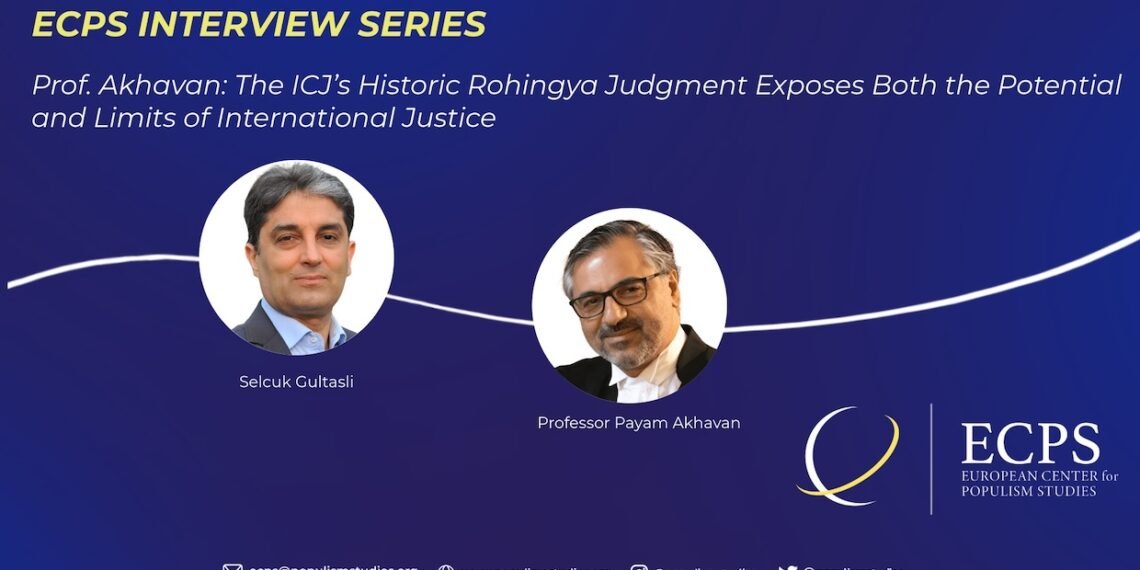
In an interview with the ECPS, Professor Payam Akhavan, Professor of International Law at the University of Toronto and Special Advisor on Genocide to the ICC Prosecutor, examines the historic ICJ judgment holding Myanmar responsible for genocide against the Rohingya. While acknowledging its unprecedented significance, he warns that “the judgment will largely remain symbolic for the foreseeable future.” Professor Akhavan explores the legal complexities of genocidal intent, the destructive convergence of ethnic populism and military authoritarianism, and the geopolitical obstacles undermining international accountability. Emphasizing that “the answer to Myanmar lies in a political solution, not a legal judgment,” he advocates multiethnic democratic transformation, constitutional reform, and universal human rights, insisting that “Despair is not an option.”
Interview by Selcuk Gultasli*
The International Court of Justice’s (ICJ) November 19, 2026, judgment holding Myanmar responsible for genocide against the Rohingya marks a historic moment in international justice. Yet the divided ruling exposes profound legal and political challenges surrounding genocidal intent, state accountability, and enforcement. Decades of authoritarian rule, ethnoreligious exclusion, and institutionalized discrimination have left the Rohingya largely stateless and displaced, raising fundamental questions about justice beyond judicial recognition.
In an interview with the European Center for Populism Studies (ECPS), Professor Payam Akhavan, Professor of International Law, Senior Fellow, and inaugural Chair in Human Rights at Massey College, University of Toronto, offers a critical assessment of this landmark judgment. An Associate Member of the Institut de droit international and Special Advisor on Genocide to the ICC Prosecutor, Professor Akhavan previously served as counsel to The Gambia in the ICJ proceedings and to Bangladesh in proceedings before the International Criminal Court (ICC).
Professor Akhavan argues that the judgment represents an unprecedented achievement while illustrating the structural limitations of international justice. Although the Court’s decision establishes historic state accountability, he cautions that “the judgment will largely remain symbolic for the foreseeable future.” Drawing on his experiences in Bangladesh’s Kutupalong refugee camp, he emphasizes the profound distance between judicial recognition in The Hague and the continuing suffering of displaced Rohingya communities. Their prospects for safe and dignified return, he warns, remain remote.
The interview also examines the jurisprudential controversy surrounding genocidal intent. Professor Akhavan maintains that “even very terrible atrocities are not necessarily genocide,” emphasizing the distinction between genocide, crimes against humanity, and ethnic cleansing. His analysis highlights the tension between strict legal interpretation and victims’ demands for accountability, alongside the possibility of establishing localized genocide.
Beyond jurisprudence, Professor Akhavan situates the Rohingya tragedy within a broader historical trajectory of discriminatory nationalism, statelessness, and authoritarian violence. He warns that when ethnic populism and military authoritarianism coincide, “the consequences become particularly destructive.” Myanmar’s failed democratic liberalization further demonstrates how weak institutions and the political mobilization of imaginary enemies can facilitate mass atrocities.
Addressing geopolitical obstacles, including the UN Security Council veto powers and declining commitment to multilateralism, Professor Akhavan advocates sustained international pressure, sanctions, and complementary judicial proceedings. Nevertheless, he insists that “the answer to Myanmar lies in a political solution, not a legal judgment.” His prescription calls for multiethnic democratic transformation, a new constitution, and a government committed to the rule of law and equal human rights. Ultimately, his message combines institutional realism with moral determination: “Despair is not an option.”