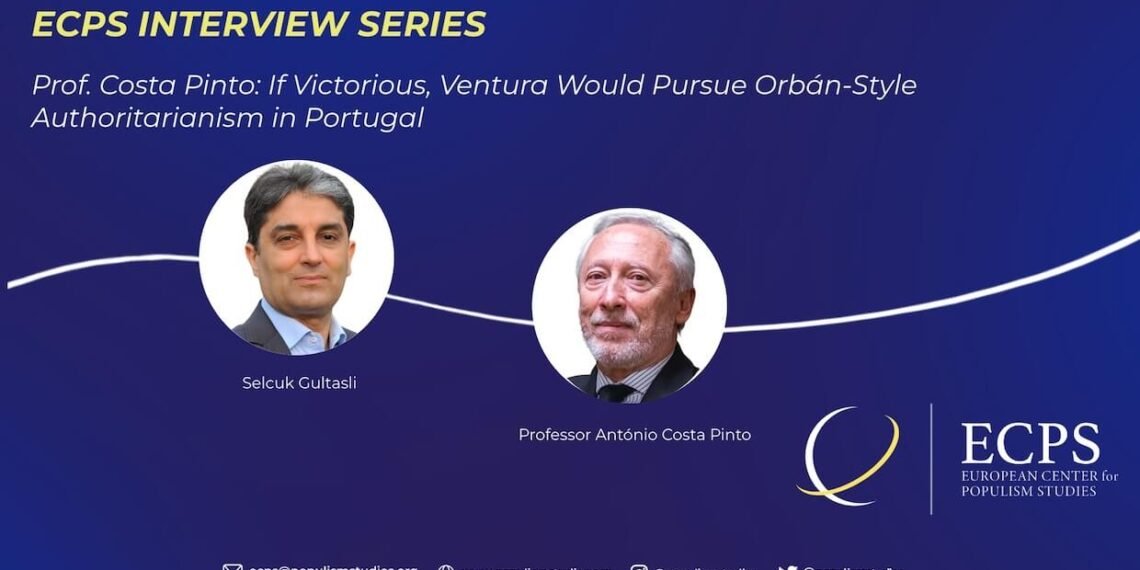
In this in-depth ECPS interview, Professor António Costa Pinto—one of Europe’s leading scholars of authoritarianism—offers a historically grounded analysis of Chega’s meteoric rise and André Ventura’s advance to the second round of Portugal’s 2026 presidential election. Far from an electoral accident, Professor Costa Pinto situates Chega’s breakthrough within long-standing structural conditions, recurrent political crises, and the fragmentation of the center-right. He traces how Ventura mobilizes authoritarian legacies of “law and order,” welfare chauvinism, and anti-elite resentment without openly rehabilitating Salazarism. Immigration, demographic change, and plebiscitary populism emerge as key drivers of Chega’s success. Crucially, Professor Costa Pinto argues that Orbán’s Hungary—not Trump or Bolsonaro—serves as Ventura’s primary model, raising urgent questions about democratic resilience in Portugal as uncertainty on the right deepens.
Interview by Selcuk Gultasli
In this in-depth interview with the European Center for Populism Studies (ECPS), Professor António Costa Pinto—Research Professor (ret.) at the Institute of Social Sciences, University of Lisbon, and a leading authority on authoritarianism and the radical right—offers a historically grounded analysis of the unprecedented rise of Chega and its leader, André Ventura. The discussion is anchored in a critical political moment: Ventura’s advance to the second round of the 2026 presidential election, which Professor Costa Pinto describes as neither a mere accident nor a sudden rupture, but the product of deeper transformations within Portuguese democracy.
As Professor Costa Pinto explains, Chega’s breakthrough cannot be understood as an isolated electoral shock. “The Chega Party and André Ventura have, in a way, a short history in Portuguese democracy,” he notes, “but over the last four years, the party has gone from one MP and 1.5 percent to 23 percent.” This rapid ascent, he argues, reflects the convergence of long-standing structural conditions—most notably the persistence of conservative authoritarian values in Portuguese society—with a series of destabilizing political crises that created what he calls “populist junctures.”
A central theme of the interview is the fragmentation of the center-right, which Professor Costa Pinto identifies as a key enabling factor. Portugal now has “three parties representing the right in Parliament,” and Chega’s strategy is explicitly hegemonic: to replace the traditional center-right as the dominant force. Ventura, Professor Costa Pinto observes, has succeeded because “he was able to mobilize his electorate,” even as his capacity to expand it in a runoff remains uncertain.
The interview also situates Chega within Portugal’s authoritarian legacies without reducing it to a simple revival of Salazarism. While Chega does not openly rehabilitate the Estado Novo (the corporatist Portuguese state installed in 1933), Professor Costa Pinto notes that it selectively draws on the past, particularly through “law and order” and moral authority. “Salazar is presented as the example of a non-corrupt dictator,” Professor Costa Pinto explains, adding that Chega appropriates “the idea of a conservative regime in which law and order prevailed,”while avoiding deeper identification with an unpopular dictatorship.
Immigration emerges as the party’s most powerful mobilizing issue. According to Professor Costa Pinto, “the central card that Chega has been playing over the last four years—and one that is closely associated with its electoral success—is immigration.” He links this to recent demographic shifts, especially increased migration from South Asia, and to growing anxieties among working-class voters. These dynamics underpin Chega’s welfare chauvinism, which combines statist social policies with exclusionary nationalism.
Crucially, Professor Costa Pinto frames Ventura within a transnational authoritarian constellation. “In a way, Orbán is the model for Ventura,” he states plainly. “The type of regime that Ventura would seek to consolidate in Portugal… is precisely the kind of competitive authoritarian regime that Orbán has managed to establish in Hungary.” While Trumpist styles and Bolsonaro’s experience in Brazil matter symbolically, Professor Costa Pinto stresses that Ventura adapts these influences pragmatically to Portuguese political culture.
Ultimately, the interview raises pressing questions about democratic resilience. While Professor Costa Pinto believes that Ventura is unlikely to win the presidency, he cautions that “the game is not over” on the right. Portugal, he concludes, faces a period of sustained uncertainty—one in which democratic institutions remain intact, but increasingly contested.