
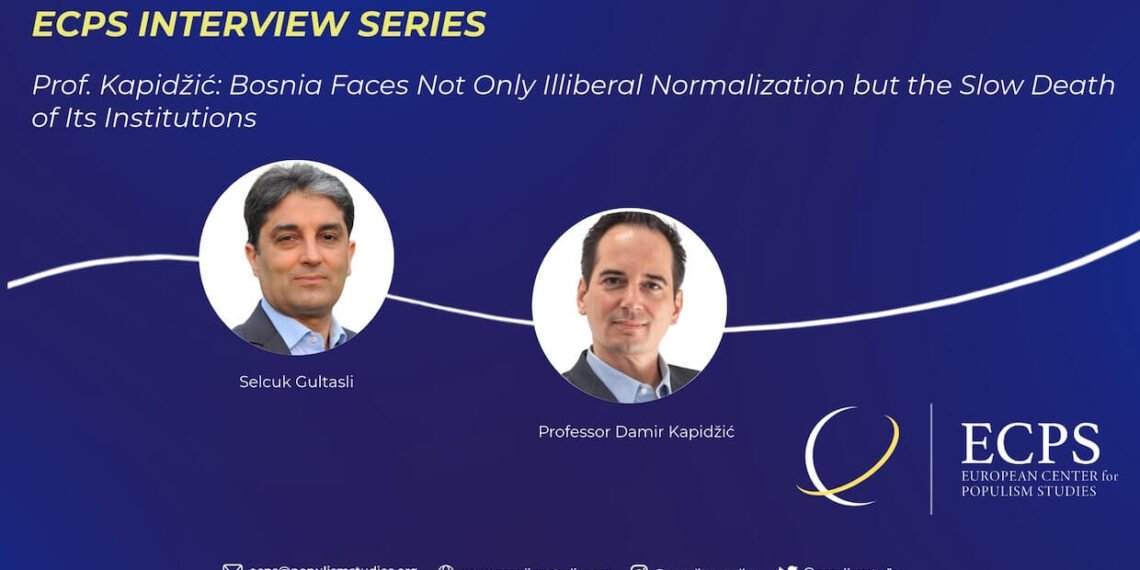
In an interview with the ECPS, Professor Damir Kapidžić examines Bosnia and Herzegovina’s October 4 elections through the intertwined lenses of ethnonationalism, democratic erosion, patronage, institutional paralysis, and foreign influence. He argues that the country’s principal democratic danger lies less in dramatic constitutional breakdown than in the “slow death” of institutions gradually weakened by illiberal practices, elite capture, and political incentives that reward dysfunction. Professor Kapidžić also highlights the durability of ethno-national patronage, the limits of civic alternatives, and the persistence of war memory and religious identity in structuring political competition. Looking beyond the elections, he cautions that Bosnia remains “stuck in the past,” with democratic renewal unlikely without changes in both domestic incentives and the wider external environment.
Interview by Selcuk Gultasli
Bosnia and Herzegovina approaches its October 4 elections at a moment when the country’s post-Dayton political order is once again under pressure over statehood, entity autonomy, ethnic representation, and democratic legitimacy. The campaign is shaped less by a conventional left-right divide than by competing visions of citizenship, constituent peoples, sovereignty, and the future of the Bosnian state. Against this background of ethnonationalism, populism, democratic erosion, and geopolitical influence, the elections offer an important vantage point from which to assess not only who will govern, but also the deeper institutional structures that continue to constrain Bosnia and Herzegovina’s democratic development.
In this wide-ranging interview with the European Center for Populism Studies (ECPS), Professor Damir Kapidžić, Professor of Comparative Politics at the Faculty of Political Science and Director of the Institute for Social Science Research at the University of Sarajevo, argues that Bosnia’s most consequential democratic danger may not take the form of spectacular constitutional collapse. Rather, it lies in the gradual erosion and paralysis of institutions. “We do see the possibility of what I would not call a dramatic constitutional breakdown, but rather a slow death,” he warns, explaining that institutions can simply cease to function when government formation, regulatory bodies, or judicial appointments are left indefinitely unresolved. In his assessment, “the gradual normalization of illiberal practices is likely to continue,”while “a more likely scenario… would simply be a slow demise.”
Professor Kapidžić situates this institutional vulnerability within the contradictions of the Dayton system. While power-sharing has helped prevent renewed large-scale intercommunal violence, he argues that political elites have also “been able to capture the system for their own purposes.” The resulting elite consensus, he observes, has often centered not on effective governance but on “keeping the rule of law weak, not resolving wartime legacies, and capturing state institutions.”
These dynamics are reinforced by deeply embedded patronage networks. Coalition negotiations, Professor Kapidžić notes, are rarely programmatic; instead, they revolve around “the division of power and resources rather than the creation of policies.” Ethnonational parties therefore operate not only as guardians of identity but also as gatekeepers of material opportunity, presenting themselves as protectors of their communities’ access to “resources and employment.”
Looking beyond October 4, Professor Kapidžić remains cautious about the prospect of democratic renewal. Bosnia, he argues, is “very stable, but also stable in a negative sense,” with progress occurring “either very slowly or not at all.” The deeper problem is a political order “stuck in the past”—not simply the wartime past, but “the past 30 years of very little changing.” Without altered domestic incentives and a transformed external environment, Bosnia risks remaining trapped in what he describes as a recurrent political loop, “without clear signposts, clear guidelines about the possibilities, or a clear path forward.”