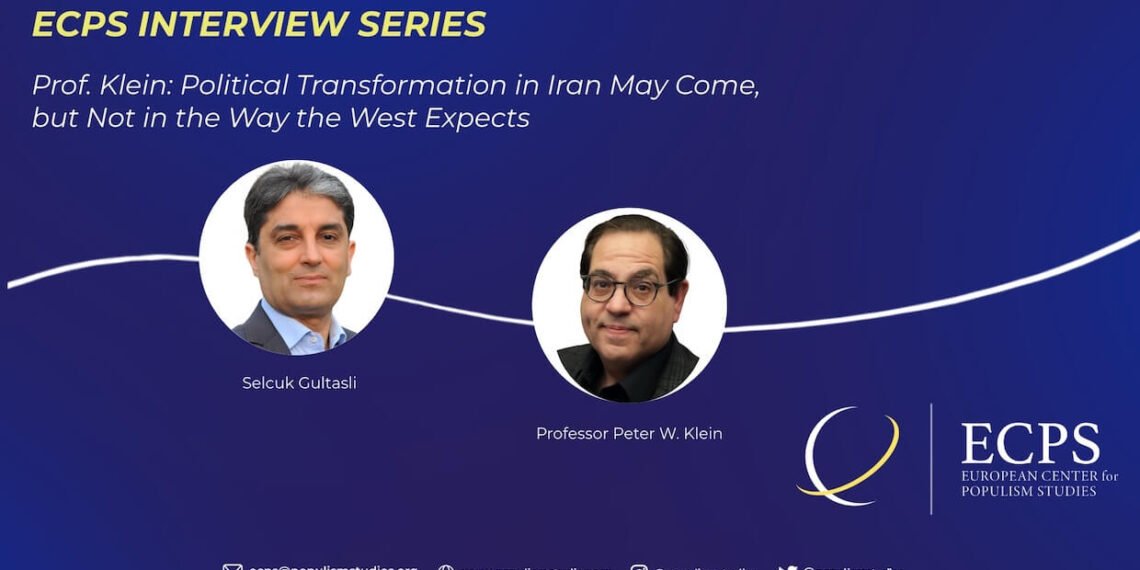
Professor Peter W. Klein offers a historically grounded warning against simplistic regime-change narratives in Iran. In this ECPS interview, the Emmy Award–winning investigative journalist and University of British Columbia professor argues that political transformation in Iran may occur, but not in ways the West expects. Drawing on cases such as Hungary in 1956, the Bay of Pigs, Iraq, and Afghanistan, Professor Klein shows how external encouragement of uprising without sustained commitment can produce abandonment, repression, and long-term instability. He stresses that Iran’s history with the United States, the entrenched role of the IRGC, and the country’s internal complexity make any externally driven transition deeply uncertain. At the same time, he warns that escalation could trigger wider regional blowback, making caution, historical memory, and strategic realism indispensable.
Interview by Selcuk Gultasli
Giving an interview to the European Center for Populism Studies (ECPS), Professor Peter W. Klein, an Emmy Award–winning investigative journalist, documentary filmmaker, and full professor at the School of Journalism, Writing, and Media at the University of British Columbia, offers a historically grounded and sobering assessment of regime change narratives surrounding Iran. Drawing on decades of reporting from conflict zones and his scholarship on media, power, and political transformation, Professor Klein cautions against simplistic assumptions that authoritarian systems collapse once a single leader is removed. As he puts it bluntly, the notion that eliminating one figure will transform an entire political order is deeply misguided: “Removing one leader—whether it is Khamenei or Maduro—is enough… [that] everything else will somehow fall into place. But Venezuela is not Iran.”
Professor Klein situates the current debate about Iran within a longer historical pattern in US foreign policy: Rhetorical encouragement of uprisings without sustained commitment. Reflecting on historical precedents—from the 1956 Hungarian Revolution to the Bay of Pigs invasion and the 1991 Shiite uprising in Iraq—he identifies a recurring cycle in which external actors implicitly encourage rebellion but fail to provide protection once uprisings occur. Recalling the Hungarian case, he notes that revolutionary hopes were fueled by signals from the West, yet “when the revolution happened… there was no cover.” The consequences were devastating: The uprising was crushed, and reformist leader Imre Nagy was ultimately executed. These experiences, Professor Klein argues, highlight the moral and strategic dilemmas that arise when “the words don’t match the actions.”
This historical lens also informs Professor Klein’s skepticism toward contemporary discussions of regime change in Iran. While acknowledging that dissatisfaction with the Iranian regime is real, he emphasizes the structural and historical constraints shaping political change. Iranian public attitudes toward foreign intervention remain deeply influenced by historical memory—especially the 1953 CIA-backed coup, which continues to generate suspicion toward US rhetoric about liberation and democracy. Even where domestic frustration exists, external calls for uprising may produce the opposite effect. As Professor Klein explains, “many Iranians may resist calls for regime change if those calls come directly from the United States.”
Beyond historical memory, Professor Klein underscores the institutional resilience of the Iranian state, particularly the central role of the Islamic Revolutionary Guard Corps (IRGC). Far from being an isolated security apparatus, the IRGC is deeply embedded in Iran’s political economy and social fabric. Its integration across military, economic, and political spheres makes the idea of a rapid grassroots overthrow highly improbable. In such contexts, he warns, expectations of swift democratic transition often ignore the realities of authoritarian resilience.
Professor Klein also highlights the dangers of escalation in the broader Middle East. With conflicts already unfolding across Gaza, Lebanon, and other regional arenas, miscalculation could transform localized confrontation into a wider regional war. The stakes, he warns, are immense: “The blowback from a regional conflict would be enormous… the cost of that may simply be too high.”
Ultimately, Professor Klein cautions against confident predictions about Iran’s political future. Transformation may indeed occur, but its direction remains uncertain and may not align with Western expectations. “There may be change,” he concludes, “but it may not be the kind of change that many people in the West would want.”