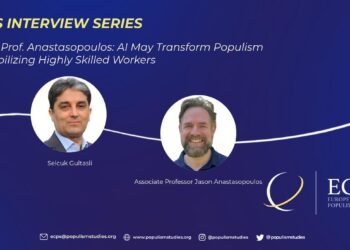

Professor Jeffrey Kopstein argues that Trumpism is best analyzed not primarily as populism, but as patrimonial rule—where “the state itself becomes an extension of the ruler’s household” and governance turns into “a family business.” In this ECPS interview, Professor Kopstein distinguishes patrimonialism from classic competitive authoritarianism: rather than merely “tilting the playing field,” patrimonial leaders seek to “own the entire field.” He traces how loyalty tests, selective legality, and the “monetization of office” reshape elite incentives and accelerate institutional hollowing. Drawing on Weberian theory, Professor Kopstein warns that irreversibility arrives when career survival depends on pleasing a patron rather than serving an office—and when the line between public and private interests starts to seem “quaint.” The interview also examines selective impunity, conditional judicial autonomy, personalized coercion, and why democratic resistance must target structural vulnerabilities rather than “waiting for collapse.”
Interview by Selcuk Gultasli
Giving an interview to the European Center for Populism Studies (ECPS), Jeffrey Kopstein, Professor of Political Science at the University of California, Irvine, offers a conceptually rigorous reinterpretation of Trumpism that moves beyond the familiar vocabulary of populism and competitive authoritarianism. Anchored in Weberian state theory and comparative authoritarianism, Professor Kopstein argues that the most analytically precise framework for understanding the contemporary transformation of American governance is patrimonialism—a form of rule in which the state is treated as the personal domain of the leader. As he memorably puts it, under patrimonial logic “the state itself becomes an extension of the ruler’s household,” collapsing the boundary between public authority and private interest and turning governance into what he repeatedly calls “a family business.”
Professor Kopstein’s intervention challenges dominant scholarly narratives that focus primarily on rhetoric, electoral manipulation, or ideological polarization. While competitive authoritarianism “rigs the game,” he contends, patrimonialism seeks something more radical: ownership of the system itself. In his words, the logic is “not simply to tilt the playing field, but to own the entire field.” This shift, he suggests, captures a deeper transformation from constitutional republicanism toward personalized rule structured by loyalty, selective legality, and the monetization of office. Trumpism, he argues, is best understood through this lens because its defining features—“loyalty tests, public humiliation of subordinates, monetization of office, and the personalization of coercive authority”—are not incidental pathologies but the governing principle of the system.
A central theme of the interview is institutional hollowing. Drawing on Max Weber’s theory of modern bureaucracy, Professor Kopstein explains how privileging personal loyalty over professional expertise erodes state capacity from within. When career advancement depends on pleasing the patron rather than serving impersonal offices, information deteriorates, policy becomes erratic, and public goods provision declines. The critical threshold, he warns, is reached when citizens and elites alike lose the ability to distinguish between public and private interests—when that distinction begins to seem “quaint.” At that point, patrimonial consolidation is effectively complete.
Equally significant is Professor Kopstein’s analysis of elite incentives. When public office becomes a revenue stream, neutrality becomes costly and adaptation becomes rational. Economic success increasingly depends not on market entrepreneurship but on proximity to power, reversing the conventional liberal assumption that wealth generates political influence. In patrimonial systems, he notes, the causal arrow often runs in the opposite direction: political power produces wealth. This dynamic helps explain why scandals, legal controversies, or reputational crises frequently fail to weaken such regimes. Surviving scandal without consequences signals immunity and reinforces an aura of invincibility among supporters.
By reframing Trumpism as a patrimonial project rather than merely a populist movement, Professor Kopstein invites scholars to redirect analytical attention from mass ideology to elite control over institutions, resources, and coercive capacity. The interview thus situates contemporary American politics within a broader comparative perspective on personalist rule, offering a sobering account of how democratic systems can be gradually transformed without the overt dismantling of formal institutions.
Here is the edited version of our interview with Professor Jeffrey Kopstein, revised slightly to improve clarity and flow.
Not Tilting the Field but Owning It: Trumpism as Patrimonial Rule

Professor Jeffrey Kopstein, thank you so much for joining our interview series. Let me start right away with the first question: In your Persuasion article, you argue that Trumpism represents a shift from constitutional republicanism toward patrimonial rule. Conceptually, how does this transformation differ from classic competitive authoritarianism, and why does patrimonialism better capture the logic of power under Trump?
Professor Jeffrey Kopstein: First of all, thanks so much for having me. Competitive authoritarianism—I’m not a specialist on exactly that concept, but I’ve read it, and I know Lucan Way very well—refers to regimes that manipulate electoral competition while preserving institutional arenas as sites of contestation. Elections still matter, courts still operate, and opposition exists, albeit under constraints.
By contrast, patrimonialism treats the state itself as an extension of the ruler’s household. It becomes a family business. Offices turn into instruments of personal loyalty, law is applied selectively, and the boundaries—most importantly—between public power and private benefit collapse. The logic here is not simply, to use their language, to tilt the playing field, but to own the entire field. In this view, the state is a family business.
Stephen Hanson and I argue that Trumpism is better understood in patrimonial terms because its defining features are loyalty tests, public humiliation of subordinates, monetization of office, and the personalization of coercive authority. These are not incidental excesses; they are the governing principle. If I could leave you with a sound bite, competitive authoritarianism rigs the game, whereas patrimonialism claims ownership of the stadium.
When Pleasing the Patron Overrides Serving the Office
Drawing on Weberian theory and your work on modern statehood, how does the systematic privileging of personal loyalty over bureaucratic expertise in the US reshape state capacity—and at what point does institutional hollowing become politically irreversible?
Professor Jeffrey Kopstein: Let’s go back to Weber. It’s always the right thing to do. Weber argued that modern statehood depends on impersonal offices and expertise. When loyalty replaces competence, three things happen: information degrades, exits increase, and compliance becomes politicized. Policies become erratic, feedback loops collapse, and public goods deteriorate.
Irreversibility sets in not in a single legal moment, but when expectations shift—when career incentives depend on pleasing the patron rather than serving the office. At that point, even restoration-minded elites begin to hesitate to act.
So, there is no single point of no return, but it arrives when survival in government depends on loyalty rather than competence. We are not in a perfect patrimonial world yet in the United States. The way I would put it is this: our notion of the state depends on a clear separation between the public interest and the private interest. When we are no longer able to understand that difference, when it seems quaint, then we will know that the patrimonial regime has fully consolidated.
From Market Entrepreneurship to Proximity to Power

You describe the Trump presidency as collapsing the boundary between public authority and private enrichment. How does this blurring alter elite incentives, especially among business, judicial, and security elites who must decide whether to resist, adapt, or profit?
Professor Jeffrey Kopstein: It’s a really important question. Clearly, Trump has been very busy turning the state into a family business, and as we say in the article, business is booming. When public office becomes monetizable, elites shift incentives toward adaptation and profit rather than resistance. And we see that already. We see that with chip makers; rather than economic entrepreneurship, it’s proximity to power that determines whether you are a rich elite. We just saw that this last week with Anthropic and AI.
If you’re out of favor with the government, they can, sort of, crush you. Even in that dust-up between Elon Musk and Trump, it’s super interesting. Here you have the richest man in the world versus the most powerful man in the world, and in that fight, my judgment is Trump crushed him like a bug. It was not close. We’re used to thinking in the United States—and basic political science says—that if you’re rich, that gives you power, that economics determines political power. But in many parts of the world, and at many times in history, it’s actually the reverse: great power yields great wealth. And I think we’re starting to see that in the United States. So, the bottom line is that when office becomes a revenue stream, neutrality becomes a liability.
In Patrimonial Systems, Scandals Create an Aura of Invincibility
How should scholars interpret the political effects of the Epstein files and Trump’s alleged proximity to that scandal—not in moral terms, but as a demonstration of selective impunity within a patrimonial system? Under what conditions do scandals cease to delegitimize power and instead reinforce it?
Professor Jeffrey Kopstein: In patrimonial systems, surviving scandal often reinforces power. Scandals cease to delegitimize authority when media ecosystems are polarized, selective enforcement is normalized, and elites expect law to be wielded strategically rather than neutrally.
So, under these conditions, I think proximity to scandal that produces no consequences signals immunity—that they can’t be punished. And everybody understands this. So, people stop thinking in terms of enforcing the law, or in terms of, is Trump competent? Is he crazy? Is he a pervert? I mean, all of those things become sort of uninteresting. It’s not that people won’t continue to try; it’s that each one of those he survives within a patrimonial regime doesn’t weaken him—it actually strengthens him, because it creates this aura of invincibility.
So, the bottom line is that, in a rule-of-law system, the kinds of things that would have disqualified Trump long ago—in a patrimonial system—succeed, at least for his most ardent followers, in creating, to put it in Weberian terms, for the leader and his staff, a kind of image of strength.
Patrimonial Stability Rests on Ambition, Fear, and Beneficiaries
Comparatively speaking, how does Trump’s apparent insulation from reputational or legal consequences resemble patterns observed in other patrimonial regimes, such as Russia, Turkey, or Hungary? Is this best understood as elite coordination failure or as successful authoritarian learning?
Professor Jeffrey Kopstein: Does it have to be either? It could be both. Insulation from consequences reflects both coordination failure and successful authoritarian learning. The fragmentation of opposition enables consolidation, and we see that with the Democratic Party in the United States right now. It’s somewhat of a mess, although they are trying to find their footing.
In Hungary, we’re going to see what happens. Orban has succeeded, in a sense, in playing the opposition like a fiddle. He appears to be threatened right now, and we will see whether he moves toward a full authoritarian route, as opposed to the competitive authoritarian route, though he may. The same dynamic applies to Turkey as well—though you would know much better than I do. My understanding is that it is also in a similar situation. Over time, rulers manage elites through selective reward and punishment, especially through court-politics dynamics. People at the top, if they begin opposing, either leave—or, if the regime is fully consolidated, as in Russia, they may face physical liquidation.
Now, in most patrimonial regimes, it is not like Russia. You can have patrimonialism in both a democracy and a dictatorship; the line runs orthogonal to the distinction between the two. It is not coterminous with it. Patrimonial stability does not require universal support. It relies on individualized ambition and fear. There are large numbers of distributional beneficiaries of Erdogan, of Orban, of Netanyahu in Israel, and now increasingly of Trump in the United States. So, yes.
Courts Persist Under Patrimonialism but Align in Political Cases

You note that courts rarely disappear under patrimonialism but instead become conditionally autonomous. How does the high rate of judicial alignment with Trump administration interests reshape expectations about the judiciary as a democratic backstop?
Professor Jeffrey Kopstein: I think you raise a really important point. Even in a patrimonial regime, even in an authoritarian regime, for the most part courts continue to exist. They handle normal matters—inheritance, ordinary criminal behavior, standard criminal law—but here we are really talking about political cases, cases that deal especially with the power of the executive.
Under those circumstances, the courts begin to align with the patron. You see that somewhat in the United States. There are already things that people on the Court want. Those who, for example, are interested in libertarian ideas hope Trump will deliver them, although Trump is not a pure libertarian. Those interested in Christian nationalism in the United States hope he will give them what they want as well. Those interested in enhanced executive authority—there are some on the Court in that camp too—are also aligned with the Federalist Society and want that outcome. They, of course, expect Trump to deliver it.
That said, there are certain issues on which the Court will resist. We saw that in the case of tariffs, where the Court ruled against Trump. They may still allow him to pursue similar goals by other means. Over time, the Court figures out how far it can contradict the great father figure—which is what patrimonialism actually implies—and where it cannot.
Personalized Coercion Replaces Impersonal Enforcement
From a patrimonial perspective, how does the use of agencies such as ICE—operating with diminished oversight and heightened personal loyalty—alter the relationship between citizens and the state? Does this represent bureaucratic drift or deliberate personalization of coercion?
Professor Jeffrey Kopstein: It could be both, but patrimonialism really highlights the personalization of coercion. If you look at the US budget right now, Trump has, on purpose, cut a huge number of regular bureaucratic jobs, which appears to align exactly with what one would expect Republicans to do. However, the budget has not gone down.
They have actually created this huge new bureaucracy that is personally dependent on Trump, and that’s ICE. And it’s becoming not just a personal empire; it’s becoming something like a real estate empire. They’re acquiring a lot of territory, which, of course, Trump likes—real estate. So this personalization of coercive agencies is deliberate. It takes away not only from legal oversight, but also removes or disempowers people who are not personally dependent on Trump.
Thus, the legal forms remain while the zones of exceptional enforcement expand. When oversight weakens and loyalty is rewarded, enforcement becomes personalized. It becomes somewhat theatrical. The objective is not efficient enforcement, but loyal enforcement. Those two things can overlap, but they can also be very different.
Episodic Force and Symbolic Threat as Tools of Control

Unlike 20th-century dictatorships, Trumpism relies less on mass repression and more on episodic coercion and symbolic threat. How much actual violence is necessary for patrimonial consolidation in a mature media democracy?
Professor Jeffrey Kopstein: I’ve written pretty extensively on this. Consolidation does not require mass repression. There has been a lot of discussion of fascism and totalitarianism and all that kind of stuff, Hanson and I worry about it a great deal. But what is probably also true is that selective, visible coercion effectively reshapes expectations. A few exemplary punishments communicate risk pretty broadly. It’s not to say that there won’t continue to be resistance to ICE. We saw that in Minnesota; we’ve seen it in other places. I’m here in California, where we have a pretty active resistance, and our state government—California has 40 million people; it’s a country—has continued to resist. But ICE is still around; it’s in my neighborhood. It doesn’t need to terrorize everyone; it only needs to make everyone calculate as if it could. And that’s the case. It changes expectations.
Succession Anxiety Is the Structural Weakness of Personalist Rule
You argue that succession is the Achilles’ heel of patrimonial regimes. How does Trump’s discourse around a third term function strategically to freeze elite expectations and delay post-Trump realignments?
Professor Jeffrey Kopstein: It’s absolutely crucial. As you said, succession is the Achilles’ heel of a patrimonial regime. Under most circumstances, patrimonialism is the oldest form of government in the world. Under most circumstances, patrimonialism is related to kingship or queenship. It passes on through the royal family. Of course, remaking the state as a family business in the modern world—we don’t have kings or queens anymore—so you would think it would pass through his family. It doesn’t seem all that likely in Trump’s case that the sons are going to be the successors. Interestingly, the daughter Ivanka is probably the most cognitively fit to be the successor. But patrimonial women don’t do very well either.
But the key here is that personalist regimes destabilize when elites anticipate an endpoint. So, signaling negotiable terms that that endpoint may not come freezes expectations and discourages hedging. As the end comes closer, the staff start scrambling like rats on the deck of a sinking ship. And the whole point of this third-term discussion—which he may very well want, and I don’t think he could easily get, but he will try, and it is to be taken extremely seriously as a pressure point against the consolidation of a patrimonial regime—is that it is extremely important that it be opposed, because it’s all about maintaining the leader and his staff. And if the staff see that endpoint, the regime itself becomes destabilized. So, yes, succession anxiety is the Achilles’ heel of a patrimonial regime. All experience shows that.
Populism Explains Mobilization, Patrimonialism Explains Governance
To what extent does labeling Trumpism as “populist” obscure its deeper patrimonial logic? What analytical errors follow if scholars focus too heavily on mass ideology rather than elite control of resources and institutions?
Professor Jeffrey Kopstein: I think it’s really important. On the one hand, populism—most of political science, most scholars, most social science are very interested in this, and populism is part of it—focuses on how people come to power, the rhetoric, the appeal, and how they stay in power. What patrimonialism looks at is something different: it examines what they do when they come to power, how they actually govern. Governance is extremely important, and populism, we think, obscures patrimonial control. It highlights rhetoric.
Patrimonialism highlights elite control over appointments, enforcement, resources—things that populism doesn’t talk about at all. The two aren’t completely contradictory, but they address really different dimensions. So, populism, or dictatorship versus democracy, is part of a discourse concerned with how leaders come to power and stay in power. Patrimonialism is interested in what they do to the state once they come to power. And that’s just something very different.
Foreign Policy as Regime Maintenance by Other Means

How does Trump’s coercive, transactional foreign policy—toward NATO allies, territorial revisionism (as in Greenland), and extraterritorial enforcement—serve domestic patrimonial consolidation rather than traditional strategic goals?
Professor Jeffrey Kopstein: As we’re talking about this, of course, the world’s foreign policies are in great flux and turmoil with what’s going on in the Middle East. One of the things about patrimonialism is that patrimonial leaders, because they have a very traditionalist view, no longer see borders as legal; they view them as historical and traditional—fuzzy, if you will—and that really works at odds with the modern world.
Even more important than that, they view their relations with other countries, as you said, as transactional. Transactional diplomacy dramatizes sovereignty and creates distributable rents for loyalists. So, who’s going to control Greenland? Will it be Donald Trump Jr. creating mines for strategic minerals that university professors will be forced to work in like a gulag? I don’t think so, but that’s the idea.
So, foreign policy becomes a sort of regime maintenance by other means. It’s an extension. Traditional international relations tends to ignore the makeup, the regime type, of domestic politics, but we think that foreign policy—and Trump’s foreign policy in particular—is especially driven by this domestic makeup, by domestic politics.
Patrimonial Stability Depends on Cohesion Between Leader and Staff
From a comparative international perspective, how likely is it that sustained allied resistance and strategic balancing against the United States could feed back into domestic regime instability—or do patrimonial rulers generally externalize such costs successfully?
Professor Jeffrey Kopstein: They can. It’s an excellent question, and we don’t have a great answer to that, to be honest. But, on the one hand, foreign wars—and we’re in one right now—can produce a sort of rally-around-the-flag phenomenon, although in the United States right now my understanding is that the war, the bombing of Iran, is not very popular.
But here’s the point: external resistance destabilizes only if it fractures key domestic elites. That’s the point. Again, Weber and patrimonialism tells us, that you need to look at the relationship between the leader and his staff.
And so it only works—it only destabilizes—if it fractures the elites underneath the leader. And why? Because balancing imposes costs. Destabilization occurs when those costs split the coalition. So, that’s how I would answer that, although our emphasis is really not on foreign policy. But it’s an important question.
When the State Becomes a Family Business, Public Goods Deteriorate
You emphasize that patrimonial regimes are structurally bad at providing public goods. What kinds of policy failures—climate disasters, pandemics, financial crises—are most likely to puncture the aura of inevitability surrounding Trumpism?
Professor Jeffrey Kopstein: What you would expect from a patrimonial regime, as you said quite correctly, is that as a bureaucracy based on merit recruitment is degraded and becomes a plaything of the family business, you would see a systematic under-provision of public goods, or only those public goods that serve the interests of the extended household of the leader being provided. So, you’d expect two things to happen. One—and the one you pointed to—is that when we need the state to respond to disasters, and we saw this with COVID, but you can also see it with financial crises and other kinds of public health breakdowns, there is an institutional halt. When we need the state, what the state represents under those circumstances is a hedge against disaster. And so we need the state, and we may not have it.
I’m living here in California. We get earthquakes. If we need the state after a really bad earthquake, if it has been degraded enough, we won’t have it. But there’s a second type of deterioration that is slower moving, and that is the under-provision of public goods for things like roads, bridges, and airports. Over time, what you should see is public infrastructure decaying, and we already have that in the United States, and it’s going to get worse. I live next to the second-largest city in the United States, Los Angeles, and the airport here is like a third-world airport. It’s not really being built up or maintained. That’s called LAX (Los Angeles International Airport). You should expect to see much of the public infrastructure in the United States start to look more and more like LAX.
Effective Opposition Raises the Costs of Loyalty and Lowers the Costs of Exit

And finally, Professor Kopstein, given your critique of “waiting for collapse,” what forms of democratic resistance are most effective against patrimonial rule? Specifically, how can opposition forces exploit structural weaknesses—succession anxiety, declining popularity, and governance failure—without reinforcing siege narratives?
Professor Jeffrey Kopstein: That’s the hardest question you’ve asked yet, but I want to reinforce the assumption we make, and as we wrote in this article, that we should not expect scandal, incompetence, the Supreme Court, nor foreign policy failures to save us. None of those things will probably work. Patrimonial leaders are pretty good at dealing with all of them. The weaknesses of patrimonialism, as we’ve been discussing, are much more structural, as you said quite explicitly. They’re slow-moving. They’re unspectacular. So, we’ve talked about splits, succession failures, institutional hollowing—things that are slow-moving and fly under the radar. That is why it is so difficult for us to deal with this type of regime, to understand it, and to expose it.
So, I think focusing on succession and undermining inevitability is key. That is why each congressional House race matters: if you can show that the Democrats won by more than expected, or that Trump did not win by as much as he expected in a particular district, that punctures the aura of inevitability. Most important is to connect governance failures to institutional hollowing. That is the key weak point here—to connect those two—and to avoid rhetoric that is easily reframed as elite disdain. The bottom line is: don’t wait for collapse. Raise the costs of loyalty, fracture the elite, and lower the costs of exit.