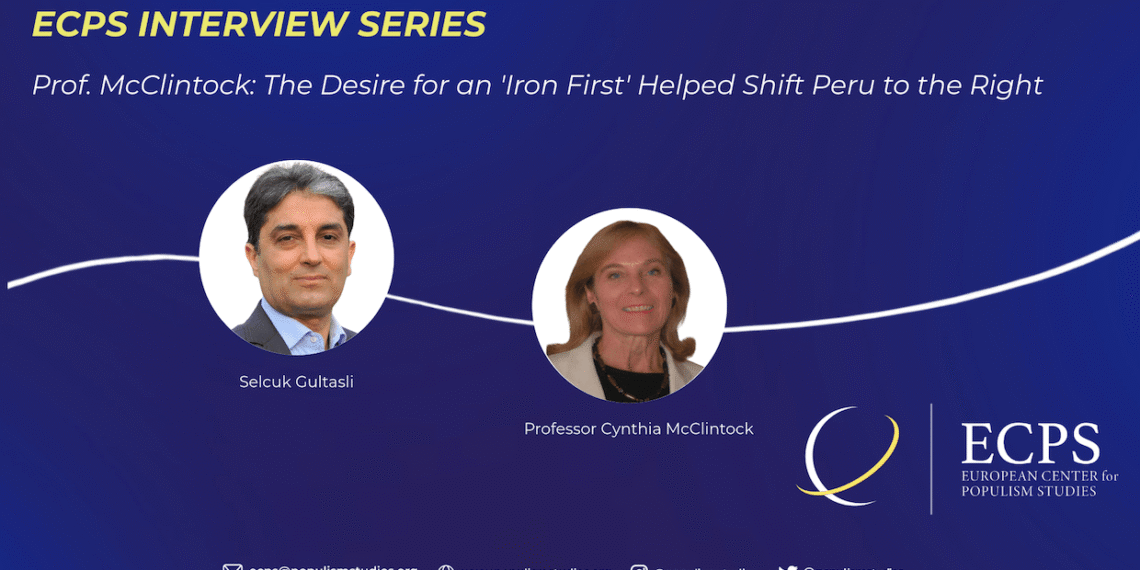
Peru’s razor-thin 2026 presidential election has reopened fundamental debates about democratic legitimacy, populism, institutional resilience, and political representation in Latin America. As Keiko Fujimori returns to power amid allegations of electoral fraud, rising insecurity, and deep public distrust, critical questions emerge about whether Peru is entering a period of democratic stabilization or renewed political crisis. In this timely interview, Professor Cynthia McClintock of George Washington University examines the structural forces reshaping Peruvian politics—from fragmented party competition and the enduring legacy of Fujimorismo to the regional rise of right-wing populism. She argues that “the desire for the iron fist” has helped shift Peru to the right while warning that the country remains democratically vulnerable despite important institutional and economic advances.
Interview by Selcuk Gultasli
Peru’s 2026 presidential election represents one of the most consequential democratic tests in contemporary Latin America. The razor-thin runoff between Keiko Fujimori and Roberto Sánchez unfolded against a backdrop of escalating organized crime, allegations of electoral fraud, institutional reform, and profound public distrust in political institutions. Although the election culminated in the return of Fujimorismo to the presidency, it also exposed the enduring fragility of Peru’s democratic order and highlighted broader regional debates over populism, representation, democratic legitimacy, and state capacity. Rather than resolving Peru’s long-running political crisis, the election underscored the persistent tensions between demands for democratic accountability and growing public desires for order and security.
In this timely interview, Professor Cynthia McClintock, Professor of Political Science and International Affairs at George Washington University and Director of GWU’s Latin American and Hemispheric Studies Program, offers a nuanced assessment of Peru’s political trajectory while placing recent developments within broader comparative debates on democratic resilience in Latin America. Drawing on decades of scholarship on Peruvian politics, electoral institutions, democratization, and runoff elections, Professor McClintock argues that the 2026 contest should not be understood simply as a story of ideological polarization. Instead, she contends that "most Peruvian voters were actually not at these extremes; rather, their vote fragmented," pointing to the unprecedented presence of thirty-five presidential candidates and the collapse of the democratic center before the runoff.
Throughout the interview, Professor McClintock examines why democratic legitimacy has become increasingly fragile despite Peru’s comparatively strong macroeconomic performance. She warns that declining trust in electoral institutions constitutes "a very worrisome pattern," while emphasizing that rising insecurity has fundamentally reshaped political competition. In her view, "there’s been a particularly tragic increase in extortion in Peru, which has led to this desire for the iron fist," helping explain both the electoral shift to the right and the growing appeal of right-wing populism across the region.
At the same time, Professor McClintock cautions against simplistic interpretations of Peru’s political evolution. She argues that institutional reforms—including bicameralism and runoff elections—remain valuable, insisting that "institutions matter," even though "there is no magic formula for high-quality democracy." Likewise, while recognizing the continuing appeal of Fujimorismo, she stresses that Peru’s persistent fragmentation has prevented any single populist actor from fully consolidating power, making Alberto Fujimori "an exception" rather than the rule.
Ultimately, Professor McClintock presents Peru as a democracy caught between meaningful progress and persistent vulnerability. Although she concludes that the country "is still vulnerable to these problems," she also reminds us that Peru has made remarkable democratic advances over recent decades. The conversation therefore offers not only an illuminating analysis of Peru’s turbulent political landscape but also broader insights into the evolving relationship between populism, democratic representation, institutional resilience, and political legitimacy across Latin America.