
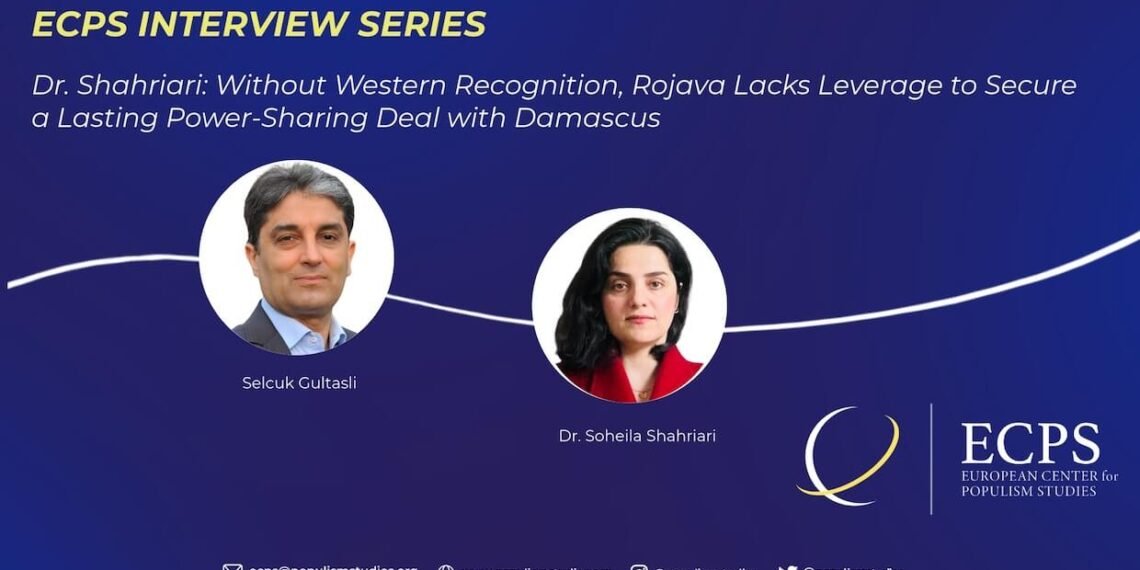
In this ECPS interview, Dr. Soheila Shahriari offers a theoretically grounded diagnosis of Rojava’s most precarious post-ISIS moment. She argues that the Autonomous Administration of North and East Syria should be understood not as a wartime improvisation, but as a long-evolving counter-hegemonic project rooted in democratic confederalism, gender equality, pluralism, and social ecology. Yet Dr. Shahriari underscores a stark geopolitical constraint: without formal recognition and enforceable guarantees from Western actors—especially the EU and the United States—Rojava lacks the diplomatic leverage to secure a durable decentralized settlement with Damascus. The interview explores how instrumental Western engagement, Turkey’s securitization paradigm, and Syria’s recentralization drive converge to endanger non-state democratic experiments. It also examines diaspora mobilization, the global resonance of Kurdish women’s politics, and the fragile future of local partnerships in conflict zones.
Interview by Selcuk Gultasli
Giving an interview to the European Center for Populism Studies (ECPS), Dr. Soheila Shahriari from École des Hautes Études en Sciences Sociales (EHESS) in France offers a wide-ranging and theoretically grounded assessment of the Autonomous Administration of North and East Syria (Rojava) at a moment of profound uncertainty. As shifting regional alignments, great-power bargaining, and Syrian state consolidation converge to narrow the space for Kurdish self-rule, Dr. Shahriari situates Rojava not merely as a wartime anomaly but as a counter-hegemonic democratic experiment struggling to survive in an international system dominated by state sovereignty, realpolitik, and authoritarian resurgence. The interview is organized around a central warning captured in the headline: Without formal recognition and protection from Western actors, Rojava lacks the diplomatic leverage necessary to secure a durable decentralized settlement with Damascus.
Dr. Shahriari argues that the current crisis stems less from military weakness than from structural diplomatic isolation. Despite their decisive role in defeating ISIS alongside the United States, Kurdish-led forces failed to convert battlefield legitimacy into institutional guarantees. The January ceasefire and negotiations over integration into Syrian state structures illustrate the narrowing options available to the Autonomous Administration under pressure from Damascus, Ankara, and shifting US priorities. In this context, Dr. Shahriari emphasizes that external recognition is not symbolic but constitutive of survival: without enforceable guarantees from actors such as the European Union and the United States, any decentralization arrangement risks becoming a temporary tactical compromise rather than a stable power-sharing order.
At the same time, the interview highlights the distinctive ideological and institutional character of the Rojava project. Dr. Shahriari describes it as an anti-statist political paradigm rooted in democratic confederalism, gender equality, pluralism, and ecological principles—an alternative model of governance emerging amid global democratic recession and Middle Eastern authoritarian consolidation. The conversation also explores how women-led institutions function as a “symbolic infrastructure” of resilience, how diaspora activism and transnational networks have reshaped Kurdish political imaginaries, and how the global visibility of Kurdish women fighters transformed international legitimacy. Yet these achievements, she notes, have not translated into formal diplomatic recognition, leaving the experiment vulnerable to geopolitical bargaining among states.
The interview also examines the structural limits of liberal internationalism and the instrumental nature of Western engagement with non-state democratic actors. Dr. Shahriari contends that Western powers’ prioritization of strategic alliances—particularly with Turkey—over normative commitments has undermined both Rojava’s prospects and the credibility of democratic rhetoric. Consequently, the future of Kurdish self-administration depends not only on negotiations with Damascus but on whether Western governments are willing to move from tactical cooperation to institutional protection.
Ultimately, Dr. Shahriari frames Rojava’s predicament as emblematic of a broader tension in contemporary world politics: the clash between innovative democratic experiments and an international order still organized around sovereign states and security competition. Whether Rojava becomes a model of negotiated decentralization or a casualty of regional power politics, she concludes, will depend on the availability of credible external guarantees—without which even the most resilient non-state democracy faces structural vulnerability.