In this long ECPS commentary, Professor Ibrahim Ozturk examines the 2026 US–Israeli strikes on Iran as part of a broader transformation in global power politics rather than an isolated regional conflict. He argues that the confrontation reflects a strategic intersection of energy security, regional military dynamics, and intensifying great-power rivalry, particularly between the United States and China. The crisis surrounding the Strait of Hormuz—through which a substantial share of global oil flows—demonstrates how military escalation, energy markets, and geopolitical competition are increasingly intertwined. Professor Ozturk suggests that contemporary conflicts are being managed through strategic compartmentalization: limited escalation, selective alliances, and narrative control. In this emerging landscape, regional actors and global powers alike seek to reshape influence within a fragmented and increasingly competitive international order.
By Ibrahim Ozturk
The Israeli-US attack on Iran, at this pivotal moment, is more than just another Middle Eastern conflict or a simple prelude to a new oil shock. It should be seen as part of a broader shift in global power, in which regional conflict, energy security, and great-power rivalry are managed together rather than separately. The aim in this deliberately segmented crisis caused by the last military stand-off with Iran is (i) to weaken Iran’s nuclear and missile capabilities to bolster Israel’s regional dominance focused on security; (ii) Washington’s effort to retain strategic control over global energy flows amid rising competition with China; and (iii) in doing so, to keep the conflict politically contained—avoiding the perception of a broader clash of civilizations in the Muslim world, thus preventing them from falling under China’s influence and minimizing the reasons for China’s growing influence in the Global South.
That stance closely aligns with a recent British parliamentary report, which suggests that energy, war, diplomacy, and narrative are no longer separate policy areas. Instead, they are being strategically managed together. The result is a new power dynamic—one that shifts away from crisis management within a liberal international order and toward a more fragmented system characterized by selective coalitions, limited violence, and varying legitimacy.
Beyond Energy and Iran’s Nuclear Capacity
Without any convincing legal justification, UN resolution, or data from American institutions indicating that Iran posed an imminent threat—and launched during ongoing negotiations—these attacks resulted in the “arbitrary” killing of thousands of civilians in Iran, the massacre of schoolchildren, the arbitrary sinking of an unarmed Iranian ship returning from military exercises in India and of a Sri Lankan ship, killing hundreds of soldiers, as well as severe damage to many UNESCO-protected historical monuments in Iran. In such a context, the first and most important task is to correctly situate these attacks by the US–Israel axis.
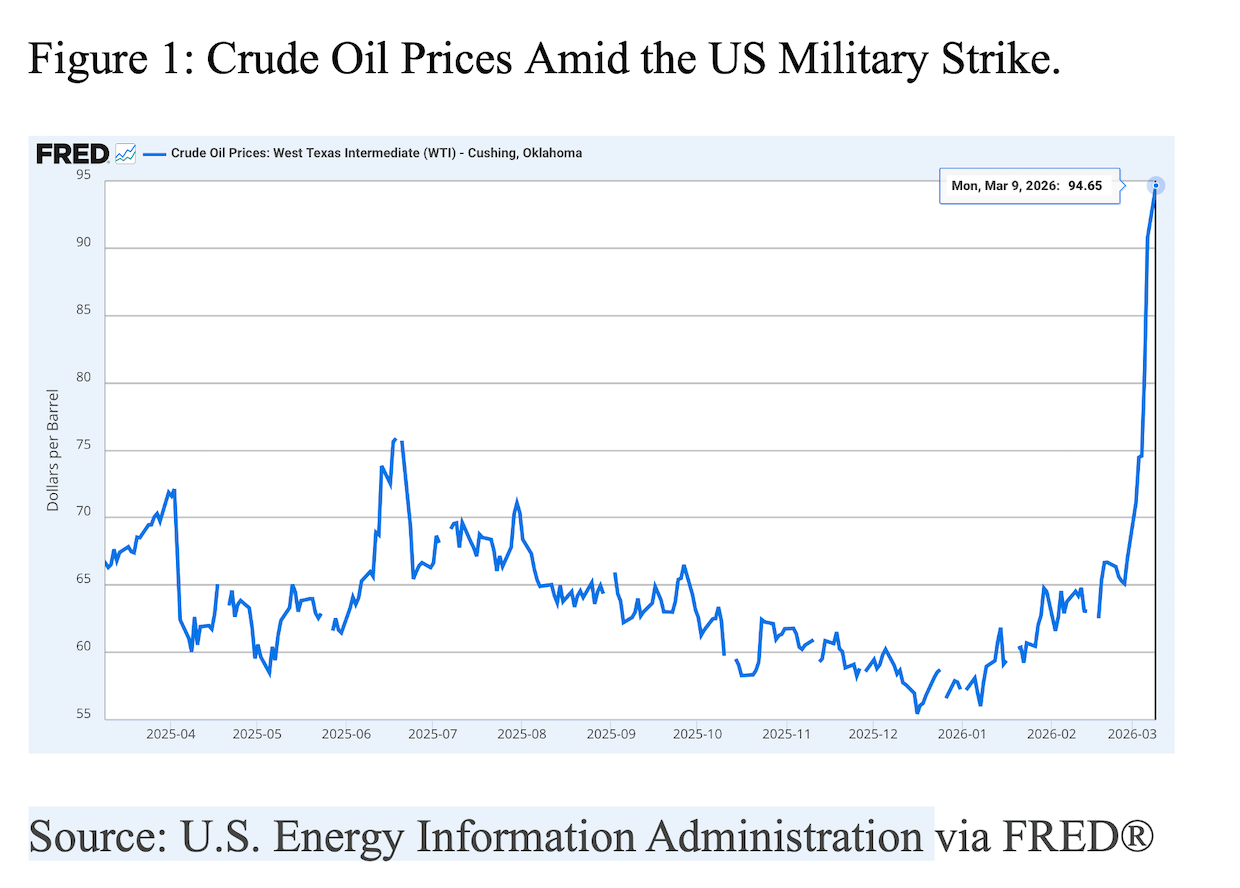
On February 28, 2026, Israel and the US carried out coordinated strikes on Iran, targeting leadership sites, military forces, and nuclear and ballistic missile infrastructure. The immediate market response was straightforward. After the attacks, global energy markets became extremely volatile, with Brent crude soaring to a peak of $119.50 on March 9, 2026, as the closure of the Strait of Hormuz threatened 20% of global supply. This ‘panic spike’ was followed by a sharp intraday reversal, with prices sliding back toward $90.00 after US officials indicated a quick end to the military operations, ultimately leaving the market stuck in a highly volatile trading range between $85.00 and $105.00 (Figure 1).
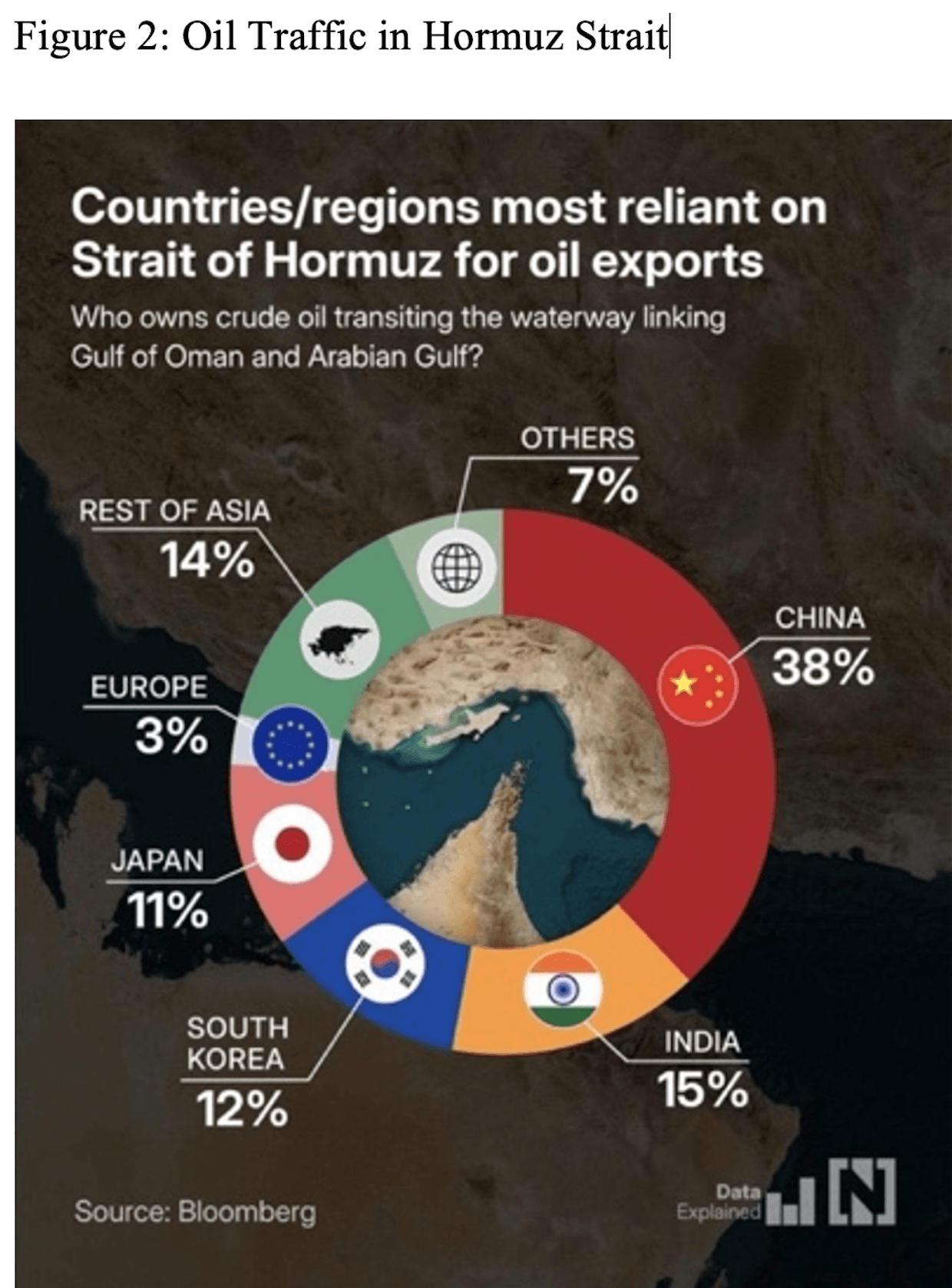
The strategic role of the Strait of Hormuz in the global oil supply is beyond discussion. In 2025, nearly 15 million barrels of crude oil per day and about 20 million barrels of total oil transited Hormuz, most of which headed to Asian markets rather than Europe (Figure 2). Any serious disruption, therefore, impacts not just supply but also freight, insurance, and risk premiums across the wider global economy. Therefore, the 2026 assault on Iran has clearly and rightly revived a familiar concern: that the global economy remains vulnerable to disruption at the Strait of Hormuz.
Energy Leverage and the China Factor
The energy dimension gives this compartmentalization broader strategic significance. The IEA reports that China and India together received 44 percent of the crude oil exported through Hormuz in 2025, while Europe accounted for only around 4 percent of those crude flows. The Atlantic Council similarly estimates that roughly 78 percent of Middle Eastern crude exports to China, Japan, South Korea, and Taiwan passed through the Strait in 2025. A crisis involving Iran and Hormuz is therefore not merely a Middle Eastern problem; it is also a point of pressure on Asian industrial power.
China is particularly vulnerable, though not helpless. The Oxford Institute for Energy Studies estimates that about half of China’s crude imports and roughly one-third of its LNG come from the Middle East. According to comprehensive market monitoring and tanker-tracking data, unofficial Iranian oil flows to China reached an average of approximately 1.38 million barrels per day (mb/d) in 2025 (Kpler; Vortexa). While some short-term fluctuations were observed in early 2025, the annual average remained robust, consistently exceeding the 1.3 million marks. Reuters and financial analysts report that China purchased more than 80 percent of Iran’s total shipped crude throughout the year (Reuters; Modern Diplomacy). This volume represents approximately 13.4 percent of China’s total seaborne oil imports, underscoring Iran’s critical, albeit unofficial, role in Beijing’s energy security strategy despite ongoing international sanctions (Energy Policy Research Foundation). In this context, pressure on Iran also indirectly affects a vital part of the Chinese economy. However, the strategic significance should not be overstated. The EIA indicates that China’s crude supply sources are diverse, with Russia and Saudi Arabia remaining its top suppliers in 2024, while the IEA’s Global Energy Review shows China continuing to lead global renewable capacity growth. Blocking Iranian flows can cause friction, uncertainty, and increased costs, but it is unlikely to fundamentally derail China’s rise on its own.
The situation in Venezuela aligns with this perspective. Even before the January 2026 US unilateral and unlawful military strike that led to Nicolás Maduro’s kidnapping, Venezuelan crude oil was not a key element of Chinese energy security. Reuters reported that, in the first half of 2019, China imported around 350,000 barrels of Venezuelan crude daily—about 3.5 percent of its total imports. In 2025, Reuters estimated Chinese imports from Venezuela at approximately 470,000 barrels per day, or roughly 4.5 percent of China’s seaborne crude imports. A later Reuters report stated that Venezuelan supply accounted for only about 4 percent of China’s crude imports. The message is clear: Venezuela has been a useful supplier to China due to its discounts and political convenience, but not a vital part of Chinese energy security. Disrupting one sanctioned supplier may be strategically significant; however, it is not automatically a decisive move.
There is also a broader distribution issue. An oil price spike caused by war would hurt not only Asia but also Europe. The IEA has already warned of renewed volatility in the gas market and ongoing pressure on European competitiveness, while its Electricity 2026 report notes that electricity prices for energy-intensive industries in the European Union remained roughly twice US levels in 2025. In contrast, the EIA indicates that the US has been a net petroleum exporter since 2020, and its world oil transit chokepoints analysis shows that US imports from Persian Gulf countries have decreased significantly over time. The energy situation is real and important—but in the larger power struggle, it appears as a meaningful yet still limited factor rather than a decisive tool of containment.
Despite all these facts and figures, it would be inaccurate to view the current crisis as just a repeat of the 1970s. The main issue is not only scarcity but also how conflict is framed, limited, and strategically handled. The war is better understood as a managed crisis within a larger shift in global order: force is used, but not arbitrarily; escalation is tolerated, but only to a certain extent; legitimacy is not universal but gradually built through temporary alliances and selective diplomatic efforts. In this context, energy is more than just a commodity at risk. It is a vital part of a broader strategic struggle.
Israel’s Security Dilemma and the Logic of Securitization
As R. Gilpin puts it, history suggests that moments of major power shifts or systemic transitions do not simply unsettle small and middle powers; they also redistribute opportunity. Some regional actors use great-power rivalry, imperial retreat, or strategic ambiguity to rise above their original weight—as Piedmont-Sardinia did in the wake of the Crimean War, Meiji Japan under the pressure of Western encroachment, and Ibn Saud amid the collapse of Ottoman authority. Some others, for instance, misread the same fluidity and overreach, as Saddam Hussein’s Iraq did in 1990, when a bid for regional expansion triggered the first major post–Cold War crisis and ended in rapid military defeat. In this sense, periods of power transition rarely leave the regional tier untouched: they create openings for some states to rise and traps for others to collapse. Israel’s conduct in the present phase of global power transition suggests that it is trying to exploit precisely such a window—not merely reacting to uncertainty but attempting to convert it into a regional hegemonic opportunity.
As US primacy becomes more contested and the Middle East is reorganized by overlapping energy, security, and corridor politics, Israel appears to be pursuing a dual strategy of expansion through both partnership and coercion. Besides, on the side of deterrence, its aggressive stance on war also reflects Israel’s recognizable security calculation. For years, Iranian missile capabilities, proxy networks, and nuclear advances have been cast in Israeli strategic discourse as existential or near-existential threats. From that vantage point, the February 2026 campaign is intelligible even if it is not thereby rendered lawful or strategically prudent. Once a hostile regime is defined as a total strategic danger, the political threshold for extraordinary measures falls: Preemptive force, regime-degrading strikes, regional militarization, and external coalition-building become easier to justify.
That said, deepening structured cooperation with states can help establish a favorable regional order. In that context, Israel is using punitive military actions against adversaries such as Iran, Syria, Hamas, and allied armed groups to weaken hostile capabilities, restore deterrence, and expand its strategic maneuvering space. This suggests that Israel is acting less like a besieged small state and more like an aspiring regional poweraiming to secure regional dominance before the emerging multipolar order becomes less accommodating. This also explains why the current conflict setup is not just about immediate battlefield outcomes but about shaping the future political landscape of the Eastern Mediterranean and the broader Middle East.
The partnership aspect of this strategy is particularly evident in the Eastern Mediterranean. Israel’s trilateral framework with Greece and Cyprus has evolved well beyond ad hoc diplomacy into a more institutionalized framework for security, maritime coordination, energy cooperation, connectivity, and technological partnership, sharply excluding Turkey. The December 2025 joint declaration explicitly linked this cooperation to natural gas development, electricity interconnectors, energy security, the Great Sea Interconnector, and the India-Middle East-Europe Economic Corridor (IMEC), The emerging axis is supported by tangible defense ties: Greece has approved the purchase of Israeli PULS rocket systems, and Reuters has reported plans to strengthen joint exercises among Greece, Israel, and Cyprus in the Eastern Mediterranean. At the same time, Egypt, Greece, and Cyprus have solidified their own trilateral format focused on maritime security, natural gas infrastructure, energy diversification, and UNCLOS-based delimitation. The broader framework connecting Egypt, Greece, Cyprus, and Israel is the East Mediterranean Gas Forum, which institutionalizes regional gas cooperation and uses energy as a tool for political unity. Collectively, these arrangements go beyond typical bilateral or trilateral diplomacy; they are forming the backbone of an emerging Eastern Mediterranean order, with Israel playing an increasingly central role.
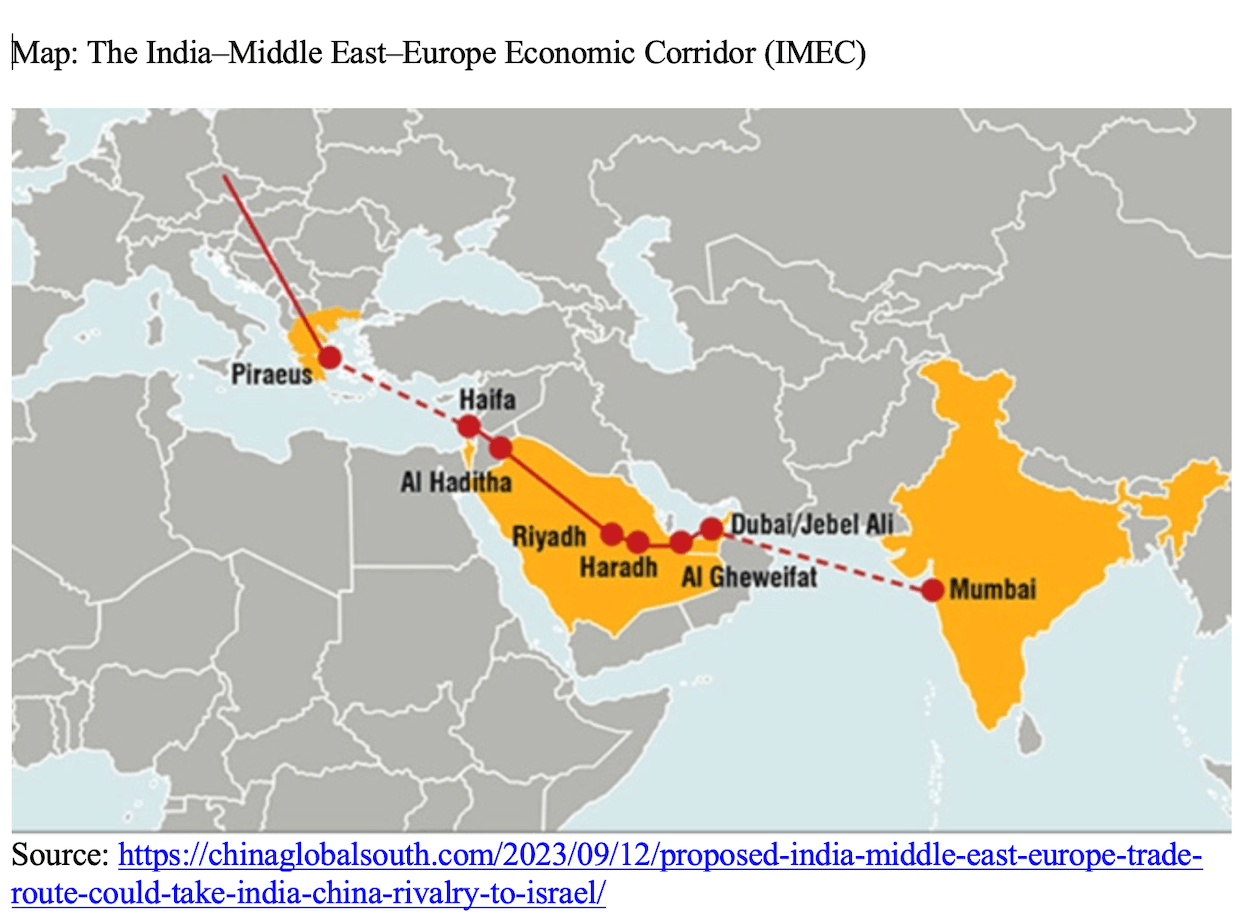
Rising patterns show that Israel’s Mediterranean strategy is now part of a broader geo-economic vision extending from the Caspian Sea in the Caucasus-Central Asia region to India and Europe. In his February 2026 address to the Knesset, Indian Prime Minister Narendra Modi described India and Israel as sharing “ancient civilizational ties” and called for deeper cooperation through IMEC and I2U2, giving the relationship a geopolitical depth beyond transactional defense ties. This matters because Israel’s partnerships are no longer confined to immediate neighbors; they are increasingly tied to larger corridor projects, technology platforms, and Indo-Middle Eastern alignments. This relationship is anchored in the geopolitical logic of the India–Middle East–Europe Economic Corridor (IMEC), a proposed multimodal route linking India to Europe via the UAE, Saudi Arabia, Jordan, and Israel, with maritime, rail, energy, and digital components converging on Israel’s Mediterranean gateway, and again excluding Turkey. Promoted by its backers as a faster and more resilient alternative to existing routes—and widely read as part of a broader effort to balance China’s Belt and Road Initiative (BRI)—IMEC helps explain why India–Israel ties now extend beyond bilateral cooperation into the strategic architecture of an emerging Indo-Mediterranean order.
At the same time, not every actor moving closer to Israel should be labeled as part of an open pro-Israel bloc. Saudi Arabia still publicly conditionally normalizes relations on Palestinian statehood, yet its strategic interests overlap with Israel’s on issues such as containing Iran, protecting energy supplies, and maintaining a favorable regional balance. The new Syrian leadership’s revived US-mediated security talks with Israel present an even clearer example of pragmatic convergence. These are not full alliances, but they do show that Israel is operating in an environment where former or potential adversaries are increasingly involved in patterns of coordination, deconfliction, or selective accommodation. The broader point is that Israel is trying to transform multipolar disorder into a hierarchical regional order: building networks where possible, managing enemies where necessary, and using both cooperation and calibrated force to expand the sphere within which it can act as the dominant regional power.
Strategic Compartmentalization and the Avoidance of a Civilizational Trap
This is where Samuel Huntington’s Clash of Civilizations thesis becomes relevant—though not in the crude sense often invoked in moments of war. Huntington argued that post-Cold War conflicts would increasingly follow cultural and religious fault lines. Yet the emerging strategy of Washington and its regional allies is not to embrace such a clash outright, but to instrumentalize its logic selectively while containing its broader consequences.
According to SIPRI, Israel is widely recognized to possess a nuclear arsenal. Meanwhile, the International Court of Justice has ruled that Israel’s ongoing presence in the occupied Palestinian territory is illegal, and repeated UN reports under Security Council Resolution 2334 continue to document settlement expansion. At the same time, UN humanitarian reports recorded that, by early December 2025, Gaza’s Ministry of Health reported more than 70,000 Palestinians killed, over 170,000 injured, and mass displacement on a devastating scale. Taken together, these facts make any claim that Israeli actions remain firmly within a stable zone of legal and moral legitimacy highly questionable.
Thus, the US-Israeli challenge has never been limited to threat detection alone. It has also involved managing the political fallout from their responses. From Trump’s and Netanyahu’s perspectives, the operation against Iran needed to be framed in a way that preserved as much international legitimacy as possible, even when a clear legal justification was difficult to establish. At the same time, the conflict had to be prevented from escalating into a civilizational clash that could push Muslim-majority societies toward China and expand Beijing’s strategic influence across the Global South. Here, deeper contradictions become unavoidable.
Iran and Hamas are cast as securitized and containable threats, while Gulf monarchies and other Muslim-majority states are engaged through donor diplomacy, regime-security guarantees, and calibrated alliance management. The objective is not simply to fight an adversary, but to prevent the war from consolidating an anti-Western political identity across the broader Muslim world—especially at a moment when parts of the Global South are drifting toward more China-friendly alignments.
This is precisely where the current war differs from a simple Huntingtonian interpretation. The conflict has not been allowed to evolve into a straightforward “West versus Islam” narrative. Instead, much of the diplomatic framework has sought to confine it to a narrower Iran-Hamas security issue. The Council on Foreign Relations noted that the Board of Peace relied heavily on participation from Gulf Arabs and Central Asians, while excluding direct Palestinian political representation at the highest levels of decision-making. Conversely, the UN Human Rights Office sharply criticized this setup as incompatible with a reparative, rights-based approach to reconstruction. From an analytical perspective, however, the main point is not whether the structure is morally convincing. It is that the structure acts as a mechanism of compartmentalization: some actors are isolated as threats to be disarmed or neutralized, while others are kept within a cooperative framework of reconstruction, stabilization, and donor politics.
The regional response confirms that interpretation. In their extraordinary GCC-EU joint statement, Gulf and European ministers condemned Iran’s attacks on GCC states, emphasized that GCC territories had not been used to launch attacks against Iran, invoked self-defense, and highlighted the importance of protecting maritime routes, supply chains, and energy market stability. Meanwhile, Carnegie noted that Gulf monarchies are caught between Iranian escalation and US recklessness, with their main focus on preserving fragile economic and security systems. This is not the language of a unified civilizational bloc; it is the language of regime survival. Nor did the broader Muslim political field unify into a single anti-Western Front. The OIC’s condemnation of Israeli attacks on Iran coexists with muted and ambivalent official Gulf reactions, while AP reporting emphasized elite anger at the US for exposing Gulf states to retaliation without sufficient warning or protection. As a European Council joint statement states, what emerged was fragmentation rather than bloc unity—and that fragmentation was not accidental but part of the crisis’s strategic outcome.
As a conclusion to this part, Gulf monarchies are neither full participants in an anti-Iran crusade nor members of an anti-Western camp. They are defensive actors seeking to preserve commercial credibility, domestic order, and external security amid a war they did not want. That posture is inherently compartmentalizing. It seeks to prevent regional collapse without fully endorsing the strategic logic that produced the crisis in the first place.
Washington’s Domestic Politics and the Uses of External Crisis
The domestic American context also matters, although it should be approached with analytical caution. While the operational details of the strike on Iran are often examined solely from a kinetic perspective, the decision-making process cannot be separated from the Trump administration’s increasing domestic vulnerabilities. The kinetic action serves as the ultimate "escape forward," where the smoke of external conflict hides the fire of internal issues. Notably, two factors—the recently disclosed Epstein Scandal and the motivations of Trump’s eschatological cabinet—are significant.
A DOJ/FBI memorandum issued in July 2025 stated that investigators found no evidence of a Jeffrey Epstein “client list.” However, in March 2026, the Associated Press reported that newly disclosed files—previously omitted due to an alleged coding error—contained strong allegations involving Donald Trump. While this may not directly confirm a causal link between scandal exposure and war-making, as the Department of Justice and the Federal Bureau of Investigation note, it nonetheless supports a more defensible argument: a scandal-ridden domestic environment can increase the short-term political value of external escalation by diverting scrutiny, reinforcing partisan discipline, and shifting media focus to security rather than accountability.
Beyond the tactical use of distraction, this pressure is increasingly driven by a fundamentalist-Christian elite that has gained unprecedented influence within the cabinet. The appointment of Christian-Zionist ideologues to key bureaucratic positions in the US and diplomatic roles abroad, especially in Israel and the surrounding region, shows that the administration’s foreign policies are being guided by eschatological beliefs. The recent gathering of prominent pastors to "anoint" the President for a perceived war acts as a strategic response to the Epstein disclosures. By portraying the President as a Cyrus-figure—a flawed vessel chosen for divine geopolitical realignment—this faction provides a moral cover that redefines personal scandal as part of spiritual warfare.
In this context, Epstein’s emergence as a posthumous influence agent suggests that the timing of these disclosures may be less coincidental and more coercive. Trapped between the threat of legal disgrace and the demands of his Dominionist base, the President’s move toward external escalation becomes an expected outcome of survival politics. The combination of these allegations with radical religious rhetoric shows that the administration is being pushed into a policy space where aggression is used as the main tool for maintaining domestic stability and ideological legitimacy.
Europe’s Passive Alignment with Trump’s Vision
Europe now appears less as a strategic leader and more as a sign of Western division. Although it remains an important economic player, its geopolitical influence is diminishing. It is a giant in market size, but surprisingly weak in political unity, strategic direction, and external influence. Its direct reliance on Hormuz crude is lower than Asia’s, but it remains highly vulnerable to energy price shocks, industrial setbacks, and alliance pressures. What is especially notable is that Europe has faced the recent escalation in the Middle East while transatlantic relations are already strained. A recent European Parliament study notes that since early 2025, EU-US relations have been increasingly tense over NATO, Greenland, Ukraine, trade, technology, climate, and China, indicating a deeper split in strategic visions across the Atlantic. A recent ECPS Report concurs, finding that the transatlantic relationship has reached a turning point under Trump-era right-wing populism, with erosion in security, trade, international institutions, and democratic norms. In this context, Europe faces the Iran-Israel crisis not with confidence, but amid broader geopolitical confusion.
Yet this is exactly what reveals Europe’s muted stance on Israel. While Washington has become a source of pressure and unpredictability for Europe, the EU has struggled to develop a clear and independent position on Israel. This silence signifies more a weakness than a deliberate strategy: leadership gaps, the lack of a strong, shared perspective within the Union, and the lingering influence of Cold War-era habits of outsourcing hard security to the US. The ECPS volume is especially useful here because it views the current Atlantic crisis not as isolated turbulence but as a systemic shift that requires greater European agency and strategic independence. Europe’s relative passivity, then, should be seen not just as deference but as a sign of unpreparedness: a wealthy political bloc that has yet to turn economic influence into geopolitical power.
Conclusion
The 2026 war with Iran should be seen as more than just a regional military conflict or a temporary energy crisis. It reveals a broader shift in the global order, in which the lines between war, energy security, alliance politics, and narrative control are increasingly blurred. What is emerging isn’t a return to a stable US-centered system, nor a fully developed multipolar balance, but rather a fragmented and coercive landscape. In this environment, major powers, regional players, and smaller states seek to gain advantages through selective alliances, limited escalation, and compartmentalized crisis management. In this context, Israel has acted with unusual clarity, trying to turn global uncertainty into regional dominance through military deterrence, strategic partnerships, and corridor politics. The Gulf monarchies sit at a crucial middle ground, balancing pressure, exposure, and opportunities. Europe, on the other hand, seems less a driver of outcomes than a reflection of Western fatigue—economically significant, politically hesitant, and strategically unprepared for a world where American leadership has become both less dependable and more disruptive.
The deeper significance of this moment lies specifically here. The crisis isn’t just about Iran, or even about the immediate future of the Middle East. It’s about how power is exercised in an era when the liberal language of rules, institutions, and multilateral restraint persists but increasingly lacks the material cohesion or political authority that once sustained it. Strategic compartmentalization has become the preferred way to manage disorder: adversaries are securitized and targeted, partners are reassured and selectively brought in, and broader civilizational escalation is contained rather than solved. This might bring temporary stability, but it does so by reinforcing a new international logic—one characterized by differentiated legitimacy, asymmetrical coercion, and declining normative consistency. The real lesson of the Iran war, then, isn’t just that energy geopolitics has returned, but that it now functions within a more severe and openly hierarchical struggle over who will shape the regional and global order to come.
References
Associated Press. (2026, January 3). “What we know about a U.S. strike that captured Venezuela’s Maduro and what comes next.” AP News. https://www.pbs.org/newshour/nation/what-we-know-about-a-u-s-strike-that-captured-venezuelas-maduro
Associated Press. (2026, March 6). “Gulf allies complain U.S. didn’t notify them of Iran attacks and ignored their warnings, sources say.” AP News. https://apnews.com/article/iran-us-trump-gulf-states-drones-defense-69d5bc227e468f06e20e5ad069330c7d
Associated Press. (2026, March 6). “Justice Department releases Epstein files with unverified accusations against Trump.” AP News. https://apnews.com/article/epstein-files-missing-release-doj-trump-f9cb1358a649c61f4bb7793bf358393b
Atlantic Council. (2026, March 6). “What a Middle East oil and LNG crisis means for China and East Asia.” https://www.atlanticcouncil.org/dispatches/what-a-middle-east-oil-and-lng-crisis-means-for-china-and-east-asia/
Britannica. (n.d.). “Crimean War.” In: Encyclopaedia Britannica. https://www.britannica.com/event/Crimean-War
Britannica. (n.d.). “Ibn Saud.” In: Encyclopaedia Britannica. https://www.britannica.com/biography/Ibn-Saud
Britannica. (n.d.). “Meiji Restoration.” In: Encyclopaedia Britannica. https://www.britannica.com/event/Meiji-Restoration
Britannica. (n.d.). “Persian Gulf War.” In: Encyclopaedia Britannica. https://www.britannica.com/event/Persian-Gulf-War
Carnegie Endowment for International Peace. (2026, March 3). “The Gulf monarchies are caught between Iran’s desperation and the U.S.’s recklessness.” https://carnegieendowment.org/emissary/2026/03/gulf-states-iran-war-security
Council of the European Union. (2026, March 5). Joint statement by GCC-EU Ministers’ meeting on recent developments in the Middle East: Iran’s attacks against GCC states. https://www.consilium.europa.eu/en/press/press-releases/2026/03/05/joint-statement-by-gcc-eu-ministers-meeting-on-recent-developments-in-the-middle-east-iran-s-attacks-against-gcc-states/
Council on Foreign Relations. (2026, February 19). “Gaza Board of Peace meets today.” https://www.cfr.org/articles/gaza-board-of-peace-meets-today
Council on Foreign Relations. (2026, February 24). “A guide to the Gaza peace deal.” https://www.cfr.org/articles/guide-trumps-twenty-point-gaza-peace-deal
East Mediterranean Gas Forum. (n.d.). “Overview.” https://emgf.org/pages/about/overview.aspx
Gilpin, R. (1981). War and change in world politics. Cambridge University Press.
House of Commons Library. (2026, March 2). US-Israel strikes on Iran: February/March 2026. UK Parliament. https://commonslibrary.parliament.uk/research-briefings/cbp-10521/
International Court of Justice. (2024, July 19). Advisory opinion of 19 July 2024: Legal consequences arising from the policies and practices of Israel in the Occupied Palestinian Territory, including East Jerusalem. https://www.icj-cij.org/index.php/node/204160
International Energy Agency. (2025). Global energy review 2025: Electricity. https://www.iea.org/
International Energy Agency. (2025, February 23). European gas market volatility puts continued pressure on competitiveness and cost of living. https://www.iea.org/
International Energy Agency. (2026, February 6). Electricity 2026: Prices. https://www.iea.org/reports/electricity-2026/prices
International Energy Agency. (2026, February 12). Strait of Hormuz: Oil security and emergency response. https://www.iea.org/about/oil-security-and-emergency-response/strait-of-hormuz
Kennedy, P. (1987). The rise and fall of the great powers: Economic change and military conflict from 1500 to 2000. Random House.
Ministry of External Affairs, Government of India. (2026, February 25). Prime Minister addresses the Israeli Parliament – Knesset (February 25, 2026). https://www.mea.gov.in/press-releases.htm?dtl%2F40822%2FPrime+Minister+addresses+the+Israeli+Parliament++Knesset+February+25+2026=
Nolte, D. (2010). “How to compare regional powers: Analytical concepts and research topics.” Review of International Studies, 36(4), 881–901. https://doi.org/10.1017/S026021051000135X
Oxford Institute for Energy Studies. (2026, March 1). Disruption in the Strait of Hormuz: Implications for China’s energy security. https://www.oxfordenergy.org/
Prime Minister of the Hellenic Republic. (2025, January 8). Joint declaration of the tenth Egypt-Cyprus-Greece Trilateral Summit (Cairo, 8 January 2025). https://www.primeminister.gr/en/2025/01/08/35631
Prime Minister of the Hellenic Republic. (2025, December 22). Joint declaration – The 10th Trilateral Summit of Israel, Greece, and Cyprus. https://www.primeminister.gr/en/2025/12/22/37647
Reuters. (2019, August 19). “China CNPC suspends Venezuelan oil loading, worried about U.S. sanctions – sources.” https://www.reuters.com/
Reuters. (2025, February 5). “Saudi Arabia, in swift response to Trump, says no ties with Israel without a Palestinian state.” https://www.reuters.com/world/middle-east/saudi-arabia-says-it-wont-establish-ties-with-israel-without-creation-2025-02-05/
Reuters. (2025, December 29). “Greece, Israel and Cyprus to step up joint exercises in eastern Mediterranean.” https://www.reuters.com/business/aerospace-defense/greece-israel-cyprus-step-up-joint-exercises-eastern-mediterranean-2025-12-29/
Reuters. (2026, January 5). “China’s oil investments in Venezuela.” https://www.reuters.com/business/energy/chinas-oil-investments-venezuela-2026-01-05/
Reuters. (2026, January 5). “Syria, Israel resume U.S.-mediated security talks.” https://www.reuters.com/world/middle-east/syria-israel-resume-us-mediated-security-talks-2026-01-05/
Reuters. (2026, January 13). “China’s heavy reliance on Iranian oil imports.” https://www.reuters.com/business/energy/chinas-heavy-reliance-iranian-oil-imports-2026-01-13/
Reuters. (2026, January 14). “Venezuelan oil exports to China set to drop as U.S. blockade limits cargoes.” https://www.reuters.com/business/energy/venezuelan-oil-exports-china-set-drop-us-blockade-limits-cargoes-2026-01-14/
Saudi Press Agency. (2026). “OIC strongly condemns Israeli attacks on Iran.” https://www.spa.gov.sa/
Stockholm International Peace Research Institute. (2025). Israel. https://www.sipri.org/
United Nations. (2025, June 25). Implementation of Security Council resolution 2334 (2016). https://www.un.org/
United Nations. (2025, December 3). Occupied Palestinian Territory flash appeal 2026. https://www.unocha.org/publications/report/occupied-palestinian-territory/flash-appeal-occupied-palestinian-territory-2026-issued-december-2025
United Nations Human Rights Office of the High Commissioner. (2026, March 2). UN experts condemn “Board of Peace,” call for a reparative, rights-based approach to reconstruction in Gaza. https://www.ohchr.org/en/press-releases/2026/03/un-experts-condemn-board-peace-call-reparative-rights-based-approach
U.S. Energy Information Administration. (2024, March 29). How much petroleum does the United States import and export? https://www.eia.gov/
U.S. Energy Information Administration. (2026, March 3). World oil transit chokepoints. https://www.eia.gov/international/analysis/special-topics/World_Oil_Transit_Chokepoints
U.S. Energy Information Administration. (2025, February 11). China’s crude oil imports decreased from a record as refiners lowered runs. https://www.eia.gov/

Power Transition in the Middle East: The Intersection of US Global Rivalries and Israel’s Regional Ambitions
In this long ECPS commentary, Professor Ibrahim Ozturk examines the 2026 US–Israeli strikes on Iran as part of a broader transformation in global power politics rather than an isolated regional conflict. He argues that the confrontation reflects a strategic intersection of energy security, regional military dynamics, and intensifying great-power rivalry, particularly between the United States and China. The crisis surrounding the Strait of Hormuz—through which a substantial share of global oil flows—demonstrates how military escalation, energy markets, and geopolitical competition are increasingly intertwined. Professor Ozturk suggests that contemporary conflicts are being managed through strategic compartmentalization: limited escalation, selective alliances, and narrative control. In this emerging landscape, regional actors and global powers alike seek to reshape influence within a fragmented and increasingly competitive international order.
By Ibrahim Ozturk
The Israeli-US attack on Iran, at this pivotal moment, is more than just another Middle Eastern conflict or a simple prelude to a new oil shock. It should be seen as part of a broader shift in global power, in which regional conflict, energy security, and great-power rivalry are managed together rather than separately. The aim in this deliberately segmented crisis caused by the last military stand-off with Iran is (i) to weaken Iran’s nuclear and missile capabilities to bolster Israel’s regional dominance focused on security; (ii) Washington’s effort to retain strategic control over global energy flows amid rising competition with China; and (iii) in doing so, to keep the conflict politically contained—avoiding the perception of a broader clash of civilizations in the Muslim world, thus preventing them from falling under China’s influence and minimizing the reasons for China’s growing influence in the Global South.
That stance closely aligns with a recent British parliamentary report, which suggests that energy, war, diplomacy, and narrative are no longer separate policy areas. Instead, they are being strategically managed together. The result is a new power dynamic—one that shifts away from crisis management within a liberal international order and toward a more fragmented system characterized by selective coalitions, limited violence, and varying legitimacy.
Beyond Energy and Iran’s Nuclear Capacity
Without any convincing legal justification, UN resolution, or data from American institutions indicating that Iran posed an imminent threat—and launched during ongoing negotiations—these attacks resulted in the “arbitrary” killing of thousands of civilians in Iran, the massacre of schoolchildren, the arbitrary sinking of an unarmed Iranian ship returning from military exercises in India and of a Sri Lankan ship, killing hundreds of soldiers, as well as severe damage to many UNESCO-protected historical monuments in Iran. In such a context, the first and most important task is to correctly situate these attacks by the US–Israel axis.
On February 28, 2026, Israel and the US carried out coordinated strikes on Iran, targeting leadership sites, military forces, and nuclear and ballistic missile infrastructure. The immediate market response was straightforward. After the attacks, global energy markets became extremely volatile, with Brent crude soaring to a peak of $119.50 on March 9, 2026, as the closure of the Strait of Hormuz threatened 20% of global supply. This ‘panic spike’ was followed by a sharp intraday reversal, with prices sliding back toward $90.00 after US officials indicated a quick end to the military operations, ultimately leaving the market stuck in a highly volatile trading range between $85.00 and $105.00 (Figure 1).
The strategic role of the Strait of Hormuz in the global oil supply is beyond discussion. In 2025, nearly 15 million barrels of crude oil per day and about 20 million barrels of total oil transited Hormuz, most of which headed to Asian markets rather than Europe (Figure 2). Any serious disruption, therefore, impacts not just supply but also freight, insurance, and risk premiums across the wider global economy. Therefore, the 2026 assault on Iran has clearly and rightly revived a familiar concern: that the global economy remains vulnerable to disruption at the Strait of Hormuz.
Energy Leverage and the China Factor
The energy dimension gives this compartmentalization broader strategic significance. The IEA reports that China and India together received 44 percent of the crude oil exported through Hormuz in 2025, while Europe accounted for only around 4 percent of those crude flows. The Atlantic Council similarly estimates that roughly 78 percent of Middle Eastern crude exports to China, Japan, South Korea, and Taiwan passed through the Strait in 2025. A crisis involving Iran and Hormuz is therefore not merely a Middle Eastern problem; it is also a point of pressure on Asian industrial power.
China is particularly vulnerable, though not helpless. The Oxford Institute for Energy Studies estimates that about half of China’s crude imports and roughly one-third of its LNG come from the Middle East. According to comprehensive market monitoring and tanker-tracking data, unofficial Iranian oil flows to China reached an average of approximately 1.38 million barrels per day (mb/d) in 2025 (Kpler; Vortexa). While some short-term fluctuations were observed in early 2025, the annual average remained robust, consistently exceeding the 1.3 million marks. Reuters and financial analysts report that China purchased more than 80 percent of Iran’s total shipped crude throughout the year (Reuters; Modern Diplomacy). This volume represents approximately 13.4 percent of China’s total seaborne oil imports, underscoring Iran’s critical, albeit unofficial, role in Beijing’s energy security strategy despite ongoing international sanctions (Energy Policy Research Foundation). In this context, pressure on Iran also indirectly affects a vital part of the Chinese economy. However, the strategic significance should not be overstated. The EIA indicates that China’s crude supply sources are diverse, with Russia and Saudi Arabia remaining its top suppliers in 2024, while the IEA’s Global Energy Review shows China continuing to lead global renewable capacity growth. Blocking Iranian flows can cause friction, uncertainty, and increased costs, but it is unlikely to fundamentally derail China’s rise on its own.
The situation in Venezuela aligns with this perspective. Even before the January 2026 US unilateral and unlawful military strike that led to Nicolás Maduro’s kidnapping, Venezuelan crude oil was not a key element of Chinese energy security. Reuters reported that, in the first half of 2019, China imported around 350,000 barrels of Venezuelan crude daily—about 3.5 percent of its total imports. In 2025, Reuters estimated Chinese imports from Venezuela at approximately 470,000 barrels per day, or roughly 4.5 percent of China’s seaborne crude imports. A later Reuters report stated that Venezuelan supply accounted for only about 4 percent of China’s crude imports. The message is clear: Venezuela has been a useful supplier to China due to its discounts and political convenience, but not a vital part of Chinese energy security. Disrupting one sanctioned supplier may be strategically significant; however, it is not automatically a decisive move.
There is also a broader distribution issue. An oil price spike caused by war would hurt not only Asia but also Europe. The IEA has already warned of renewed volatility in the gas market and ongoing pressure on European competitiveness, while its Electricity 2026 report notes that electricity prices for energy-intensive industries in the European Union remained roughly twice US levels in 2025. In contrast, the EIA indicates that the US has been a net petroleum exporter since 2020, and its world oil transit chokepoints analysis shows that US imports from Persian Gulf countries have decreased significantly over time. The energy situation is real and important—but in the larger power struggle, it appears as a meaningful yet still limited factor rather than a decisive tool of containment.
Despite all these facts and figures, it would be inaccurate to view the current crisis as just a repeat of the 1970s. The main issue is not only scarcity but also how conflict is framed, limited, and strategically handled. The war is better understood as a managed crisis within a larger shift in global order: force is used, but not arbitrarily; escalation is tolerated, but only to a certain extent; legitimacy is not universal but gradually built through temporary alliances and selective diplomatic efforts. In this context, energy is more than just a commodity at risk. It is a vital part of a broader strategic struggle.
Israel’s Security Dilemma and the Logic of Securitization
As R. Gilpin puts it, history suggests that moments of major power shifts or systemic transitions do not simply unsettle small and middle powers; they also redistribute opportunity. Some regional actors use great-power rivalry, imperial retreat, or strategic ambiguity to rise above their original weight—as Piedmont-Sardinia did in the wake of the Crimean War, Meiji Japan under the pressure of Western encroachment, and Ibn Saud amid the collapse of Ottoman authority. Some others, for instance, misread the same fluidity and overreach, as Saddam Hussein’s Iraq did in 1990, when a bid for regional expansion triggered the first major post–Cold War crisis and ended in rapid military defeat. In this sense, periods of power transition rarely leave the regional tier untouched: they create openings for some states to rise and traps for others to collapse. Israel’s conduct in the present phase of global power transition suggests that it is trying to exploit precisely such a window—not merely reacting to uncertainty but attempting to convert it into a regional hegemonic opportunity.
As US primacy becomes more contested and the Middle East is reorganized by overlapping energy, security, and corridor politics, Israel appears to be pursuing a dual strategy of expansion through both partnership and coercion. Besides, on the side of deterrence, its aggressive stance on war also reflects Israel’s recognizable security calculation. For years, Iranian missile capabilities, proxy networks, and nuclear advances have been cast in Israeli strategic discourse as existential or near-existential threats. From that vantage point, the February 2026 campaign is intelligible even if it is not thereby rendered lawful or strategically prudent. Once a hostile regime is defined as a total strategic danger, the political threshold for extraordinary measures falls: Preemptive force, regime-degrading strikes, regional militarization, and external coalition-building become easier to justify.
That said, deepening structured cooperation with states can help establish a favorable regional order. In that context, Israel is using punitive military actions against adversaries such as Iran, Syria, Hamas, and allied armed groups to weaken hostile capabilities, restore deterrence, and expand its strategic maneuvering space. This suggests that Israel is acting less like a besieged small state and more like an aspiring regional poweraiming to secure regional dominance before the emerging multipolar order becomes less accommodating. This also explains why the current conflict setup is not just about immediate battlefield outcomes but about shaping the future political landscape of the Eastern Mediterranean and the broader Middle East.
The partnership aspect of this strategy is particularly evident in the Eastern Mediterranean. Israel’s trilateral framework with Greece and Cyprus has evolved well beyond ad hoc diplomacy into a more institutionalized framework for security, maritime coordination, energy cooperation, connectivity, and technological partnership, sharply excluding Turkey. The December 2025 joint declaration explicitly linked this cooperation to natural gas development, electricity interconnectors, energy security, the Great Sea Interconnector, and the India-Middle East-Europe Economic Corridor (IMEC), The emerging axis is supported by tangible defense ties: Greece has approved the purchase of Israeli PULS rocket systems, and Reuters has reported plans to strengthen joint exercises among Greece, Israel, and Cyprus in the Eastern Mediterranean. At the same time, Egypt, Greece, and Cyprus have solidified their own trilateral format focused on maritime security, natural gas infrastructure, energy diversification, and UNCLOS-based delimitation. The broader framework connecting Egypt, Greece, Cyprus, and Israel is the East Mediterranean Gas Forum, which institutionalizes regional gas cooperation and uses energy as a tool for political unity. Collectively, these arrangements go beyond typical bilateral or trilateral diplomacy; they are forming the backbone of an emerging Eastern Mediterranean order, with Israel playing an increasingly central role.
Rising patterns show that Israel’s Mediterranean strategy is now part of a broader geo-economic vision extending from the Caspian Sea in the Caucasus-Central Asia region to India and Europe. In his February 2026 address to the Knesset, Indian Prime Minister Narendra Modi described India and Israel as sharing “ancient civilizational ties” and called for deeper cooperation through IMEC and I2U2, giving the relationship a geopolitical depth beyond transactional defense ties. This matters because Israel’s partnerships are no longer confined to immediate neighbors; they are increasingly tied to larger corridor projects, technology platforms, and Indo-Middle Eastern alignments. This relationship is anchored in the geopolitical logic of the India–Middle East–Europe Economic Corridor (IMEC), a proposed multimodal route linking India to Europe via the UAE, Saudi Arabia, Jordan, and Israel, with maritime, rail, energy, and digital components converging on Israel’s Mediterranean gateway, and again excluding Turkey. Promoted by its backers as a faster and more resilient alternative to existing routes—and widely read as part of a broader effort to balance China’s Belt and Road Initiative (BRI)—IMEC helps explain why India–Israel ties now extend beyond bilateral cooperation into the strategic architecture of an emerging Indo-Mediterranean order.
At the same time, not every actor moving closer to Israel should be labeled as part of an open pro-Israel bloc. Saudi Arabia still publicly conditionally normalizes relations on Palestinian statehood, yet its strategic interests overlap with Israel’s on issues such as containing Iran, protecting energy supplies, and maintaining a favorable regional balance. The new Syrian leadership’s revived US-mediated security talks with Israel present an even clearer example of pragmatic convergence. These are not full alliances, but they do show that Israel is operating in an environment where former or potential adversaries are increasingly involved in patterns of coordination, deconfliction, or selective accommodation. The broader point is that Israel is trying to transform multipolar disorder into a hierarchical regional order: building networks where possible, managing enemies where necessary, and using both cooperation and calibrated force to expand the sphere within which it can act as the dominant regional power.
Strategic Compartmentalization and the Avoidance of a Civilizational Trap
This is where Samuel Huntington’s Clash of Civilizations thesis becomes relevant—though not in the crude sense often invoked in moments of war. Huntington argued that post-Cold War conflicts would increasingly follow cultural and religious fault lines. Yet the emerging strategy of Washington and its regional allies is not to embrace such a clash outright, but to instrumentalize its logic selectively while containing its broader consequences.
According to SIPRI, Israel is widely recognized to possess a nuclear arsenal. Meanwhile, the International Court of Justice has ruled that Israel’s ongoing presence in the occupied Palestinian territory is illegal, and repeated UN reports under Security Council Resolution 2334 continue to document settlement expansion. At the same time, UN humanitarian reports recorded that, by early December 2025, Gaza’s Ministry of Health reported more than 70,000 Palestinians killed, over 170,000 injured, and mass displacement on a devastating scale. Taken together, these facts make any claim that Israeli actions remain firmly within a stable zone of legal and moral legitimacy highly questionable.
Thus, the US-Israeli challenge has never been limited to threat detection alone. It has also involved managing the political fallout from their responses. From Trump’s and Netanyahu’s perspectives, the operation against Iran needed to be framed in a way that preserved as much international legitimacy as possible, even when a clear legal justification was difficult to establish. At the same time, the conflict had to be prevented from escalating into a civilizational clash that could push Muslim-majority societies toward China and expand Beijing’s strategic influence across the Global South. Here, deeper contradictions become unavoidable.
Iran and Hamas are cast as securitized and containable threats, while Gulf monarchies and other Muslim-majority states are engaged through donor diplomacy, regime-security guarantees, and calibrated alliance management. The objective is not simply to fight an adversary, but to prevent the war from consolidating an anti-Western political identity across the broader Muslim world—especially at a moment when parts of the Global South are drifting toward more China-friendly alignments.
This is precisely where the current war differs from a simple Huntingtonian interpretation. The conflict has not been allowed to evolve into a straightforward “West versus Islam” narrative. Instead, much of the diplomatic framework has sought to confine it to a narrower Iran-Hamas security issue. The Council on Foreign Relations noted that the Board of Peace relied heavily on participation from Gulf Arabs and Central Asians, while excluding direct Palestinian political representation at the highest levels of decision-making. Conversely, the UN Human Rights Office sharply criticized this setup as incompatible with a reparative, rights-based approach to reconstruction. From an analytical perspective, however, the main point is not whether the structure is morally convincing. It is that the structure acts as a mechanism of compartmentalization: some actors are isolated as threats to be disarmed or neutralized, while others are kept within a cooperative framework of reconstruction, stabilization, and donor politics.
The regional response confirms that interpretation. In their extraordinary GCC-EU joint statement, Gulf and European ministers condemned Iran’s attacks on GCC states, emphasized that GCC territories had not been used to launch attacks against Iran, invoked self-defense, and highlighted the importance of protecting maritime routes, supply chains, and energy market stability. Meanwhile, Carnegie noted that Gulf monarchies are caught between Iranian escalation and US recklessness, with their main focus on preserving fragile economic and security systems. This is not the language of a unified civilizational bloc; it is the language of regime survival. Nor did the broader Muslim political field unify into a single anti-Western Front. The OIC’s condemnation of Israeli attacks on Iran coexists with muted and ambivalent official Gulf reactions, while AP reporting emphasized elite anger at the US for exposing Gulf states to retaliation without sufficient warning or protection. As a European Council joint statement states, what emerged was fragmentation rather than bloc unity—and that fragmentation was not accidental but part of the crisis’s strategic outcome.
As a conclusion to this part, Gulf monarchies are neither full participants in an anti-Iran crusade nor members of an anti-Western camp. They are defensive actors seeking to preserve commercial credibility, domestic order, and external security amid a war they did not want. That posture is inherently compartmentalizing. It seeks to prevent regional collapse without fully endorsing the strategic logic that produced the crisis in the first place.
Washington’s Domestic Politics and the Uses of External Crisis
The domestic American context also matters, although it should be approached with analytical caution. While the operational details of the strike on Iran are often examined solely from a kinetic perspective, the decision-making process cannot be separated from the Trump administration’s increasing domestic vulnerabilities. The kinetic action serves as the ultimate "escape forward," where the smoke of external conflict hides the fire of internal issues. Notably, two factors—the recently disclosed Epstein Scandal and the motivations of Trump’s eschatological cabinet—are significant.
A DOJ/FBI memorandum issued in July 2025 stated that investigators found no evidence of a Jeffrey Epstein “client list.” However, in March 2026, the Associated Press reported that newly disclosed files—previously omitted due to an alleged coding error—contained strong allegations involving Donald Trump. While this may not directly confirm a causal link between scandal exposure and war-making, as the Department of Justice and the Federal Bureau of Investigation note, it nonetheless supports a more defensible argument: a scandal-ridden domestic environment can increase the short-term political value of external escalation by diverting scrutiny, reinforcing partisan discipline, and shifting media focus to security rather than accountability.
Beyond the tactical use of distraction, this pressure is increasingly driven by a fundamentalist-Christian elite that has gained unprecedented influence within the cabinet. The appointment of Christian-Zionist ideologues to key bureaucratic positions in the US and diplomatic roles abroad, especially in Israel and the surrounding region, shows that the administration’s foreign policies are being guided by eschatological beliefs. The recent gathering of prominent pastors to "anoint" the President for a perceived war acts as a strategic response to the Epstein disclosures. By portraying the President as a Cyrus-figure—a flawed vessel chosen for divine geopolitical realignment—this faction provides a moral cover that redefines personal scandal as part of spiritual warfare.
In this context, Epstein’s emergence as a posthumous influence agent suggests that the timing of these disclosures may be less coincidental and more coercive. Trapped between the threat of legal disgrace and the demands of his Dominionist base, the President’s move toward external escalation becomes an expected outcome of survival politics. The combination of these allegations with radical religious rhetoric shows that the administration is being pushed into a policy space where aggression is used as the main tool for maintaining domestic stability and ideological legitimacy.
Europe’s Passive Alignment with Trump’s Vision
Europe now appears less as a strategic leader and more as a sign of Western division. Although it remains an important economic player, its geopolitical influence is diminishing. It is a giant in market size, but surprisingly weak in political unity, strategic direction, and external influence. Its direct reliance on Hormuz crude is lower than Asia’s, but it remains highly vulnerable to energy price shocks, industrial setbacks, and alliance pressures. What is especially notable is that Europe has faced the recent escalation in the Middle East while transatlantic relations are already strained. A recent European Parliament study notes that since early 2025, EU-US relations have been increasingly tense over NATO, Greenland, Ukraine, trade, technology, climate, and China, indicating a deeper split in strategic visions across the Atlantic. A recent ECPS Report concurs, finding that the transatlantic relationship has reached a turning point under Trump-era right-wing populism, with erosion in security, trade, international institutions, and democratic norms. In this context, Europe faces the Iran-Israel crisis not with confidence, but amid broader geopolitical confusion.
Yet this is exactly what reveals Europe’s muted stance on Israel. While Washington has become a source of pressure and unpredictability for Europe, the EU has struggled to develop a clear and independent position on Israel. This silence signifies more a weakness than a deliberate strategy: leadership gaps, the lack of a strong, shared perspective within the Union, and the lingering influence of Cold War-era habits of outsourcing hard security to the US. The ECPS volume is especially useful here because it views the current Atlantic crisis not as isolated turbulence but as a systemic shift that requires greater European agency and strategic independence. Europe’s relative passivity, then, should be seen not just as deference but as a sign of unpreparedness: a wealthy political bloc that has yet to turn economic influence into geopolitical power.
Conclusion
The 2026 war with Iran should be seen as more than just a regional military conflict or a temporary energy crisis. It reveals a broader shift in the global order, in which the lines between war, energy security, alliance politics, and narrative control are increasingly blurred. What is emerging isn’t a return to a stable US-centered system, nor a fully developed multipolar balance, but rather a fragmented and coercive landscape. In this environment, major powers, regional players, and smaller states seek to gain advantages through selective alliances, limited escalation, and compartmentalized crisis management. In this context, Israel has acted with unusual clarity, trying to turn global uncertainty into regional dominance through military deterrence, strategic partnerships, and corridor politics. The Gulf monarchies sit at a crucial middle ground, balancing pressure, exposure, and opportunities. Europe, on the other hand, seems less a driver of outcomes than a reflection of Western fatigue—economically significant, politically hesitant, and strategically unprepared for a world where American leadership has become both less dependable and more disruptive.
The deeper significance of this moment lies specifically here. The crisis isn’t just about Iran, or even about the immediate future of the Middle East. It’s about how power is exercised in an era when the liberal language of rules, institutions, and multilateral restraint persists but increasingly lacks the material cohesion or political authority that once sustained it. Strategic compartmentalization has become the preferred way to manage disorder: adversaries are securitized and targeted, partners are reassured and selectively brought in, and broader civilizational escalation is contained rather than solved. This might bring temporary stability, but it does so by reinforcing a new international logic—one characterized by differentiated legitimacy, asymmetrical coercion, and declining normative consistency. The real lesson of the Iran war, then, isn’t just that energy geopolitics has returned, but that it now functions within a more severe and openly hierarchical struggle over who will shape the regional and global order to come.
References
Associated Press. (2026, January 3). “What we know about a U.S. strike that captured Venezuela’s Maduro and what comes next.” AP News. https://www.pbs.org/newshour/nation/what-we-know-about-a-u-s-strike-that-captured-venezuelas-maduro
Associated Press. (2026, March 6). “Gulf allies complain U.S. didn’t notify them of Iran attacks and ignored their warnings, sources say.” AP News. https://apnews.com/article/iran-us-trump-gulf-states-drones-defense-69d5bc227e468f06e20e5ad069330c7d
Associated Press. (2026, March 6). “Justice Department releases Epstein files with unverified accusations against Trump.” AP News. https://apnews.com/article/epstein-files-missing-release-doj-trump-f9cb1358a649c61f4bb7793bf358393b
Atlantic Council. (2026, March 6). “What a Middle East oil and LNG crisis means for China and East Asia.” https://www.atlanticcouncil.org/dispatches/what-a-middle-east-oil-and-lng-crisis-means-for-china-and-east-asia/
Britannica. (n.d.). “Crimean War.” In: Encyclopaedia Britannica. https://www.britannica.com/event/Crimean-War
Britannica. (n.d.). “Ibn Saud.” In: Encyclopaedia Britannica. https://www.britannica.com/biography/Ibn-Saud
Britannica. (n.d.). “Meiji Restoration.” In: Encyclopaedia Britannica. https://www.britannica.com/event/Meiji-Restoration
Britannica. (n.d.). “Persian Gulf War.” In: Encyclopaedia Britannica. https://www.britannica.com/event/Persian-Gulf-War
Carnegie Endowment for International Peace. (2026, March 3). “The Gulf monarchies are caught between Iran’s desperation and the U.S.’s recklessness.” https://carnegieendowment.org/emissary/2026/03/gulf-states-iran-war-security
Council of the European Union. (2026, March 5). Joint statement by GCC-EU Ministers’ meeting on recent developments in the Middle East: Iran’s attacks against GCC states. https://www.consilium.europa.eu/en/press/press-releases/2026/03/05/joint-statement-by-gcc-eu-ministers-meeting-on-recent-developments-in-the-middle-east-iran-s-attacks-against-gcc-states/
Council on Foreign Relations. (2026, February 19). “Gaza Board of Peace meets today.” https://www.cfr.org/articles/gaza-board-of-peace-meets-today
Council on Foreign Relations. (2026, February 24). “A guide to the Gaza peace deal.” https://www.cfr.org/articles/guide-trumps-twenty-point-gaza-peace-deal
East Mediterranean Gas Forum. (n.d.). “Overview.” https://emgf.org/pages/about/overview.aspx
Gilpin, R. (1981). War and change in world politics. Cambridge University Press.
House of Commons Library. (2026, March 2). US-Israel strikes on Iran: February/March 2026. UK Parliament. https://commonslibrary.parliament.uk/research-briefings/cbp-10521/
International Court of Justice. (2024, July 19). Advisory opinion of 19 July 2024: Legal consequences arising from the policies and practices of Israel in the Occupied Palestinian Territory, including East Jerusalem. https://www.icj-cij.org/index.php/node/204160
International Energy Agency. (2025). Global energy review 2025: Electricity. https://www.iea.org/
International Energy Agency. (2025, February 23). European gas market volatility puts continued pressure on competitiveness and cost of living. https://www.iea.org/
International Energy Agency. (2026, February 6). Electricity 2026: Prices. https://www.iea.org/reports/electricity-2026/prices
International Energy Agency. (2026, February 12). Strait of Hormuz: Oil security and emergency response. https://www.iea.org/about/oil-security-and-emergency-response/strait-of-hormuz
Kennedy, P. (1987). The rise and fall of the great powers: Economic change and military conflict from 1500 to 2000. Random House.
Ministry of External Affairs, Government of India. (2026, February 25). Prime Minister addresses the Israeli Parliament – Knesset (February 25, 2026). https://www.mea.gov.in/press-releases.htm?dtl%2F40822%2FPrime+Minister+addresses+the+Israeli+Parliament++Knesset+February+25+2026=
Nolte, D. (2010). “How to compare regional powers: Analytical concepts and research topics.” Review of International Studies, 36(4), 881–901. https://doi.org/10.1017/S026021051000135X
Oxford Institute for Energy Studies. (2026, March 1). Disruption in the Strait of Hormuz: Implications for China’s energy security. https://www.oxfordenergy.org/
Prime Minister of the Hellenic Republic. (2025, January 8). Joint declaration of the tenth Egypt-Cyprus-Greece Trilateral Summit (Cairo, 8 January 2025). https://www.primeminister.gr/en/2025/01/08/35631
Prime Minister of the Hellenic Republic. (2025, December 22). Joint declaration – The 10th Trilateral Summit of Israel, Greece, and Cyprus. https://www.primeminister.gr/en/2025/12/22/37647
Reuters. (2019, August 19). “China CNPC suspends Venezuelan oil loading, worried about U.S. sanctions – sources.” https://www.reuters.com/
Reuters. (2025, February 5). “Saudi Arabia, in swift response to Trump, says no ties with Israel without a Palestinian state.” https://www.reuters.com/world/middle-east/saudi-arabia-says-it-wont-establish-ties-with-israel-without-creation-2025-02-05/
Reuters. (2025, December 29). “Greece, Israel and Cyprus to step up joint exercises in eastern Mediterranean.” https://www.reuters.com/business/aerospace-defense/greece-israel-cyprus-step-up-joint-exercises-eastern-mediterranean-2025-12-29/
Reuters. (2026, January 5). “China’s oil investments in Venezuela.” https://www.reuters.com/business/energy/chinas-oil-investments-venezuela-2026-01-05/
Reuters. (2026, January 5). “Syria, Israel resume U.S.-mediated security talks.” https://www.reuters.com/world/middle-east/syria-israel-resume-us-mediated-security-talks-2026-01-05/
Reuters. (2026, January 13). “China’s heavy reliance on Iranian oil imports.” https://www.reuters.com/business/energy/chinas-heavy-reliance-iranian-oil-imports-2026-01-13/
Reuters. (2026, January 14). “Venezuelan oil exports to China set to drop as U.S. blockade limits cargoes.” https://www.reuters.com/business/energy/venezuelan-oil-exports-china-set-drop-us-blockade-limits-cargoes-2026-01-14/
Saudi Press Agency. (2026). “OIC strongly condemns Israeli attacks on Iran.” https://www.spa.gov.sa/
Stockholm International Peace Research Institute. (2025). Israel. https://www.sipri.org/
United Nations. (2025, June 25). Implementation of Security Council resolution 2334 (2016). https://www.un.org/
United Nations. (2025, December 3). Occupied Palestinian Territory flash appeal 2026. https://www.unocha.org/publications/report/occupied-palestinian-territory/flash-appeal-occupied-palestinian-territory-2026-issued-december-2025
United Nations Human Rights Office of the High Commissioner. (2026, March 2). UN experts condemn “Board of Peace,” call for a reparative, rights-based approach to reconstruction in Gaza. https://www.ohchr.org/en/press-releases/2026/03/un-experts-condemn-board-peace-call-reparative-rights-based-approach
U.S. Energy Information Administration. (2024, March 29). How much petroleum does the United States import and export? https://www.eia.gov/
U.S. Energy Information Administration. (2026, March 3). World oil transit chokepoints. https://www.eia.gov/international/analysis/special-topics/World_Oil_Transit_Chokepoints
U.S. Energy Information Administration. (2025, February 11). China’s crude oil imports decreased from a record as refiners lowered runs. https://www.eia.gov/
Latest News
ECPS Panel on US Midterms: Trumpism, Democratic Resilience, and the Rise of Democratic Socialism
Prof. Sátyro: Bolsonarismo Has Already Become Bigger Than Bolsonaro Himself
Prof. Schlozman: American Voters Are Tired of Trumpism
Who Pays to Adapt? Climate Debt and Populist Politics of Climate Justice in Africa
ECPS Joins TRACE, a New EU-Funded Project on Colonial Legacies and Climate Vulnerability
ECPS Panel on US Midterms: Trumpism, Democratic Resilience, and the Rise of Democratic Socialism
Prof. Sátyro: Bolsonarismo Has Already Become Bigger Than Bolsonaro Himself
Prof. Schlozman: American Voters Are Tired of Trumpism
Category
ECPS Panel on US Midterms: Trumpism, Democratic Resilience, and the Rise of Democratic Socialism
Prof. Sátyro: Bolsonarismo Has Already Become Bigger Than Bolsonaro Himself
Prof. Schlozman: American Voters Are Tired of Trumpism
Who Pays to Adapt? Climate Debt and Populist Politics of Climate Justice in Africa
ECPS Joins TRACE, a New EU-Funded Project on Colonial Legacies and Climate Vulnerability
Dr. Hasanović: Ethnically Defined Power Sharing in Bosnia Is the Algorithm That Continually Reproduces the Crisis