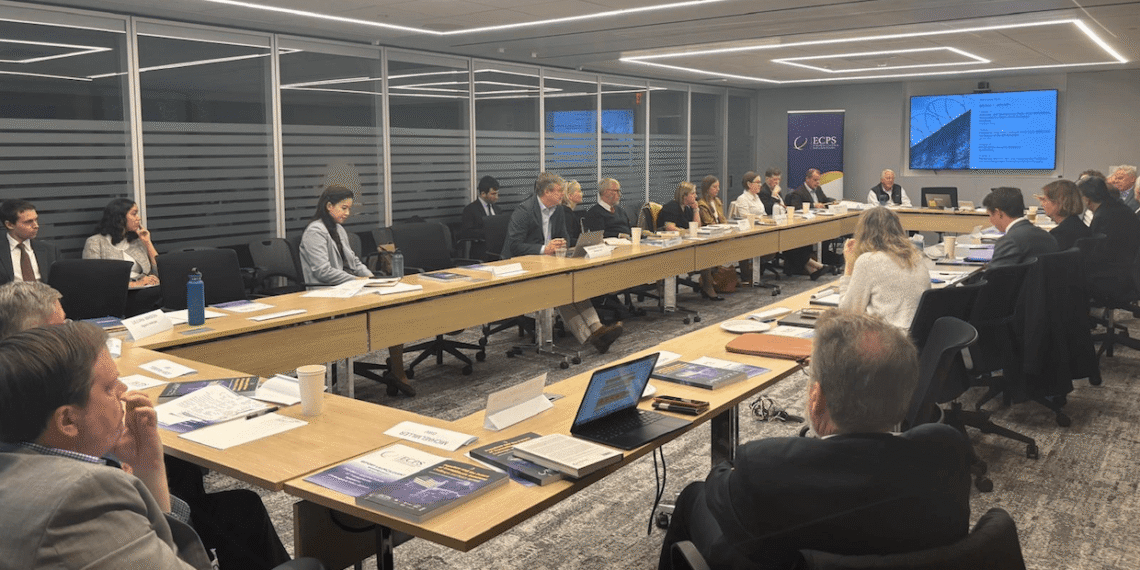
A high-level roundtable convened by the European Center for Populism Studies (ECPS) at the Center for American Progress (CAP) on April 20, 2026, brought together leading scholars and policy experts to examine how populism is reshaping transatlantic relations. Held under the Chatham House Rule, the discussion highlighted growing concerns over declining trust, institutional erosion, and the shift toward more transactional and unpredictable forms of diplomacy. Participants emphasized that populism operates less as a coherent ideology than as a governing style marked by rule-breaking and strategic uncertainty, with far-reaching consequences for global cooperation. The exchange pointed to an evolving transatlantic partnership—more selective, fragile, and contingent—while underscoring the need for renewed democratic coordination, institutional resilience, and sustained engagement beyond government channels.
Reported by ECPS Staff
On April 20, 2026, the European Center for Populism Studies (ECPS), in collaboration with the Center for American Progress (CAP), convened a closed expert roundtable in Washington, D.C., to examine the evolving nexus between populism and transatlantic relations. Bringing together a select group of scholars, policy analysts, and practitioners, the discussion focused on how contemporary political transformations—particularly the resurgence of populist leadership in the United States—are reshaping the strategic, institutional, and normative foundations of the transatlantic partnership.
Building on ECPS’s prior engagements in European policy circles, the Washington meeting shifted analytical attention toward the United States as a central agenda-setter in transatlantic relations. The discussion was structured around three thematic blocks: (1) US strategic reorientation, (2) populism and commitment to liberal democracy, and (3) pathways to re-engagement.
Framing the Discussion: A Relationship at a Turning Point
The roundtable opened with reflections on the ECPS report, which framed the current moment as a potential turning point in transatlantic relations. Participants broadly agreed that the relationship is undergoing a qualitative transformation, characterized by declining trust, shifting strategic priorities, and growing uncertainty about the durability of shared norms.
A central theme emerging from the introductory presentations was the distinction between structural and contingent explanations. While some developments—such as the US pivot to the Indo-Pacific and the relative rise of other global powers—reflect long-term structural changes, others appear closely tied to the political agency of contemporary populist leadership.
The discussion underscored that these dynamics are not mutually exclusive. Instead, structural pressures and political contingencies interact in ways that amplify uncertainty. In particular, the return of a populist administration in the United States has accelerated tendencies toward unilateralism, transactional diplomacy, and skepticism toward multilateral institutions.
Participants noted that, unlike earlier periods of tension, current disruptions are compounded by a deeper erosion of trust. European actors increasingly perceive the transatlantic relationship as subject to abrupt shifts across electoral cycles, undermining its reliability as a strategic anchor.
Populism as Political Agency: Rule-Breaking and Uncertainty
A key analytical contribution of the discussion concerned the conceptualization of populism. Rather than treating populism as a coherent ideology, participants emphasized its manifestation through political agency—specifically, the capacity of populist leaders to disrupt established norms and institutional constraints.
In this regard, populism was associated with a distinctive governing style characterized by rule-breaking behavior and the strategic use of uncertainty. As one participant argued, populist leaders often derive power from their willingness to challenge established rules, thereby reshaping the expectations that underpin international cooperation.
This dynamic has profound implications for the transatlantic system. The postwar order was built on a rules-based framework that enabled long-term planning, reduced transaction costs, and facilitated stable cooperation. When key actors repeatedly violate or reinterpret these rules, the system’s self-correcting mechanisms begin to erode.
Participants highlighted the cascading effects of such behavior. Even when most actors continue to adhere to established norms, the actions of rule-breaking leaders can disrupt dispute-resolution mechanisms, fragment global value chains, and generate systemic instability.
This perspective shifts attention from populism as rhetoric to populism as practice—an approach that foregrounds the operational consequences of leadership choices in shaping international relations.
Trade, Institutions, and the Erosion of Multilateralism
The discussion devoted significant attention to the impact of populist governance on international economic and institutional frameworks. In the domain of trade, participants noted that recent policy shifts—particularly the imposition of unpredictable tariffs—have undermined the predictability essential to global commerce.
These developments reflect a broader move toward transactionalism, in which economic relations are subordinated to short-term political objectives. While the majority of international trade continues to follow established rules, the weakening of dispute-resolution mechanisms has diminished the system’s capacity to manage conflicts effectively.
A parallel erosion was observed in multilateral institutions. Participants emphasized that these institutions depend not only on formal rules but also on the willingness of major powers to support and sustain them. When leading actors withdraw resources or disengage from cooperative frameworks, institutional effectiveness declines.
Examples discussed included the consequences of reduced US participation in global governance structures, which can create funding gaps, disrupt information-sharing networks, and weaken collective problem-solving capacities.
Importantly, participants noted that the current crisis of multilateralism is not solely the result of populist leadership. It also reflects longstanding concerns about representation and legitimacy within global institutions. Populist actors have capitalized on these grievances, framing institutional disengagement as a defense of national sovereignty.
Strategic Reorientation: Competition, Cooperation, and Fragmentation
The first thematic block of the discussion addressed the strategic dimension of transatlantic relations. Participants debated whether recent shifts represent a temporary deviation or a more durable realignment.
Several contributors argued that the United States is undergoing a strategic reorientation driven by both domestic politics and global competition. The increasing emphasis on the Indo-Pacific, coupled with a more transactional approach to alliances, suggests a recalibration of priorities that may persist beyond any single administration.
At the same time, the discussion highlighted the risks of fragmentation. As global value chains are reconfigured to enhance resilience and reduce dependency, they may become less compatible across regions. This process could lead to a form of “competitive strategic autonomy,” in which major actors develop parallel economic systems with limited interoperability.
For Europe, this presents a complex challenge. On one hand, there is a growing recognition of the need to reduce reliance on the United States and to enhance strategic autonomy. On the other hand, the transatlantic relationship remains a critical pillar of security and economic cooperation.
Participants suggested that the most plausible scenario is neither full decoupling nor a return to previous levels of integration, but rather a narrower and more selective partnership.
Populism and Liberal Democracy: Normative Divergence
The second thematic block focused on the normative dimension of transatlantic relations, particularly the status of shared democratic values. Participants expressed concern that populist politics are contributing to a divergence in commitments to liberal democratic principles.
Key tensions identified included the relationship between geopolitics and democracy promotion, the credibility of values-based foreign policy, and the role of non-state actors in sustaining democratic norms.
One line of argument emphasized that populist leaders often frame international institutions as constraints on national sovereignty, thereby weakening support for multilateral cooperation. Another perspective highlighted the internal contradictions of populist governance, noting that nationalist policies can lead to conflicts even among ideologically aligned actors.
The discussion also explored the potential for an alternative conception of transatlantic relations grounded in civilizational or cultural affinities rather than universalist values. While such narratives may resonate with certain political constituencies, participants questioned their viability as a basis for stable cooperation.
At the same time, the discussion acknowledged that populism is not inherently antithetical to democracy. Some participants emphasized its roots in legitimate grievances, including perceptions of inequality, corruption, and elite unresponsiveness. This perspective suggests that addressing the underlying drivers of populism is essential for restoring democratic legitimacy.
Pathways to Re-Engagement: Actors and Strategies
The final thematic block examined potential pathways for stabilizing and renewing transatlantic relations. Participants identified a range of actors and mechanisms that could mitigate political volatility and sustain cooperation.
At the governmental level, there was recognition of the need for pragmatic engagement across political divides. While ideological differences may limit the scope of cooperation, targeted initiatives in areas of mutual interest—such as security, trade, and technology—could provide a basis for continued collaboration.
Civil society and academic networks were highlighted as particularly important buffers against political disruption. Universities, think tanks, and research collaborations play a crucial role in maintaining dialogue, generating knowledge, and fostering mutual understanding.
Policy networks and economic stakeholders were also identified as key actors. Business communities, advocacy groups, and transnational partnerships can help sustain cooperation by emphasizing shared interests and interdependencies.
Participants emphasized that these actors are not substitutes for governmental engagement but rather complementary forces that can enhance resilience and adaptability.
Policy Reflections: Toward a More Resilient Partnership
In the concluding segment, participants were invited to propose concrete steps for improving transatlantic relations over the next two to three years.
Several recurring themes emerged:
Rebuilding Trust: Restoring predictability in policy and communication was identified as a critical priority. This includes strengthening institutional mechanisms that can endure political transitions.
Enhancing Strategic Autonomy: European actors should continue to develop independent capabilities while maintaining cooperation with the United States.
Reforming Multilateral Institutions: Addressing concerns about representation and effectiveness could help restore confidence in global governance frameworks.
Investing in Non-State Networks: Expanding collaboration among civil society, academia, and the private sector can provide stability in times of political uncertainty.
Addressing Domestic Drivers of Populism: Tackling inequality, corruption, and governance deficits is essential for mitigating the appeal of populist narratives.
Conclusion
The ECPS roundtable provided a multidimensional assessment of the challenges facing transatlantic relations in an era of populist resurgence. While the discussion highlighted significant risks—including institutional erosion, normative divergence, and strategic fragmentation—it also identified opportunities for adaptation and renewal.
A central conclusion of the meeting is that the transatlantic relationship is unlikely to return to its previous form. Instead, it is evolving into a more contingent and selective partnership shaped by both structural transformations and political agency.
At the same time, the discussion underscored the enduring importance of shared interests and values. Even as these foundations are contested, they continue to provide a basis for cooperation and resilience.
Ultimately, the future of transatlantic relations will depend not only on the actions of governments but also on the capacity of societies to sustain democratic norms, foster inclusive growth, and engage constructively across borders. In this sense, the challenge is not merely to defend existing institutions but to reimagine them in ways that reflect the complexities of a changing world.
The roundtable thus reaffirmed the need for sustained dialogue, critical reflection, and collaborative action, and essential ingredients for navigating the uncertain terrain of contemporary global politics.