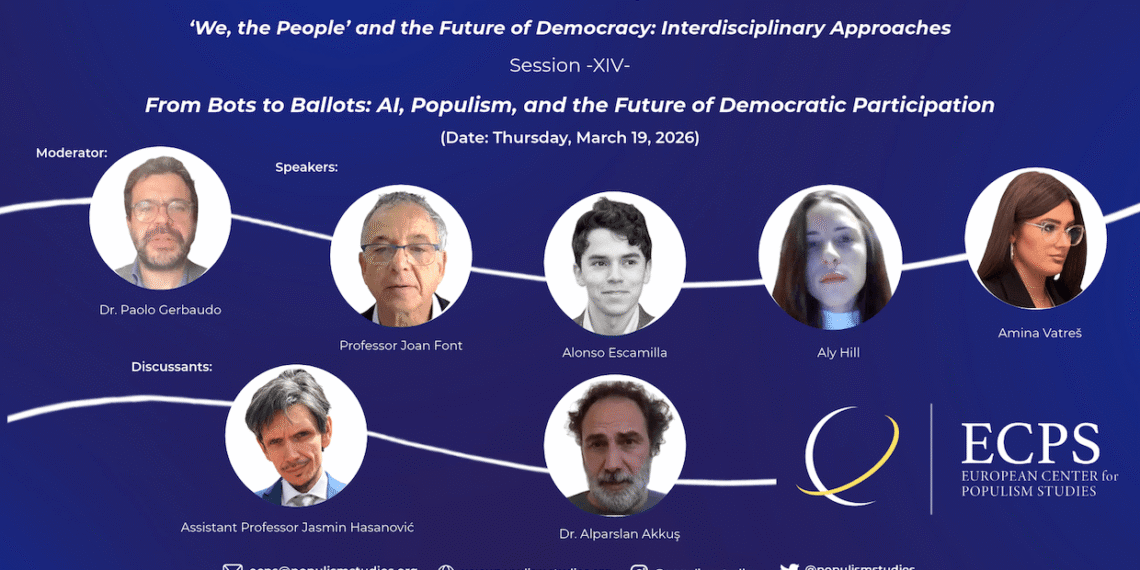
Session 14 of the ECPS Virtual Workshop Series examined how artificial intelligence, algorithmic infrastructures, and digital platforms are reshaping democratic participation in the contemporary era. Bringing together perspectives from political science, communication, cultural heritage, and democratic theory, the panel explored the implications of AI for political legitimacy, collective identity, and the future of “the people” in an increasingly post-digital world. Contributions ranged from public attitudes toward algorithmic governance and the role of ChatGPT in shaping cultural memory to Big Tech’s influence on class consciousness and the fragmentation of digital publics. Together, the presentations and discussions showed that AI is no longer external to democracy, but increasingly constitutive of its communicative, institutional, and symbolic foundations—raising urgent questions about power, accountability, and democratic contestation.
Reported by ECPS Staff
On Thursday, March 19, 2026, the European Center for Populism Studies (ECPS) convened the fourteenth session of its Virtual Workshop Series, “We, the People” and the Future of Democracy: Interdisciplinary Approaches, under the title “From Bots to Ballots: AI, Populism, and the Future of Democratic Participation.” Bringing together scholars from political science, communication studies, democratic theory, cultural heritage, and digital governance, the session examined one of the most urgent questions of contemporary political life: how artificial intelligence, algorithmic infrastructures, and platform logics are transforming democratic participation, political legitimacy, and the very conditions under which “the people” are constituted. From public attitudes toward algorithmic decision-making and the cultural politics of generative AI to the restructuring of class consciousness and the fragmentation of digital publics, the panel explored the shifting contours of democracy in an increasingly post-digital age.
The participants of the session were introduced by ECPS intern Stella Schade. Chairing the panel, Dr. Paolo Gerbaudo of the Complutense University of Madrid situated the discussion within a broader reflection on the transformation of democracy in the contemporary technological era. As he underscored, democracy has always been shaped by mediations—whether institutional, communicative, or technological—but what distinguishes the present moment is the centrality of digital infrastructures as key mediating forces in the organization of visibility, participation, and power. Algorithms, artificial intelligence systems, and platform architectures, he suggested, have become decisive “bottlenecks” through which political communication and democratic agency are increasingly filtered. In this sense, the session was framed not merely as a discussion of technology, but as an inquiry into the changing nature of democratic life itself.
Under Dr. Gerbaudo’s chairmanship, the panel featured four presentations that illuminated distinct yet interconnected dimensions of this transformation. Professor Joan Font (IESA-CSIC) examined citizens’ conceptions of democracy in relation to artificial intelligence in administration and government, asking who, if anyone, wants an algorithm to govern. Alonso Escamilla (The Catholic University of Ávila), co-authoring with Paula Gonzalo (University of Salamanca), explored how ChatGPT may shape European cultural heritage and its implications for the future of democracy. Aly Hill (University of Utah) turned to the United States to analyze how Big Tech is reshaping white working-class consciousness and reconfiguring populist narratives. Finally, Amina Vatreš (University of Sarajevo) offered a theoretical intervention on “the people” in an algorithmically mediated world, focusing on the interplay between filter bubbles, filter clashes, and populist identity formation.
The session also benefited from the incisive engagement of its discussants, Dr. Jasmin Hasanović (University of Sarajevo) and Dr. Alparslan Akkuş (University of Tübingen). Their interventions not only deepened the theoretical stakes of the presentations but also connected them to wider debates on political legitimacy, technological power, digital capitalism, and democratic fragmentation.
Together, chair, speakers, and discussants produced a rich interdisciplinary exchange that highlighted both the promise and the peril of AI-mediated politics. Session 14 thus offered a compelling inquiry into how democracy is being rearticulated in a world where digital systems no longer merely support political life, but increasingly structure its possibilities.