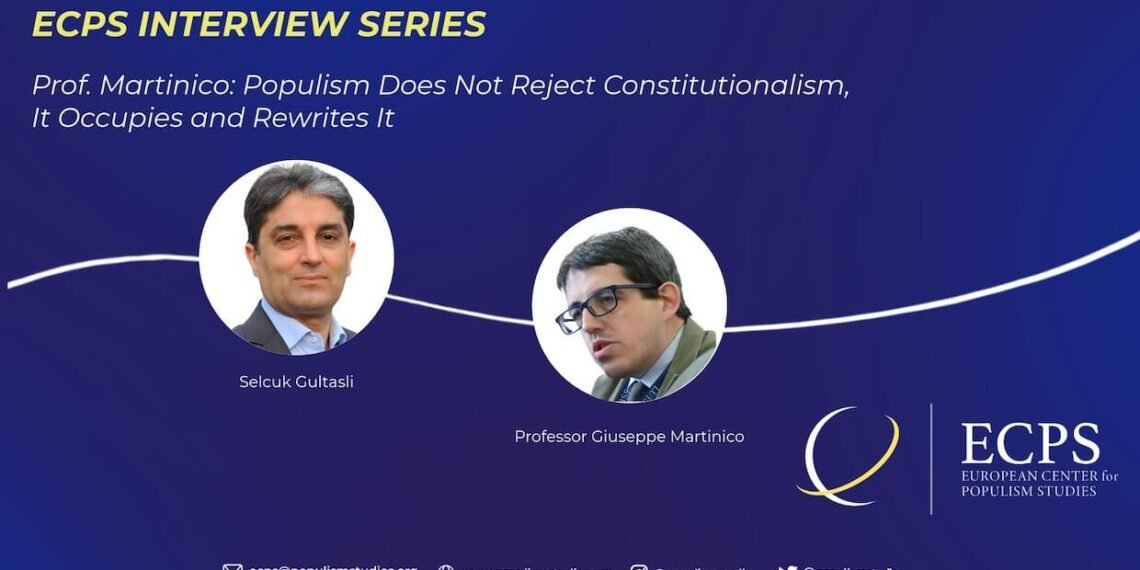
In this wide-ranging ECPS interview, Professor Giuseppe Martinico—Full Professor of Comparative Public Law at the Sant’Anna School of Advanced Studies in Pisa—examines how contemporary populist and illiberal movements increasingly weaponize constitutional law, sovereignty, and democratic institutions from within liberal constitutional orders themselves. Challenging conventional understandings of democratic backsliding, Professor Martinico argues that today’s populists often operate through “a sophisticated internal process of erosion operating under the guise of legality.” He warns that “populism acts as a parasite on the host organism of democracy,” occupying the language of constitutionalism while hollowing out its pluralist substance from within. The interview explores constitutional counternarratives, Euroscepticism, lawfare, judicial independence, memory politics, and the future resilience of constitutional democracy in Europe and beyond.
Interview by Selcuk Gultasli
Professor Giuseppe Martinico, Full Professor of Comparative Public Law at the Sant’Anna School of Advanced Studies in Pisa, is among the leading contemporary scholars examining the relationship between populism, constitutionalism, Euroscepticism, and democratic backsliding in Europe. Across a wide-ranging body of work—including Filtering Populist Claims to Fight Populism and the recent The Eurosceptic Mobilization of Constitutional Law, co-authored with Pablo Castillo-Ortiz—Professor Martinico has explored how illiberal and populist actors increasingly seek not to reject constitutional democracy outright, but to hollow it out from within by appropriating its language, institutions, and legal mechanisms.
In this interview with the European Center for Populism Studies (ECPS), Professor Martinico offers a sophisticated constitutional analysis of the contemporary populist challenge confronting liberal democracy across Europe and beyond. Rather than understanding democratic erosion primarily through the classic image of coups or overt authoritarian ruptures, Professor Martinico argues that today’s populist radical-right movements increasingly operate through what he describes as a “sophisticated internal process of erosion operating under the guise of legality.” As he explains, “Populism acts as a parasite on the host organism of democracy. It does not displace the vocabulary of democracy and constitutionalism; it occupies it. It exploits internal ambiguities and rewrites their meanings and definitions.”
Throughout the conversation, Professor Martinico examines how populist and sovereigntist actors weaponize constitutional law, sovereignty, referendums, judicial politics, and memory narratives in order to challenge the pluralist foundations of post-World War II constitutionalism. Drawing on examples from Hungary, Poland, Italy, Russia, Turkey, (Brexit) Britain, and the European Union itself, he demonstrates how contemporary illiberalism increasingly relies on formal legality, constitutional revisionism, and “lawfare” rather than open constitutional rupture.
The interview also explores the rise of what Professor Martinico and Castillo-Ortiz call “Eurosceptic constitutional counter-narratives,” through which radical-right movements transform constitutional law into a strategic weapon against European integration. At the same time, Professor Martinico warns against simplistic or purely technocratic responses to populism. Liberal democracies, he argues, must become more participatory and responsive while still preserving the “untouchable core” of pluralism, judicial independence, minority rights, and constitutional limits on majority power.
Importantly, the interview moves beyond diagnosis to address the future of constitutional democracy itself. Professor Martinico reflects on the erosion of Europe’s postwar constitutional memory, the delegitimization of intermediary institutions such as universities and courts, the growing tensions between constitutional openness and ethnonationalist identity politics, and the increasingly difficult role of supranational institutions such as the European Court of Human Rights and the Court of Justice of the European Union in resisting democratic decay.
Yet despite these profound challenges, Professor Martinico remains cautiously optimistic. Constitutional democracy, he argues, still possesses “considerable institutional and normative resources,” provided democratic societies are willing to reconnect participation with deliberation, strengthen civic institutions, and defend pluralism without abandoning democratic responsiveness.