Assoc. Prof. Robert Csehi argues that Hungary’s April 12 election represents a critical test of whether entrenched populist rule can be electorally challenged. While he notes that “it will definitely be a test of incumbency survival,” he emphasizes that deeper dynamics—“ideological adaptation, state resource asymmetries, and narrative control”—remain decisive. Assoc. Prof. Csehi highlights growing limits in Orbán’s populist discourse, which “has lost its novelty,” alongside shifting political conditions marked by economic grievances and the rise of the Tisza Party as a credible challenger. Yet, even in the event of electoral turnover, he cautions that deeply embedded institutional structures may persist, potentially leading to “a prolonged struggle over state capacity.” Hungary thus offers a crucial case for assessing the resilience and limits of populist governance in Europe.
Interview by Selcuk Gultasli
Giving an interview to the European Center for Populism Studies (ECPS), Dr. Robert Csehi, Associate Professor and Program Director of the Political Science Doctoral Program at the Corvinus University of Budapest, offers a nuanced and theoretically grounded assessment of Hungary’s evolving political landscape on the eve of a pivotal electoral contest.
As Hungary approaches its parliamentary elections on April 12, 2026, the country stands at a critical juncture. After sixteen years of rule under Viktor Orbán, the election has come to signify more than routine democratic competition. It represents a broader test of whether entrenched populist governance—characterized by institutional consolidation, discursive dominance, and asymmetrical resource control—can be meaningfully challenged through electoral mechanisms. The campaign unfolds amid deep polarization, intensifying geopolitical tensions, and mounting concerns over democratic resilience, media pluralism, and institutional fairness. At the same time, the emergence of Péter Magyar and the Tisza Party has introduced a new dynamic into Hungary’s political competition.
Against this backdrop, Assoc. Prof. Csehi underscores that “it will definitely be a test of incumbency survival,” while emphasizing that the stakes extend beyond electoral turnover to questions of “ideological adaptation, state resource asymmetries, and narrative control.” In his view, the durability of Hungary’s populist system is no longer assured. He identifies emerging cracks within the governing discourse, noting that “the supply of the populist worldview… has become less creative” and “has lost its novelty,” with the government increasingly relying on repetitive narratives—particularly around the war in Ukraine—to sustain mobilization.
At the same time, structural shifts on both the supply and demand sides of politics are reshaping the electoral terrain. The rise of the Tisza Party, Assoc. Prof. Csehi observes, has created “a new channel for people to express their grievances,”while also reactivating political engagement at the grassroots level. Concurrently, worsening economic conditions have intensified public discontent, as “people’s everyday grievances are rising,” and the government finds it increasingly difficult to externalize responsibility for inflation, corruption, and declining public services.
Assoc. Prof. Csehi’s analysis situates Hungary within a broader comparative framework, highlighting the uncertain trajectory of mature populist regimes. While electoral defeat could mark “the end of the Orbán regime” in formal terms, he cautions that deeply embedded institutional structures may persist, generating “a prolonged struggle over state capacity and institutional de-capture.” Conversely, a renewed victory for Fidesz would signal that such regimes retain significant resilience, even under conditions of economic strain and ideological fatigue.
Ultimately, as Assoc. Prof. Csehi concludes, the Hungarian case offers a critical empirical test: whether “a mature, populist-authoritarian regime can still be changed… in an electoral process.” In this sense, Hungary’s 2026 election stands as a defining moment not only for the country itself, but for understanding the resilience—and limits—of populist rule across Europe.
Here is the edited version of our interview with Associate Professor Robert Csehi, revised slightly to improve clarity and flow.
Populist Discourse Losing Creativity

Professor Csehi, welcome. Let me begin with the broader picture: In your scholarship, you argue that Hungarian populism has endured through the continuous reconstruction of “the people,” the redefinition of “the elite,” and the rearticulation of popular sovereignty. In the current campaign, do you still see this triadic logic operating effectively, or are its mobilizational limits beginning to emerge?
Assoc. Prof. Robert Csehi: I don’t think we do see some limitations to the effectiveness of this renewed populist discourse in Hungary. I think there are fundamentally three changes that actually challenge Orban’s effective populist discourse.
The first one is, in essence, that the supply of the populist worldview in the discourse has become less creative. It has lost its novelty. There were references to the war, for example, in Ukraine already in the 2022 elections—so four years ago. I mean, the war had just broken out, and they already used warmongering during that period. They pushed the campaign to the extreme in 2024 during the European parliamentary elections. They used essentially the same narrative, the same discourse. And they haven’t managed to really renew this discourse, and they keep talking about the same thing. They keep appealing to people’s fear of the war now. So, in comparison to previous elections, where every four years you had a new enemy and a new elite that was conspiring against Hungary and the government, we don’t really see that in 2026 compared to 2022 or 2024. So that’s one major change.
The second one obviously also affects, or concerns, the supply side of politics, and you already mentioned the rise of the opposition Tisza Party, which means there is actually a new channel for people to express their grievances and to mobilize their political demands behind a party which seems to have more legitimacy. It’s probably not the right word, but it resonates with people much better than the old opposition parties, which, on many grounds, have lost the trust of the people over the years—not only because they were ineffective, but also because they were involved in all sorts of scandals throughout the years. And now there is a new party which actually effectively challenges the government on a lot of issues and calls attention to many things that previously the old opposition, as we refer to it now, had not done. Plus, they really go down to the countryside, and they really do talk to people. They are engaging with the people and the electorate, and that makes a huge difference. So these are on the supply side, which are extremely relevant.
And then there is one demand-side feature which really has had a great effect. Since 2022, the Hungarian economy has not been doing very well. So, this has put a lot of things on the political agenda. People’s everyday grievances are rising, from inflation to public services, corruption, etc. It is not like Fidesz or Orban is able to cover these up anymore. We had skyrocketing inflation in the past few years, and it has become extremely difficult for the government to externalize these kinds of problems. And so people don’t shove it off anymore, like, “Oh, well, we’re still doing better no matter what the government does.” “Yeah, they might be corrupt, they might be wrong on certain policy issues, et cetera, et cetera, but we’re still better off than we were four years ago.” They don’t say that anymore. So, effectively, the economy plays a huge role in this entire story as well.
Election Tests Incumbency Survival
To what extent should the April 12 election be understood not merely as a contest between Fidesz and Tisza, but as a broader test of whether long-term populist incumbency can withstand mounting economic pressures, corruption fatigue, and shifting voter expectations?
Assoc. Prof. Robert Csehi: That’s a good question. It will definitely be a test of incumbency survival, in a sense, but, in the background, it is really about ideological adaptation, state resource asymmetries, and narrative control—namely, the extent to which these can still be maintained and used to hold power. I’m not sure to what extent these can actually withstand all the structural- and agency-based challenges that I’ve mentioned previously. So, it is going to be an interesting test from a political science perspective as well, to see whether they actually manage to survive or not, and to what extent a mature, populist-authoritarian regime can still be changed or won over in an electoral process. The jury is still out, and I’m really looking forward to seeing what happens afterwards.
EU Framed As Background Enemy

You have shown that Orbán’s Eurosceptic populism often adopts an anti-imperialist framing, portraying Brussels as an external elite constraining Hungarian sovereignty. How central is this narrative in the current campaign, and does it retain its resonance in a context where access to EU funds and economic stability are increasingly salient concerns?
Assoc. Prof. Robert Csehi: It’s a very important point in the elections. Not in terms of the EU being a central topic—by all means, that’s not the case. Really, Orbán’s campaign is focusing on the war in Ukraine. Still, they have managed to somehow link this up with the EU. They have had billboard campaigns showing Ursula von der Leyen and Manfred Weber together with Volodymyr Zelensky, suggesting that the EU is taking the money of Hungarians and channeling it to Ukraine and to President Zelensky. So, they try to mingle these things together, mix them, and bring in the EU as, again, this sort of background power that is mistaken and on the side of war.
They have populist, moralist, discursive division, where Orbán portrays himself as a pro-peace political actor, whereas everybody else who does not agree with him, by definition, becomes pro-war, even if it does not really make sense.
So, in a sense, the EU is still there; it is referenced as, once again, occupying a pro-war position. As I said previously, they try to repeat the same claims as they did in the 2024 European parliamentary elections—drawing these very fine lines between who is on the side of peace and who is on the side of war, and they clearly place Brussels and the EU on the side of the war. And as I said, it is not only about the war per se. They also try to refer to the financial side of it, bringing this back repeatedly—claiming that the EU is taking your money, holding back funds, and channeling them to Ukraine. So, they frame it as financing the war instead of supporting Hungarian people, etc.
So, it is not center stage—I would say it is still the sort of antagonistic relationship between Ukraine and Hungary at the moment—but they do try to bring this into the discussion: that the EU is somewhere in the background, conspiring and doing all sorts of shady and harmful things. And the reason why they do that is that over the past years they have managed to convert their electorate into the most Eurosceptic segment of the population. In comparison to all other party supporters—with the exception of Our Homeland, the far-right party—probably the most Eurosceptic electorate is behind Fidesz at the moment. So it is just natural that they also play those tunes for their voters.
Tisza Promises Policy Reset

From the perspective of European integration, do you interpret this election as a confrontation between two competing models of EU membership—one sovereigntist and illiberal, the other oriented toward re-integration through rule-of-law compliance and institutional alignment?
Assoc. Prof. Robert Csehi: Yes and no. On the one hand, I would agree that Orban has had a very particular idea of defending sovereignty in the EU. He has thought that the defense of national sovereignty and national interest could only be pursued in a confrontational way. You have to use the channels of the European Council or the Council itself to block things and not really participate in negotiations and deliberations.
There have been multiple occasions where Orban was not present—they sent him out to have a coffee. From research, we know that Council negotiations have shifted somewhat in recent years. What we would describe as a kind of de-Europeanization in the Hungarian approach to EU affairs is what has occurred on multiple fronts.
Compared to that, Tisza and Magyar’s approach are definitely different from Orban’s on some issues. You mentioned the rule of law. Tisza claims that it will join the European Public Prosecutor’s Office as soon as it is in government. It also promises to resolve some of these rule-of-law issues and to bring back the funds that have been frozen under Orban’s regime. So, we can expect a return to more normal relations with the EU. This promise is also supported by the personnel envisioned to lead foreign and European affairs within the party.
That said, I say yes and no because I do think that Tisza also supports a model of European integration based on strengthening intergovernmental relations, as opposed to a supranational takeover in multiple areas. We have seen this time and again. They have run into conflicts on different policy measures, even within the European Parliament and within their own faction in the European People’s Party.
So, on the one hand, there is likely to be an effort to restore relations and the credibility of Hungary as a partner within the EU. On the other hand, there will be areas where they confront and challenge the direction of European policy. It is not going to be a return to the old days where Hungarian representatives simply nodded to everything the European Union demanded from the government. Rather, it will involve a stronger representation of national interests, but in a more cooperative—as opposed to confrontational—manner than Orban has pursued.
Turnover Won’t End Orbánism
If Péter Magyar and the Tisza party were to win, would that necessarily signify the end of the Orbán era, or has Orbánism become sufficiently institutionalized within the state, the media landscape, and patronage networks to persist beyond electoral turnover?
Assoc. Prof. Robert Csehi: The easy answer, obviously, is that electorally this would be the end of the Orbán regime, at least temporarily. But when we really look into the structural features, I would say no. This will, in fact, be a very interesting period to study, to see how deep the roots of the regime actually went and grew, and how these roots actually act and behave under a new government. I would say there is fundamentally a deeper institutional structure here, which could make the life of the new government miserable on multiple accounts—from financial oversight to judicial oversight, etc. There are many aspects where the government has to govern effectively with its hands tied behind its back. So it is going to be difficult.
I would imagine that this will be something like a prolonged struggle over state capacity and institutional de-capture. They will try to take back some of these institutions with whatever legal means there are. Nevertheless, the government will have greater room for maneuver in terms of policies in many areas, and I do think that they can make changes that could have a positive outcome or resonance with the public.
And one thing we cannot really exclude as a possibility—again, the poll numbers are all over the place—but most independent pollsters show a 15 to even 20 percentage point lead for the opposition party, which could effectively also mean that Tisza would gain a two-thirds, or constitutional, majority. That would be a completely different ballgame, because with that, they could de-capture those institutions more easily. To what extent this would be done in a democratic way, or whether they would repeat something similar to what we have seen during the Fidesz era, I am not sure. I am just saying that there might be an opportunity for the new government to actually de-root the system, provided that they have a constitutional majority.
No Majority, No Regime Change
Some observers suggest that even a Tisza-led government could face significant institutional constraints stemming from constitutional engineering and entrenched loyalist networks. How should we conceptualize the possibility of electoral alternation without substantive regime transformation?
Assoc. Prof. Robert Csehi: This goes in line with my previous answer. Without a constitutional majority, what you will see is that there is likely to be governmental turnover, but there is not going to be a regime transformation. And then, there are different scenarios as to what will happen. If there is a constitutional majority, then we see a re-orientation or a re-democratization. If there is only governmental turnover without real regime transformation, what kind of room for maneuver does the new government have?
How do we conceptualize this? So this is definitely going to be an interesting case to analyze in terms of re-democratization attempts—whether they actually go deep or whether they are just going to hover at the surface, which we have seen before. We even had a study on this, on local governments, examining how they try to re-democratize even under a populist authoritarian regime. We might actually see something of this sort at the national level. But once again, the possible measures might be more confined if there is only a simple majority in Parliament, and that would definitely limit the options of the next government.
Loyalty And Shielding Protect Fidesz

Your work on populist resilience to corruption highlights how such regimes adapt to and withstand scandal. In Hungary today, which mechanisms—discursive reframing, institutional shielding, or partisan loyalty—appear most crucial in sustaining support for Fidesz?
Assoc. Prof. Robert Csehi: Given that the regime has reached its peak and is really a mature system, from a populist regime perspective, I would say, in line with our theoretical frame, that it is mostly the institutional shielding and the partisan loyalty that dominate at the moment. Let me give you an example, which is essentially a reflection of both. There is this huge scandal about the former governor of the National Bank (György Matolcsy) and his son. There is a scandal going around that hundreds of billions of forints were actually channeled out into private funds—essentially, they were just paid out to… we do not even necessarily know whom. We do know that the governor’s son really benefited from this. And what is happening now is that there is practically no police investigation going on, or, if there is, it is extremely slow. We do not really know what is happening. In the meantime, we already know that, for example, the governor’s son has tried to, or has already started to, ship his luxury car collection to Dubai, and these kinds of things.
So wealth is going out, and in the meantime, nothing is really happening. And nobody is really talking about the Matolcsy family, etc. So there is this partisan loyalty going on, and there is this institutional shielding, which does not allow these institutions to actually do anything about it. There is no prosecution going on. There might be some prosecution, but we do not really know why it is so limited, why it is so slow, why it is kept secret, and why they basically let the governor’s son do anything he pleases, given the fact that we know that hundreds of billions of forints were, in a sense, privatized. So, I do think that these two mechanisms are the most dominant ones.
Discursively, they do not even really try anymore. It is more like, “Well, we have nothing to do with the issue—let the institutions run their course,” but the institutions are not doing anything. So, it is just a sort of bogus narrative behind it.
What has really changed, on the other hand, is Péter Magyar’s rise in politics, because he is essentially an insider. And when he appeared, that was one of his biggest assets in politics, since this insider status was extremely relevant. When he talks about corruption claims against the government, it seems to mobilize anger much more effectively. This is what really matters here, because, on many issues, anger is a very strong motivational factor in politics, including in unseating incumbent governments. This is absolutely not a good feeling, I have to say, but it does trigger mobilization, and mobilization is key, obviously.
Peace Narrative Masks Polarization
The campaign has been strongly shaped by geopolitical narratives, particularly regarding Russia and Ukraine. Has Orbán’s positioning as a “peace-oriented” leader maintained its electoral appeal, or is his perceived proximity to Moscow becoming a source of political vulnerability?
Assoc. Prof. Robert Csehi: That’s not an easy question to answer. First of all, his portrayal of himself as “peace-oriented” is really just buying into his populist discourse of being a pro-peace person, while everybody else who does not agree with him is, by definition, pro-war. So, once again, you have this Manichean, moralistic kind of division within politics that populists are very fond of. Essentially, this type of division turns every political discussion and agenda point into a life-or-death situation. Here, it is literally portrayed as such: if we do not want this, then the next day, everybody is sent to the Ukrainian front and people will die there.
But I would not buy into this “peace-oriented leader” narrative at all. There is a columnist in one of the Hungarian weeklies who consistently describes Orbán as aggressor-oriented, and I think that is probably a better portrayal of what he actually is—without taking any normative position. If you ask what he means by peace, the government does not really have a clear idea of what peace would entail or how it should be achieved. In that sense, the aggressor-oriented description may be more accurate.
As for whether this narrative still works, I think it holds up quite well among the core electorate. We know from sociological and political studies that most of Orbán’s supporters come from the countryside, with lower levels of education and generally more limited economic means. Among these groups, the message still resonates. Talking about the war—through fearmongering, warmongering, and similar appeals—continues to be effective.
What they have also done quite effectively, and this is why they remain competitive, is to turn uncertainty around the war into anger. Studies on populism show that fear is not the main driver; anger is. Fear reflects uncertainty, whereas anger is directed—it needs a target. They have managed to convert uncertainty and fear into anger.
To some extent, President Zelensky also inadvertently contributed to this dynamic. A particular quote was picked up and amplified by pro-government media, portraying it as a threat to Orbán. This helped channel anger toward Zelensky and Ukraine.
They also continue to layer in additional discursive elements, such as claims that “they are taking your money.” Recently, the prime minister held town hall meetings across the country, where he accused protesters of siding with Ukraine and attempting to divert Hungarian resources there. This reflects a level of political rhetoric that is, frankly, quite unprecedented. Similarly, incidents such as damage to the Druzhba gas pipeline have been reframed as evidence that Ukraine is withholding Hungary’s energy supplies and weaponizing resources. This contributes to a constant, artificially orchestrated sense of anger directed at Ukraine. In that sense, the narrative still resonates with certain segments. There is some degree of creativity, but in terms of the broader narrative, they have not significantly shifted away from the war-centered discourse seen in 2022 and 2024.
Regarding Trump and Moscow, the situation is more complicated. Trump’s own actions—particularly the wars associated with his leadership—no longer support the earlier framing of him as a “pro-peace” figure. As a result, the government has largely stopped emphasizing this aspect and instead downplays it. Attempts to reinterpret such developments rhetorically have not been particularly convincing.
As for relations with Moscow, recent leaks concerning communications between Hungarian and Russian officials have raised questions. Depending on interpretation, these either reflect pragmatic diplomacy or suggest alignment with Russian interests, including the sharing of sensitive information.
Overall, both the Trump factor and the Russian connection appear to increase the government’s political vulnerability.
Trump Effect Mostly Symbolic
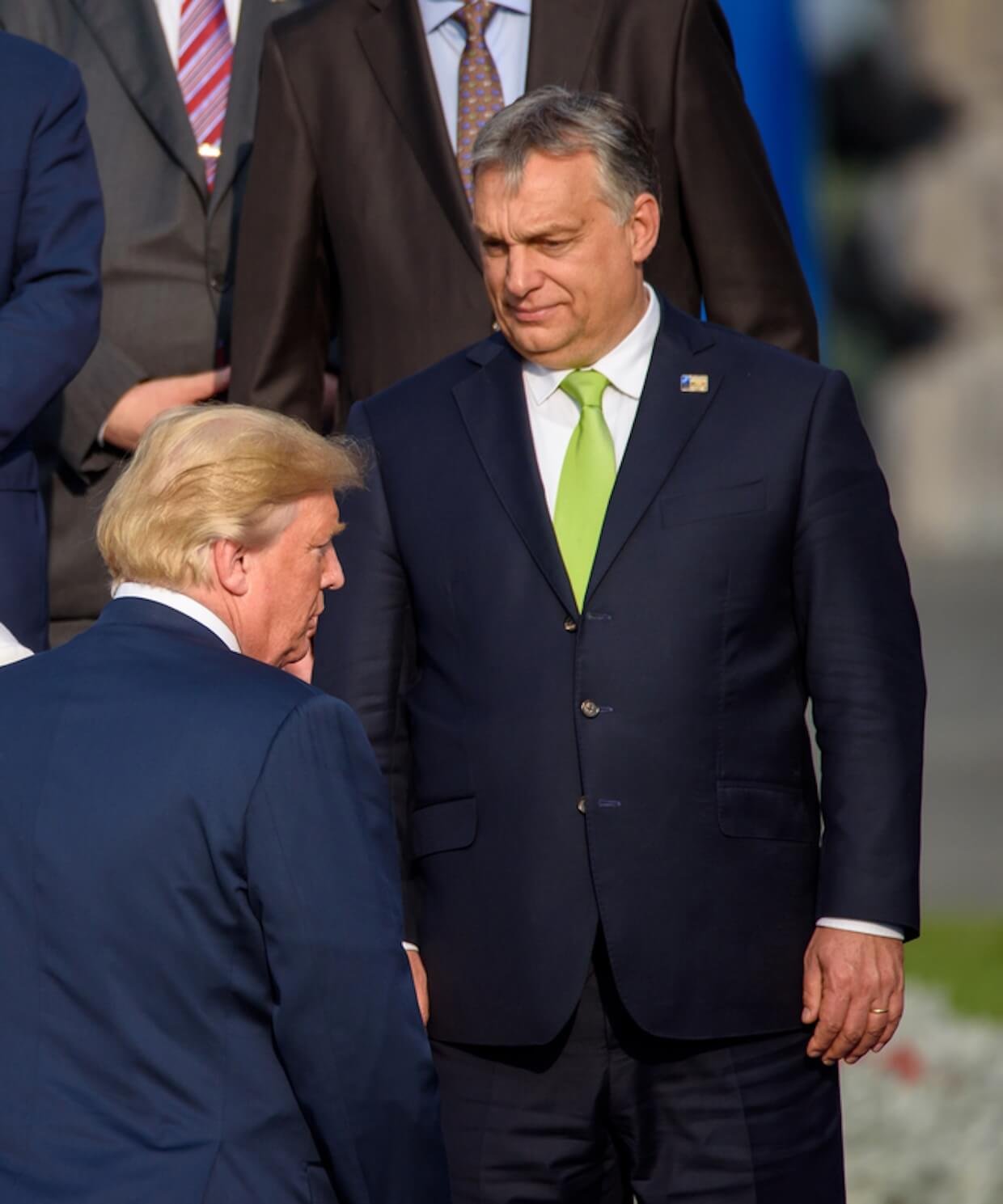
Hungary has long been embedded in a broader transnational network of right-wing populist actors. How significant is the “Trump effect” and Musk’s influence in this election, both in terms of symbolic validation and in reinforcing Orbán’s model of governance?
Assoc. Prof. Robert Csehi: I think it is really symbolic. I am not sure that, in terms of governance features, there is much there. Quite the reverse, I would say. It is really some American governors and high-ranking politicians who keep talking about copying this or that from Orbán, when it comes to, for example, dealing with LGBTQ issues in their states, etc. So, Orbán tries to position himself—and to some extent successfully—as a governance genius who should and could be copied by some of these international partners.
On the other hand, the extent to which they actually contribute to Orbán’s success is largely symbolic. As I said, the campaign is mainly about the war at this moment, so it is not really a question of whether there is transnational conservative endorsement or not—it does not matter that much. I do not see it that way. We had CPAC (the Conservative Political Action Conference) Hungary, which is a sort of mimic meeting of CPAC in the US where they invite right-wing politicians and intellectuals. It is a significant event. Just a couple of days ago, they announced that J.D. Vance, the US Vice President, is coming next Tuesday to Hungary. They probably wanted Trump to come but could not manage it, so it will be J.D. Vance. And the American government has already signaled that it supports Orbán’s re-election.
But, what matters most, once again, for the future—or for the short-term political room for maneuver of the government—is really the European partners. The EU and other European right-wing leaders are closely watching the election, because it could fundamentally change dynamics within the European Council and more generally within the integration process in the EU.
Hungary Tests Populism’s Limits
Finally, Professor Csehi, from a comparative perspective, what would each plausible outcome—a renewed Fidesz victory, a Tisza-led breakthrough, or a contested post-election scenario—tell us about the broader trajectory of populist rule in Europe and the capacity of democratic systems to dislodge entrenched illiberal incumbents?
Assoc. Prof. Robert Csehi: If Fidesz wins, this is still going to be an interesting scenario and an interesting political experience, which would tell us that, despite economic strains and despite the ideological fatigue that the government shows, and despite a strong challenger—a new challenger party emerging—the system still has some resilience. Then we would need to find out what actually triggered this resilience, or what made this resilience possible.
Now, this resilience, obviously, would send a message that electoral challenge is still possible, even with a populist regime that is extremely mature in its institutional design and structural features, etc. Therefore, none of these populist regimes are actually immune to a more systemic fatigue, and, if they want to survive, they need to be more creative in how they maintain the system.
But definitely, with a Tisza win, we would get very good information on how much democratic backsliding there actually was in the system, across different aspects. Most likely, this would generate immense knowledge that we could gain, and that would be extremely valuable for future studies. So I am very much looking forward to seeing what will happen. Those are my two cents on this point.