Please cite as:
Sharma, Dinesh & Streich, Gregory W. (2026). “The Orphan Paradox in India and the USA.” Journal of Populism Studies (JPS). July 06, 2026. https://doi.org/10.55271/JPS000128
Abstract
Why do some societies repeatedly elevate leaders marked by childhood loss, trauma, and adversity during periods of national crisis, while at other times they prefer leaders from established political, economic, and social elites? The Orphan Paradox explores a psychological, cultural, and developmental theory of democratic leadership that integrates developmental science, political history, economics, and personality theory to explain this recurring pattern in the United States and India. Drawing on biographical analyses of presidents and prime ministers from the eighteenth century to the present, the paper distinguishes between traumagenic outsiders—leaders whose identities were shaped by parental loss, family disruption, poverty, or other forms of early adversity—and patrician insiders, who emerged from stable, privileged, and institutionally embedded backgrounds. The central argument is that democratic electorates respond not only to policy preferences and economic conditions but also to symbolic narratives of resilience, authenticity, and continuity. During periods of war, economic inequality, institutional crisis, or social upheaval, voters are more likely to identify with leaders whose life histories embody hardship and recovery. Conversely, during periods of stability and prosperity, electorates tend to favor experienced insiders who represent institutional continuity, expertise, and elite governance. This dynamic produces a recurring epistemic or structural oscillation in democratic leadership between outsider reformers and insider custodians, which is not just a political phenomenon but a deeply psychological process.
Keywords: Orphan Paradox, Democratic Leadership, Political Psychology, Populism, Political Dynasties, Democratic Resilience, India, United States, Leadership
By Dinesh Sharma & Gregory W. Streich
Dynastic Politics in India and the USA
In both India and the United States, political dynasties have played a defining role in shaping democratic leadership, revealing how personal lineage and inherited legitimacy continue to intersect with modern electoral politics (Dal Bó et al., 2009; Hess, 2016).[1] In India, the Nehru–Gandhi family has dominated Congress Party politics for decades, serving as the symbolic and organizational center of the party since independence (Brass, 1994; Guha, 2007). Beyond the Congress, regional parties often mirror this pattern, functioning as quasi-familial enterprises in which leadership succession passes through kinship lines—examples include the Yadavs in Uttar Pradesh, the Thackerays in Maharashtra, and the Karunanidhi family in Tamil Nadu’s Dravida Munnetra Kazhagam (DMK) (Jaffrelot & Verniers, 2016; Wyatt, 2013; Palshikar & Kumar, 2004). These familial structures often blur the boundaries between public service and private inheritance, creating networks of loyalty that reinforce both political continuity and resistance to internal reform (Chandra, 2016).
The United States, though formally committed to competitive primaries and elections with open political participation, exhibits its own dynastic patterns. The Kennedys, Bushes, Roosevelts, and Adams–each representing distinct political eras and ideological lineages—have used family name recognition, donor networks, and the symbolic capital of service and sacrifice to sustain their influence across generations (Hess, 2016; Feinstein & Masur, 2020). More recently, the Trump family’s growing presence within Republican politics underscores how populism, too, can potentially become dynastic, converting media visibility and brand identity into a new form of hereditary legitimacy (Saldin & Teles, 2020; D’Antonio, 2015). Trump may be the first modern president to combine outsider populism with explicit aspirations toward patrician and founder-level historical status. He attacks existing dynasties (Bush, Kennedy) yet simultaneously attempts to create a new one and to place himself in the symbolic lineage of Washington, Lincoln, and other nation-defining presidents such as Jackson and McKinley.
Across both democracies, the enduring appeal of dynastic politics reflects a paradox: voters simultaneously profess faith in meritocracy while responding to the familiarity, continuity, and symbolic legitimacy that political families provide (Besley & Reynal-Querol, 2011). Dynasties persist by drawing upon accumulated forms of capital—symbolic, financial, social, and emotional (Bourdieu, 1986)—yet their influence often weakens during periods of public disillusionment, corruption scandals, economic distress, or generational fatigue (Vaishnav, 2017). Dynastic politics thus functions as both a stabilizing and destabilizing force within democracy, embodying the tension between inherited privilege and democratic renewal.
Yet the counterpart to the dynastic heir is the political orphan or the outsider—the individual who possesses neither inherited status nor established networks of privilege. In many democracies, moments of political upheaval create opportunities for leaders whose authority derives not from lineage but from narratives of adversity, resilience, and personal struggle. Among the most striking of these figures are those who experienced significant childhood loss through parental death, family disruption, abandonment, or displacement. The Orphan Paradox proposed here, which constitutes our main thesis, suggests that early experiences of rupture may cultivate psychological characteristics—such as independence, ambition, resilience, and a heightened sensitivity to insecurity—that can later translate into political leadership.[2] Whereas dynastic leaders inherit political capital, orphan leaders are often compelled to construct it. Their biographies resonate with citizens who perceive themselves as marginalized, overlooked, or excluded from established systems of power. It allows outsiders, such as orphans, to speak for the people against the establishment, as is evident in recent years in the populist turn and the rise of amateur politicians. In this sense, the orphan and the heir represent two competing pathways to political legitimacy: one rooted in inheritance and continuity, the other in adversity and self-creation.
The Orphan Paradox describes the condition of loss: the absence of foundational support—whether parental, institutional, cultural, or even genetic—creates a dual trajectory. On one hand, it heightens vulnerability to instability, alienation, and maladaptive coping; on the other, it can spark remarkable resilience, innovation, and self-determined leadership. This paradox applies across multiple domains of human experience, from individual psychology to political systems and technological development (Sharma, 2026, 2025).[3]
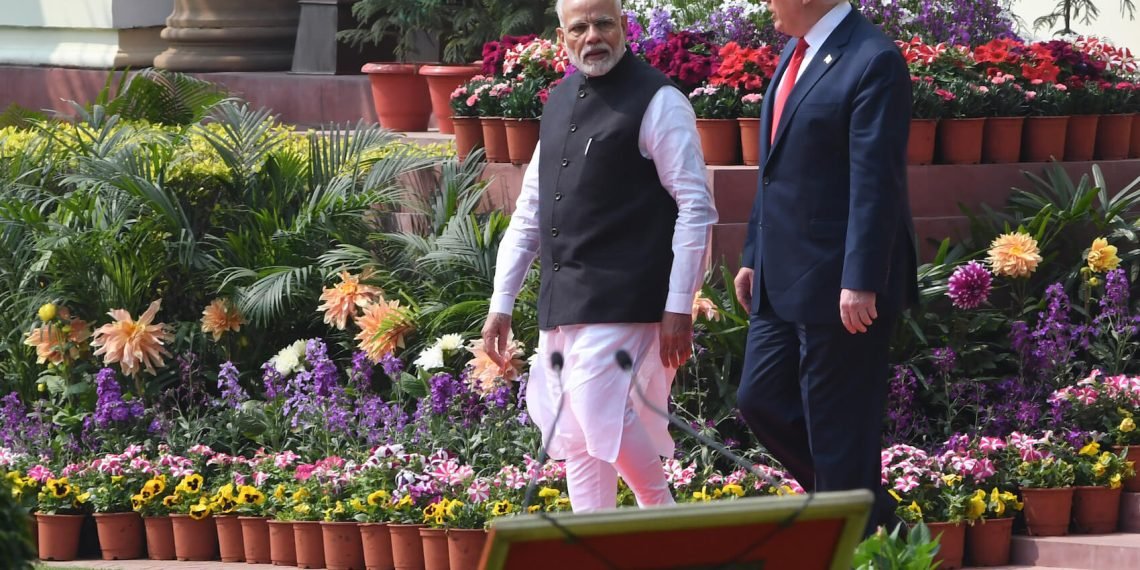
This paper examines these dynamics – the outsider and the heir, the orphan and the patrician – in two of the world’s largest and most populous democracies, India and the United States, both of which emerged from profound historical ruptures and continue to grapple with competing demands for continuity and change (Moffitt, 2016; Jaffrelot & Tillin, 2017). In particular, we connect the rise of Modi in India and Trump in the USA – two political populists, one of whom left home early as a teenager to seek spiritual renunciation and the other who carries the scars of a fraught relationship with his demanding and wealthy parents – with the current trend towards nationalists who take on corrupt elites on behalf of the people (Mudde & Kaltwasser, 2017). Ironically, while in both India and the USA, there is a turn away from the familiar, stable, dynastic family names, both Modi and Trump are examples of how populists position themselves as outsiders seeking to become establishment insiders by creating their own autocracies or dynasties.
Read the Full Text
Footnotes
[1] This paper in large part is adapted from the forthcoming book, The Orphan Paradox (Sharma, 2026), which presents a detailed psychocultural, historical, and political analysis of leadership cycles in India and the US. An earlier version of this paper was presented at the ECPS workshop on September 4. 2025. We thank Professor Akis Kalaitzidis for his comments on this paper and the book. We are also immensely grateful to Dr. Arturo G. Munoz, senior political scientist at RAND Corporation, Washington DC, for his commentary on this project. This paper was partly inspired by the contemporary rise of nationalism worldwide. An earlier version of the proposal was reviewed by Dr. Munoz, who suggested that the argument would benefit from a stronger engagement with current political developments. In particular, he encouraged a more explicit comparison between Narendra Modi and Donald Trump as contemporary leaders whose rise reflects broader global trends.
Parts of this paper were originally developed for an edited volume on WEIRD psychology, which critiques the overreliance on Western, educated, industrialized, rich, and democratic populations in psychological research (Joseph Henrich et al., 2010); the goal here is to show how democracy takes different forms in different contexts.
[2] For a full treatment of the underpinning of psychological, cultural, and political arguments, see the book, The Orphan Paradox (Sharma, 2026).
[3] The idea of the Orphan Paradox is interdisciplinary. First, developmental perspectives in leadership studies suggest that early experiences of trauma and loss can shape resilience, ambition, and identity formation over the life course. Work in political psychology and leadership analysis (e.g., Jerrold M. Post, 2003) highlights how formative adversity often informs leadership style and worldview. Second, my professional experience in the pharmaceutical sector exposed me to the concept of “orphan drugs” and “orphan markets,” terms institutionalized through policy frameworks such as the Orphan Drug Act. These refer to conditions or markets that lack early institutional support yet later become sites of innovation and intervention.