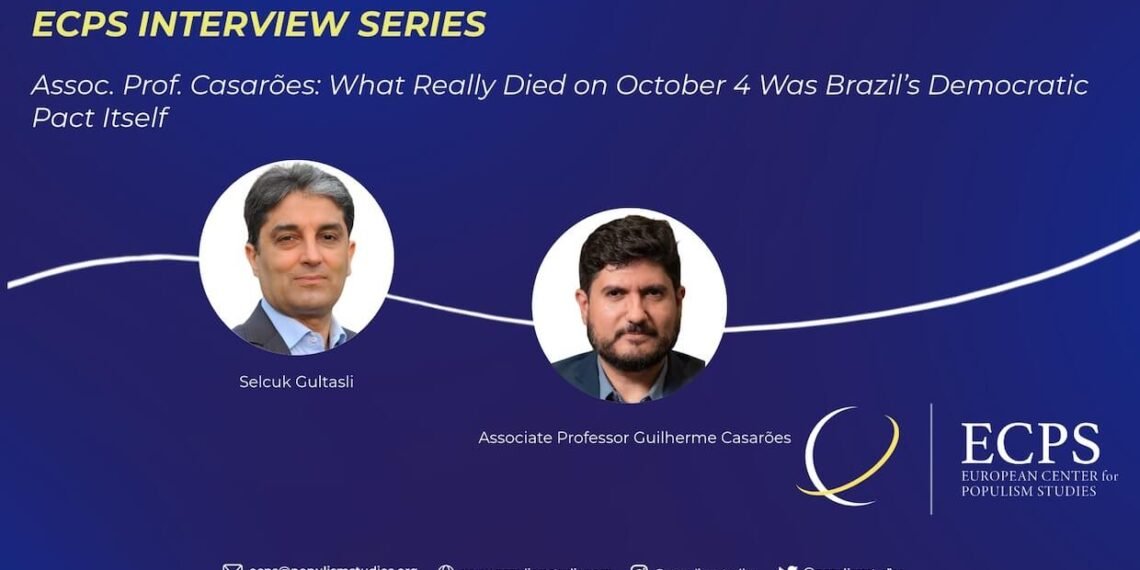
Associate Professor Guilherme Casarões argues Brazil’s October 4 election marks more than a contest between Luiz Inácio Lula da Silva and Flávio Bolsonaro: it signals a deeper transformation of the country’s democratic order. Assoc. Prof. Casarões contends that “what really died, or what really was defeated on October 4th, was Brazil’s democratic pact itself,” while stressing that this does not mean democracy has ended. He sees Bolsonarism as still fundamentally personalistic, continuing to revolve around Jair Bolsonaro even as Flávio emerges as its electoral standard-bearer. The interview explores identity polarization, Christian nationalism, punitive security politics, Trumpism, and the transnational far right, while also examining Lulism’s growing association with the establishment. Together, these dynamics place Brazil at what Assoc. Prof. Casarões describes as a consequential political “crossroads.”
Interview by Selcuk Gultasli
Brazil’s October 4, 2026 presidential election produced a first-round result that significantly altered the political landscape ahead of the October 25 runoff. Flávio Bolsonaro finished first with about 47% of the vote, ahead of incumbent President Luiz Inácio Lula da Silva on 45.1%, while right- and far-right forces also performed strongly in congressional and gubernatorial contests. The outcome sharpened the confrontation between Lulism and a post-Jair form of Bolsonarism, while also raising broader questions about the resilience of Brazil’s post-authoritarian democratic settlement, the institutionalization of the radical right, and the future of political representation in the country.
In this interview with the European Center for Populism Studies (ECPS), Guilherme Casarões, Associate Professor of Brazilian Studies at Florida International University, argues that the significance of October 4 extends well beyond the immediate electoral competition between Lula and Flávio Bolsonaro. For Assoc. Prof. Casarões, the most consequential development is not simply the continued strength of Bolsonarism without Jair Bolsonaro on the ballot, but what the election reveals about the transformation of Brazil’s democratic order. As he puts it, “what really died, or what really was defeated on October 4th, was Brazil’s democratic pact itself.”
Assoc. Prof. Casarões is careful to stress that this does not mean Brazilian democracy has ended. Rather, he argues that the political pact sustaining democracy since the transition from military rule in the mid-1980s and its constitutional consolidation in 1988 “is now gone, or at least seems to be over for now.” In his view, this makes the 2026 election even more consequential than the watershed contests of 2018 and 2022. Brazil, he argues, has reached “a crossroads,” with the future character of its democratic system increasingly uncertain.
At the same time, Assoc. Prof. Casarões resists interpreting Flávio Bolsonaro’s success as evidence that Bolsonarism has already become fully institutionalized. Despite the son’s electoral rise and the growing importance of the Liberal Party, he maintains that the movement “still gravitates around the image of Bolsonaro the father” and remains “a very personalistic movement.” Ultimately, he suggests, Bolsonarism still resembles “a cult of a person,” and “this person is Jair Bolsonaro himself.”
The interview develops this diagnosis across a wider set of themes: the decline of policy-based competition and the rise of identity polarization; Christian nationalism and the religious-populist radical right; punitive approaches to crime; the transnational circulation of far-right ideas; and the interaction between Trumpism and Bolsonarism. Assoc. Prof. Casarões also examines the contrasting trajectory of Lulism, arguing that Lula has increasingly come to symbolize the establishment itself. Taken together, his analysis presents October 4 not merely as an electoral upset, but as a possible marker of a deeper reconfiguration of Brazil’s democratic and populist politics.