
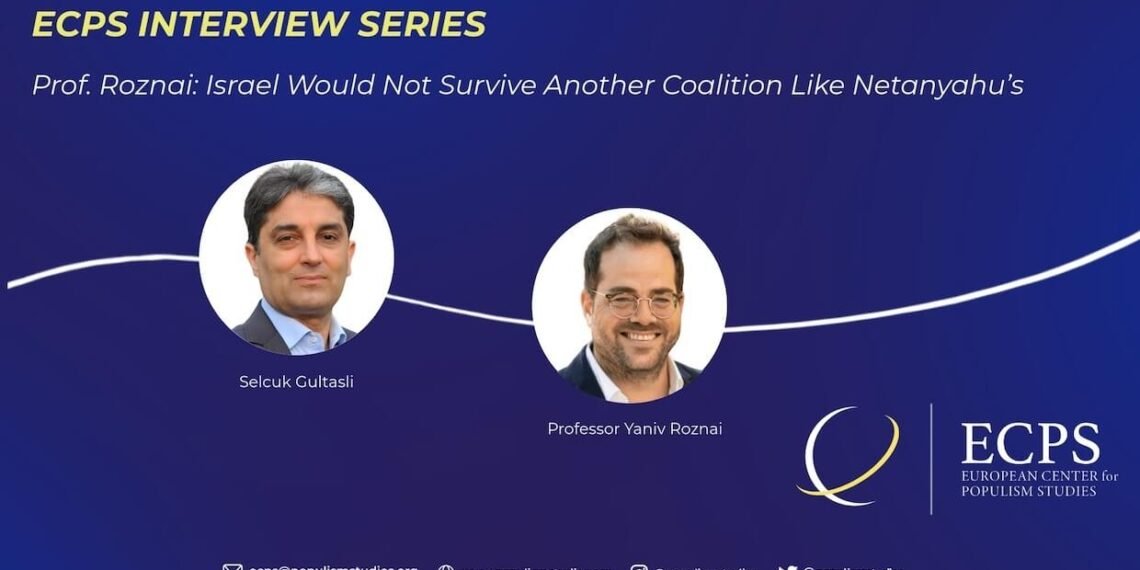
As Israel approaches the October 27 elections, constitutional scholar Professor Yaniv Roznai warns that another Netanyahu-led coalition could threaten the country’s liberal-democratic future. In an in-depth interview with the ECPS, he declares: “I genuinely fear that Israel, as a country seeking to endure for generations to come, would not survive another coalition like this.” Examining democratic backsliding, judicial independence, political polarization, and the growing influence of religious nationalism, Professor Roznai also cautions that Netanyahu’s defeat would mark only the beginning of democratic restoration. Drawing comparisons with Poland and Hungary, he argues that Israel’s fragmented opposition would face formidable coalition challenges. Meaningful democratic renewal, he maintains, requires constitutional safeguards, stronger institutional checks and balances, and democratic education.
Interview by Selcuk Gultasli
As Israel approaches the October 27 elections, its democracy faces profound challenges stemming from Prime Minister Benjamin Netanyahu’s populist leadership, the growing influence of the religious-nationalist far right, the controversial judicial overhaul, and the devastating consequences of October 7 and the war in Gaza. Together, these developments raise fundamental questions about democratic backsliding, constitutional resilience, and whether electoral change can reverse the institutional and societal transformations of recent years.
In an interview with the European Center for Populism Studies (ECPS), Professor Yaniv Roznai, Professor of Constitutional Law and Co-Director of the Rubinstein Center for Constitutional Challenges at Reichman University and Laurance S. Rockefeller Visiting Professor for Distinguished Teaching at Princeton University’s University Center for Human Values, offers a deeply concerned assessment of Israel’s democratic trajectory. A leading scholar of constitutionalism, populism, and democratic erosion, Professor Roznai warns that another Netanyahu-led coalition could have existential consequences for Israel’s liberal-democratic future.
Reflecting on the possibility of Netanyahu remaining in power, Professor Roznai states: “I genuinely fear that Israel, as a country seeking to endure for generations to come, would not survive another coalition like this.” His warning extends beyond institutional deterioration to the potential departure of Israel’s educated and liberal population. “I’m afraid that if another Netanyahu coalition comes to power, hundreds of thousands of people will leave Israel in the coming years,” he observes, pointing to the already significant emigration of academics, doctors, and other professionals.
Professor Roznai situates these concerns within a broader analysis of populist constitutionalism. Although Israel has not yet crossed the threshold into electoral authoritarianism, he argues that its democratic institutions remain vulnerable to executive encroachment. As he explains, “The more polarized a society becomes, the weaker the commitment to democratic values within a leader’s political base.” He identifies the judiciary, independent legal authorities, and civil society as essential safeguards against the concentration of political power.
Drawing on comparative experiences, Professor Roznai argues that a post-Netanyahu Israel would resemble Poland more than Hungary, primarily because of the fragmentation of its opposition and the complexities of coalition formation. Unlike Hungary, where Péter Magyar emerged as a dominant opposition leader, Israel’s alternative political camp encompasses ideologically diverse parties from the left, center, and right, alongside Arab parties. Even if Netanyahu loses, Professor Roznai cautions, the resulting government would struggle to pursue a unified agenda of democratic restoration. “From a comparative perspective, this would resemble Poland more than Hungary,” he observes, emphasizing that Israel would not have “a single leader winning the elections and exercising overwhelming control over the coalition.” Such fragmentation could complicate efforts to reverse institutional abuses and strengthen democratic safeguards.
Professor Roznai also cautions against assuming that Netanyahu’s electoral defeat would automatically restore democratic governance. “That will not be the end of the story. It will only be the beginning,” he emphasizes. Meaningful restoration, in his assessment, would require completing Israel’s Bill of Rights, strengthening constitutional safeguards, protecting judicial independence, and rebuilding democratic literacy through education.
Ultimately, his assessment presents the coming elections not simply as a contest over political leadership but as a critical juncture in the struggle over Israel’s constitutional identity, democratic institutions, and long-term national future.