

In this interview for the ECPS Voice of Youth series, Khayyam Rzazade, Marie Skłodowska-Curie Doctoral Candidate at the University of Genoa and founder of PopuliVerse, argues that populism must be understood as a global political logic rather than a regional pathology. Drawing on his research into Europe’s foreign and defense policies, he examines how populist actors selectively politicize international affairs while often maintaining established strategic commitments. Introducing his concept of foreign policy activation, Rzazade explores the conditions under which foreign policy becomes a site of people-versus-elite contestation. He also discusses PopuliVerse, an innovative research platform connecting fragmented scholarly debates, and advocates a comparative, methodologically rigorous approach that takes citizens’ political motivations seriously across diverse geographical and ideological contexts.
Interview by Natalia Crane
As populist movements increasingly influence international relations, security debates, and defense policy, understanding their political logic has become essential to contemporary political scholarship. In this interview for the European Center for Populism Studies (ECPS) Voice of Youth (VoY) series, Khayyam Rzazade, founder and editor of PopuliVerse,argues that populism must be approached as a dynamic political phenomenon transcending ideological and geographical boundaries. Reflecting on his experiences across the post-Soviet space and Europe, Rzazade emphasizes that “populism needs to be studied as a global political logic, not a regional pathology.”
Originally from Azerbaijan, Rzazade is a Marie Skłodowska-Curie Doctoral Candidate at the University of Genoa, participating in IDEoPOP, an EU-funded doctoral network examining populism’s international dimensions. Supervised by Professor Fabrizio Coticchia and co-supervised by Professor Christian Lequesne at Sciences Po Paris, he has studied at institutions including Baku State University, Ca’ Foscari University of Venice, and the College of Europe. His professional experience spans parliamentary work, European institutions, and university teaching.
Drawing on Ernesto Laclau, Benjamin Moffitt, and Cas Mudde, Rzazade conceptualizes populism not as a fixed ideology but as “a way of constructing politics around a fundamental division between ‘the people’ and an elite that is said to betray them.” His approach identifies three interconnected repertoires: plebiscitarian mobilization, antagonistic identity construction, and crisis performance. Crucially, these practices vary across political contexts, allowing the same actors to adopt populist rhetoric selectively.
This framework informs his doctoral research on how populist actors shape Europe’s foreign and defense policy, particularly amid Russia’s war against Ukraine, European rearmament, and uncertainty in transatlantic relations. Challenging assumptions that populist governments necessarily overturn established international commitments, Rzazade observes that “they pick their battles, making a loud people-versus-elite argument on one foreign policy issue and remaining entirely conventional on the next.”
His concept of foreign policy activation examines when governments transform international questions into populist political conflicts. Despite growing domestic contestation, he argues that institutional commitments to NATO and the European Union frequently constrain radical policy departures. Consequently, populist governments often produce “change within orientation rather than change of orientation.”
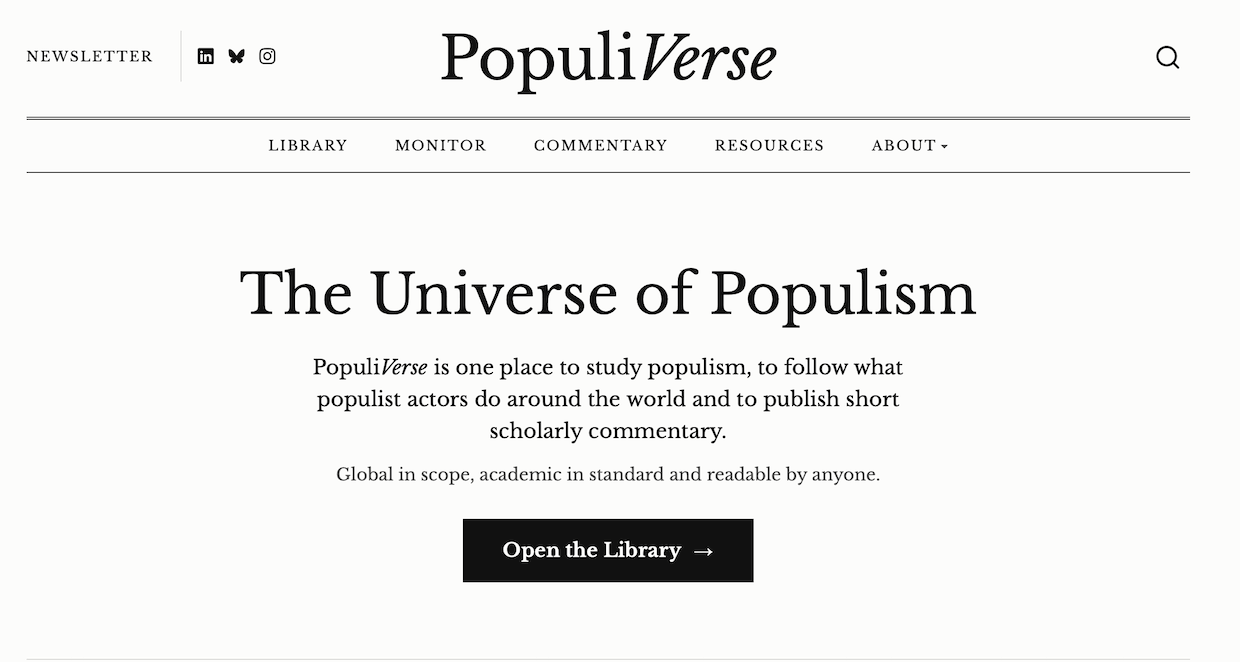
Beyond his doctoral research, Rzazade discusses PopuliVerse, an initiative connecting fragmented scholarly conversations through a research library containing more than 8,000 academic works, a monitoring publication, and a commentary platform. His ambition reflects a commitment to making comparative populism research accessible across disciplines and regions.
Ultimately, Rzazade advocates methodological openness and greater attention to understudied political contexts, particularly the post-Soviet world, Asia, and Africa. Rejecting both the pathologization and romanticization of populism, he argues that scholarly rigor requires recognizing that “the people populists speak to are not a research problem. They are citizens with reasons.”
The interview with Khayyam Rzazade is lightly edited to enhance clarity, readability, and overall flow for publication.
From European Foreign Policy to the International Dimensions of Populism

To begin, could you introduce yourself, outline your academic journey, and explain how your research interests developed? Why do you believe your area of research is particularly significant in today’s global political environment?
Khayyam Rzazade: I am a Marie Skłodowska-Curie Doctoral Candidate at the University of Genoa, working within IDEoPOP, an EU-funded doctoral network on the international dimensions of populism. My research is supervised by Professor Fabrizio Coticchia in Genoa and co-supervised by Professor Christian Lequesne at Sciences Po Paris. I also founded and edit PopuliVerse, a platform for populism research, or as I like to call it, “the universe of populism.”
I come from Azerbaijan, and my studies have taken me from Baku State University to Ca’ Foscari University of Venice, the European Academy of Diplomacy in Warsaw, and the College of Europe in Bruges, with an exchange year in Minsk in between. I have also interned at the Parliament of Azerbaijan, assisted a Member of the European Parliament, and taught Political Theory and Political Analysis to undergraduates at Baku State University and International Security to master’s students at ADA University. It has been quite a journey, and each of these experiences has left its mark on how I think.
My interests began with European foreign and security policy, particularly how the European Union builds a common response to threats such as Russia. The longer I worked on these questions, the clearer it became that foreign policy is not made only in Brussels or in ministries. It is also contested in parliaments, in the media, and around kitchen tables, and populist parties were frequently the actors challenging the established consensus. When the IDEoPOP position was announced, it felt as if it had been written with me in mind. This is how I arrived at my current research on how populist actors shape foreign and defense policy in Europe.
I believe this research matters a great deal today. Foreign and defense policy were long treated as areas of elite agreement, relatively sheltered from party competition, and that is no longer the case. Populist parties now govern or share power in several European countries, while Europe faces the war in Ukraine, a major debate over rearmament, and an uncertain transatlantic relationship.
These are decisions with long-term consequences, and citizens increasingly expect a say in them. As someone who studies populism, I try never to forget that the word begins with the people. Understanding how populists speak to citizens about security, and why so many citizens listen, is essential if Europe wants its foreign policy to remain both coherent and democratic.
Intellectual Influences: From Political Theory to Personal Experience
Who or what has most profoundly influenced your intellectual development? Are there particular scholars, books, experiences, or even unexpected sources of inspiration that have fundamentally shaped your thinking?
Khayyam Rzazade: My intellectual development has been shaped as much by places as by texts. Growing up in Azerbaijan, a young state in a difficult neighborhood, taught me early that foreign policy is never an abstraction. It touches borders, families, and daily life. Later, working at the European Parliament, I saw from the inside how slowly and carefully common European positions are built, and how fragile they can be. These two experiences still frame how I read everything else.
Among scholars, three have influenced me most. Ernesto Laclau taught me to treat populism as a political logic rather than a fixed set of policies, which is the starting point of my own conceptual framework. Benjamin Moffitt’s work on populism as a political style, and especially on the performance of crisis, showed me that how populists speak and behave matters as much as what they claim to believe. Cas Mudde’s ideational approach, even where I depart from it, gave the field a shared vocabulary without which comparative work would hardly be possible. I would also add my supervisor, Fabrizio Coticchia, whose work on Italian defense policy convinced me that defense is a domain of party politics and public opinion, not only of strategy.
The less expected sources are sport and teaching. Long-distance running and cycling have taught me more about patience and consistency than any methods course, and a doctorate is above all a test of both. Teaching undergraduates in Baku taught me that if I cannot explain an idea to a twenty-year-old in plain words, I probably do not understand it well enough yet. I still apply that test to my own writing.
Studying International Politics Across Different Academic and Cultural Contexts
Having studied and worked in several countries, how have different academic environments and cultural contexts shaped your understanding of international politics? Have these experiences challenged any of your earlier assumptions about the subjects you study?
Khayyam Rzazade: Studying in Baku, Minsk, Venice, Warsaw, Bruges, and now Genoa and Paris have given me something no single institution could: the habit of noticing how differently the same event looks from different parts of the world.
In Baku, international politics was taught and discussed as a matter of survival for a small state between large neighbors. In Minsk, I saw a political system where the gap between official discourse and everyday conversation was wide, and where people had learned to read between the lines. Venice introduced me to the Italian tradition of thinking about politics historically and theoretically. Warsaw taught me how real the Russian threat feels on the EU’s eastern border. Bruges and Brussels showed me the European Union from the inside, with its achievements and its endless compromises. Each place shifted my vantage point a little, and I think that is exactly what a scholar of international politics needs.
These experiences challenged two assumptions I once held. The first was that there is a single “European” view of security. There is not. What looks like excessive caution in Rome looks like dangerous naivety in Warsaw, and both positions are held by serious and well-informed people. This is one reason why I became interested in the domestic contestation of foreign policy.
The second assumption was that populism is mostly a Western phenomenon tied to recent economic or cultural grievances. Coming from the post-Soviet space, where appeals to “the people” against corrupt elites have a long and complicated history, I became convinced that populism needs to be studied as a global political logic, not a regional pathology.
On a more personal level, moving between academic cultures also taught me humility. Each system values different things: the argument in one place, the data in another, the elegance of the prose in a third. I have tried to take a little from each. And I have learned that a good espresso and a long walk solve more research problems than one might expect.
Understanding Populism as a Political Logic
How do you conceptualize populism in your own research, and what led you to adopt that approach? Has your understanding of the concept changed as your research has developed?
Khayyam Rzazade: In my research, I treat populism as a political logic rather than as a fixed ideology or a particular family of parties. By political logic, I mean a way of constructing politics around a fundamental division between “the people” and an elite that is said to betray them.
What makes this logic observable is how it is enacted. Here, I work with three repertoires that actors can deploy to a greater or lesser degree. The first is plebiscitarian mobilization, which means appealing directly to the people over the heads of institutions and intermediaries. The second is antagonistic identity construction, which means defining who belongs to the people and who stands against them. The third is crisis performance, which means presenting the political moment as an emergency that only the populist actor can resolve. I treat all three as gradational, so a party can be more or less populist across time and across issues.
I adopted this approach for a practical reason. My empirical domain is foreign and defense policy, where populist parties often say very little or say contradictory things, and where the question is not whether a party “is” populist but whether it chooses to make a given issue populist. A binary classification of parties cannot capture that. A gradational and issue-sensitive approach can. It also lets me work across quite different cases, from Podemos in Spain to PiS in Poland, without pretending they share an ideology.
My understanding has certainly changed. I began, like many students, with the ideational definition of populism as a thin-centered ideology, which is clear and easy to apply. Working with real speeches and real governments made me less comfortable with it. The same party can be fiercely populist on migration and entirely mainstream on NATO, and I wanted a framework that treats this variation as the interesting part rather than as noise.
I have also become more modest about what any definition can do. Populism is a concept scholars use to make sense of a messy reality, and I try to hold it lightly enough to let the cases surprise me.
The Future of Populism Studies: Beyond Competing Definitions
Populism remains one of the most contested concepts in political science. Which theoretical debates—whether over ideology, discourse, strategy, political style, or something else—do you consider most consequential for the future of the field, and what misconceptions do you encounter most frequently both inside and outside academia?
Khayyam Rzazade: The classic debate between the ideational, discursive, strategic, and stylistic approaches has been enormously productive, but I am not sure it is the one that will matter most in the coming years.
The four camps now largely agree on the core, which is the opposition between the people and the elite, and disagree mainly on where populism “lives”: whether in beliefs, language, organization, or performance.
The debate I consider more consequential is whether populism should be treated as a stable attribute of actors or as something that varies in degree across issues, moments, and audiences. This choice shapes everything downstream. If populism is a property of parties, we label a party populist once and then ask what populist parties do. If populism is instead a property of political action, the same party can be populist on one issue and entirely conventional on another, and the question becomes when and why an actor chooses to make a particular issue populist.
My own work takes the second view. I think the field is moving in that direction too, partly because text-as-data methods now allow us to measure populism speech by speech rather than party by party.
A second debate that deserves more attention concerns the relationship between populism and its host ideology. We still know surprisingly little about which outcomes are driven by populism itself and which are driven by the nationalism, socialism, or conservatism it travels with. In foreign policy, this question is unavoidable, because the “populist” and the “nationalist” explanation often predict the same behavior. Separating them is difficult.
As for misconceptions, outside academia the most common one is that populism simply means the far right, or that it is a polite word for demagogy. This misses left-wing populism entirely and turns an analytical concept into an insult.
Inside academia, the misconception I encounter most often is the assumption that populists have no real foreign policy. My research suggests the opposite. Populist governments frequently have quite coherent foreign policy goals, and the interesting question is why they choose to politicize some of them loudly and leave others untouched.
And perhaps one more, which I say with affection for my own field: we sometimes forget that the people populists speak to are not a research problem. They are citizens with reasons.
How Populist Actors Shape European Foreign and Defense Policy
Your doctoral research examines how populist actors influence foreign and defense policy in Europe, with a particular focus on Italy, Spain, and France. What have you found most interesting about the relationship between populism and foreign policy, and to what extent can populist movements fundamentally change a country’s international orientation once they enter government?
Khayyam Rzazade: What I have found most interesting is how selective populist actors are once they govern. The common expectation is that populists bring their anti-elite style into everything, including foreign policy. Looking closely at populist governments across Europe suggests something more deliberate. They pick their battles, making a loud people-versus-elite argument on one foreign policy issue and remaining entirely conventional on the next.
My current research theorizes this process, which I call foreign policy activation, and asks under what conditions a populist government chooses to turn a foreign policy issue into a populist one.
Two conditions appear central. A government needs the capacity to frame the issue, meaning a credible elite to blame and a leader able to carry the message. It must also not be trapped by its own authorship. A party that has signed a procurement contract or approved a mission while in office cannot later denounce it as an elite betrayal without contradicting itself.
On the broader question, my view is that populist governments rarely change a country’s international orientation in a fundamental sense, at least in Europe. NATO, the EU, and treaty commitments are heavy anchors, and most populist parties, once in office, discover that they value the room for maneuver these frameworks provide.
What populists do change is the politics around foreign policy. They turn settled issues into contested ones, alter the tone of alliances, and make certain commitments harder to deepen even when they do not reverse them. In some cases, such as Poland under PiS, this contestation went quite far.
But the overall picture is change within orientation rather than change of orientation. Whether that holds as populists govern for longer and in more countries at once is, frankly speaking, the question that keeps me working.
From Researching Populism to Building PopuliVerse
How did your interest in populism develop from your early academic studies into your current research, and what eventually led you to take on a more active role in supporting the wider research community through PopuliVerse?
Khayyam Rzazade: My interest in populism grew slowly and then all at once. As a student of international relations in Baku, I was trained to think about states, alliances, and power, and populism barely appeared in the curriculum.
It entered my thinking through the back door. I studied in Italy while the Five Star Movement was in government and wrote my master’s dissertation there on Brexit. Then, in Bruges, I kept running into the same puzzle. The European foreign policy I was studying in seminars was being contested at home by parties who claimed to speak for the people against the elites in Brussels, and the textbooks had little to say about it.
The pattern became impossible to ignore while I was writing my recently published article on the EU’s collective securitization of Russia between 2014 and 2022, which began as my thesis for the advanced master’s degree. National positions on sanctions and defense were shaped by domestic political struggles, and populist parties were often at the center of them. By the time the IDEoPOP position was announced, populism had moved from the margin of my interests to the center.
PopuliVerse came from a more practical frustration. When I began my doctorate, I spent months on a literature review and discovered that research on populism is enormous, scattered across political theory, comparative politics, international relations, communication studies, and sociology, and often invisible from one subfield to the next.
Every doctoral student working on populism was drawing the same map from scratch, alone, and that seemed a pity. I also noticed that populist actors do something new every week, and that there was no single place to follow those developments with a scholarly eye.
So, I decided to build the place I wished had existed when I started. I call it the universe of populism, partly as a joke and partly because I mean it. If it saves one early-career researcher a few of the months it cost me, it will have been worth building.
PopuliVerse: Addressing the Research and Information Gap
What inspired you to create PopuliVerse? Did you identify a gap in the resources available to researchers studying populism, or did your own research experiences reveal particular challenges that you wanted the platform to address?
Khayyam Rzazade: Both, really, and the two are connected. The gap I identified was not a shortage of research on populism but the opposite. There is a vast literature and no good way into it.
A search on any scholarly database returns thousands of results with no indication of which definition of populism a paper uses, which region it covers, or which “populism and X” debate it belongs to. A student interested in populism and foreign policy has to wade through work on populist communication, populist attitudes, and populist economics before finding what they need.
That is the problem the PopuliVerse Library tries to solve. It currently holds more than eight thousand academic works; each tagged along two axes: the approach to populism a piece adopts and the field it connects populism to. This allows someone to filter down to exactly the corner of the literature they care about. We do not host anyone’s PDFs. We point to the published version and let the authors and publishers keep what is theirs.
My own research revealed two further challenges. The first is speed. Populist actors generate news constantly, and scholars rarely have time to follow developments outside their own case. The PopuliVerse Monitor addresses this with a regular issue that records what populist actors did around the world, organized by region, alongside what was published in the field that month.
The second challenge is the distance between academic writing and public argument. There are very few places where doctoral candidates or more senior researchers can publish a short and well-argued scholarly piece. PopuliVerseCommentary is meant to be that place, published quarterly.
All of it is free, carries no advertising, and is designed to be citable, with DOIs and an ISSN application underway. I wanted it to be the kind of resource a serious scholar could cite without embarrassment, and a curious citizen could read without dealing with complicated language.
Building a Research Library Around a Contested Concept
Building a database of populism research involves decisions about which publications to include and how to categorize such a contested concept. How do you approach these methodological challenges, and how do you balance the need for a systematic resource with the diversity of theoretical perspectives within populism studies?
Khayyam Rzazade: The inclusion rule is simple. A work enters the Library if populism is a central object of analysis, not a passing reference, and if it has appeared in a peer-reviewed journal, an academic press, or a recognized policy institution.
I do not screen for theoretical approach, region, or conclusion. The moment a curator starts deciding which understanding of populism is the “right” one, the resource stops being a library and becomes an argument. My job is to make the field visible, and I have no intention of settling it.
The categorization is where the contested nature of the concept actually helps. Rather than imposing a single definition, the Library records the approach each work adopts, whether ideational, discursive, strategic, stylistic, or something else, as one of its tags. That turns the disagreement in the field into a filter.
A reader who works within the ideational tradition can find their colleagues, and a reader who wants to compare traditions can do so in a few clicks. The second axis tags the field populism is connected to, such as foreign policy, communication, or welfare.
Where a work resists classification, and many do, it carries more than one tag rather than being forced into one box. I will not pretend the system is perfect. Tagging eight thousand works involves judgement, and I correct errors as readers point them out. But I would rather have a transparent and improvable structure than no structure at all, and I think most scholars who have spent time drowning in search results would agree.
International Collaboration and the Importance of Academic Networks
Your work on PopuliVerse brings together perspectives from across the international research community. How have collaborations and academic networks influenced your intellectual development, your research, and your experience as an early-career scholar? What role do you think these networks play in advancing populism studies more broadly?
Khayyam Rzazade: I would not be doing this work without networks, and I mean that quite literally. IDEoPOP is itself a network: a group of doctoral candidates spread across several European universities and disciplines, all working on different aspects of populism’s international dimensions.
Having colleagues at the same stage who study the same phenomenon from other angles, such as communication or comparative politics, has corrected many of my assumptions before they reached paper. My supervisors in Genoa and Paris have been generous with their time, which is what an early-career scholar actually needs.
Co-authoring with Fabrizio Coticchia and colleagues in Genoa taught me how a paper is really built, and I am looking forward to a research stay at Monash University to work with Benjamin Moffitt, whose approach to populism has shaped my own. Each of these relationships began with an email I was nervous about sending.
For the field, I think networks do two things that individual scholars cannot. They move knowledge across the subfields that populism research is divided into, and they build the shared vocabulary that makes comparison possible.
Populism studies has grown very quickly and sometimes feels like several conversations happening in parallel rooms. Networks, whether formal projects, conference sections, or something like PopuliVerse, open the doors between those rooms.
That matters most for early-career researchers and for scholars outside the main Western European and North American centers, who often have excellent cases and limited access to the conversation. Bringing them in is not only fair; it is how the field gets better.
Connecting Academic Research with Public Understanding
Beyond academic publications and resources for other researchers, what impact would you ideally like your work to have? How can populism research contribute to understanding and addressing democratic challenges while maintaining scholarly rigor and independence?
Khayyam Rzazade: The impact I would most like to have is on how people talk about populism, inside and outside the seminar room. In public debate, the word is used either as an alarm or as an insult, and neither helps anyone understand what is happening.
If my research can help journalists, policymakers, and citizens see populism as a recognizable political logic with identifiable conditions and consequences, rather than a fever that strikes democracies from nowhere, I will consider that a real contribution.
The question of rigor and independence is one I take seriously, because populism is a field where it is easy to lose both. There is a pull towards treating populism as a pathology, which flatters the researcher and misreads the voters, and an opposite pull towards romanticizing it as the authentic voice of the people. Neither is scholarship.
The protection, in my view, is methodological honesty. Define your concept clearly, measure it transparently, let the cases contradict you, and publish the results even when they are inconvenient for your own politics.
PopuliVerse follows the same principle. It publishes work from every theoretical camp and does not take any editorial position on which is right. A field that studies the people-versus-elite divide should be the last to behave like an elite that already knows the answer.
Skills and Advice for the Next Generation of Political Scientists
As academic research becomes increasingly international and competitive, which intellectual and practical skills do you believe young political scientists need most? What advice would you offer to early-career researchers entering the field today?
Khayyam Rzazade: I think young political scientists need three things. First, a method they can really do, not just describe. Pick one method and learn it well. Second, the ability to write clearly. Most good ideas in our field are lost in bad sentences. If a reader cannot follow your argument on the first try, the problem is usually the writing, not the reader.Third, patience with theory. It is tempting to jump to data, but a paper with no clear concept behind it will not survive review, and it should not.
On the practical side, my advice is simple. Find a niche where two fields meet and few people stand. Mine is populism and defense policy. It is a small corner, but it is mine.
Send the email you are nervous about. Almost every opportunity I have had began with a message to someone I did not know. Build something that helps others, whether a dataset, a reading list, or a platform, because it teaches you the field faster than reading alone, and people remember you for it.
And protect your life outside the office. I run, cycle, practice yoga, play ultimate frisbee, and teach. A doctorate is a long race, and you cannot sprint the whole way.
The Future of Populism Studies: New Questions and Understudied Regions
Looking ahead, how do you see populism studies evolving over the next decade? Which research questions, geographical contexts, or neglected areas deserve greater scholarly attention?
Khayyam Rzazade: I expect the field to move from asking what populism is to asking what it does and under which conditions. The definitional debates of the last twenty years were necessary, but they have reached the point of diminishing returns.
The more productive questions now concern populism in power over long periods. Most of our theories were built on populists in opposition or in their first term. We know much less about what happens when they govern for a decade, as in Hungary or Poland, or return to office after losing it.
Foreign policy is part of this shift. For a long time, it was a footnote in populism studies, and I think it will become one of the main chapters because the international consequences of populist government are now impossible to ignore.
Methods will change too. Text-as-data tools and large language models will let us measure populism at a scale and precision we could not reach before. This will test many claims that have so far rested on a few well-chosen quotations.
Geographically, the field is still too centered on Western Europe, the United States, and Latin America. The post-Soviet space, where I come from, has a long history of appeals to the people against corrupt elites that fits our definitions poorly and deserves its own theorizing. South and Southeast Asia and much of Africa are similarly understudied.
One more neglected area is the voters. We have thousands of studies of populist leaders and far fewer that take seriously the reasons ordinary people give for supporting them. For a field named after the people, that is an odd gap, and I hope the next decade closes it.
A Global Observatory of Populist Discourse
On your personal website, you describe how increasing your intellectual capacity and learning bring you happiness. If resources, time, and institutional constraints were no obstacle, what research project would you most like to pursue in the future? More broadly, what do you hope will ultimately be the lasting contribution of your work to both scholarship and public understanding?
Khayyam Rzazade: If nothing stood in the way, I would build a global observatory of populist discourse. Imagine every parliamentary speech, party manifesto, and leader’s address in every democracy, continuously collected, translated, and measured for populist framing with transparent methods, and open to anyone who wants to use it.
We would finally be able to see populism rise and fall across issues, countries, and decades in something close to real time, and to test our theories against the whole world rather than a handful of cases we happen to know.
A project of that size needs a team, funding, and years, which is why I say it is a dream. But PopuliVerse is, in a modest way, a first step towards it, and I have learned that first steps tend to lead somewhere if you keep taking them.
As for a lasting contribution, I would be happy with two things. In scholarship, I hope to leave behind a clear theory of when populist actors turn foreign policy into a people-versus-elite struggle and when they leave it alone.
I also hope that my way of defining populism, which is deliberately eclectic and borrows from the ideational, discursive, strategic, and stylistic traditions rather than picking one, proves useful to others who find the camps too narrow for the cases in front of them. Alongside that, I hope to leave a resource that helps the next generation of scholars find their way into the field faster than I did.
In public understanding, I hope people will one day use the word populism more carefully, as a description of a way of doing politics rather than a verdict on the people who vote for it.
That line on my website is true. Learning is what makes me happy, and I would like my work to leave others a little more curious than they were before.