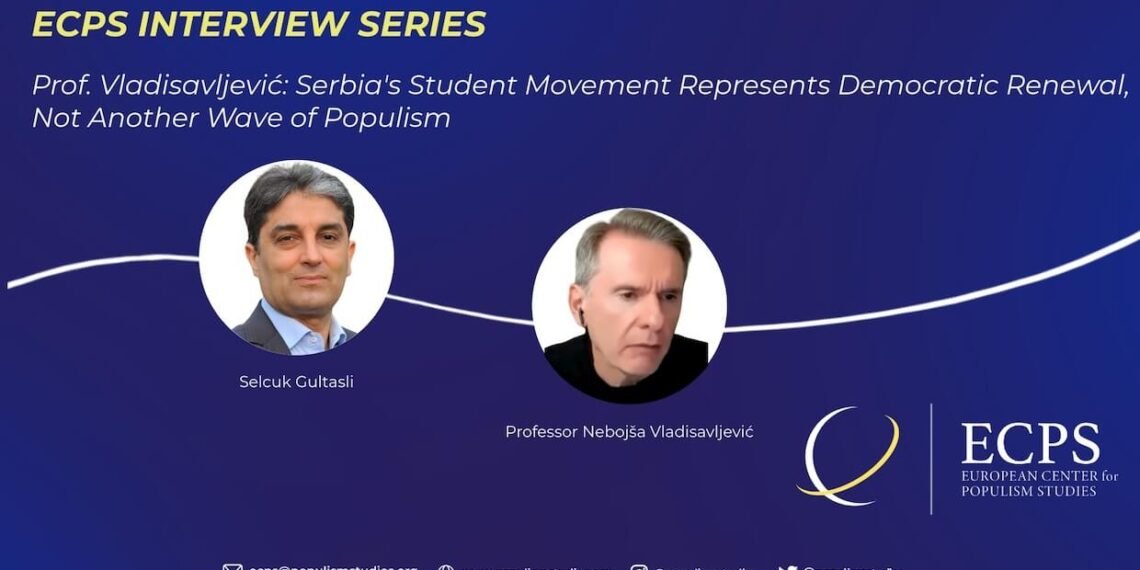
In an exclusive interview with the ECPS, Professor Nebojša Vladisavljević of the University of Belgrade examines Serbia’s student-led electoral breakthrough and its implications for populism, competitive authoritarianism, and democratic renewal. Following the October 25, 2026, defeat of Aleksandar Vučić’s ruling coalition, Professor Vladisavljević argues that the Students’ List represents an inclusive democratic movement rather than another manifestation of anti-establishment populism. Highlighting the movement’s commitment to political pluralism, minority inclusion, and the rule of law, he contrasts its grassroots mobilization with Vučić’s personalized authoritarianism, clientelism, and media manipulation. Yet he cautions that electoral victory alone cannot guarantee democratic consolidation. Serbia’s enduring challenge is translating popular resistance into accountable institutions, independent journalism, and sustainable democratic governance.
Interview by Selcuk Gultasli
Serbia stands at a historic crossroads. Nearly two years of student-led protests, sparked by the November 2024 Novi Sad railway-station tragedy, culminated in the October 25, 2026, electoral defeat of Aleksandar Vučić’s ruling coalition. Yet the transition from authoritarian rule to democratic consolidation remains uncertain. Beyond the electoral breakthrough lies a fundamental question: Does Serbia’s student-led movement represent another manifestation of anti-establishment populism, or does it offer a genuinely inclusive alternative to personalized authoritarian rule?
In an exclusive interview with the European Center for Populism Studies (ECPS), Professor Nebojša Vladisavljević, who teaches comparative and Serbian politics at the University of Belgrade and is a former President of the Serbian Political Science Association, examines the relationship between populism, authoritarianism, popular resistance, and democratic renewal. His research encompasses democratization, social movements, nationalism, ethnic conflict, and political communication.
Challenging interpretations that equate popular mobilization with populism, Professor Vladisavljević argues that Serbia’s student movement is fundamentally different from the exclusionary politics associated with Vučić’s personalized rule. “I wouldn’t describe this as an anti-establishment mobilization. The target was Vučić’s authoritarian, personalist rule,” he explains. Rather than rejecting democratic institutions, the movement seeks their restoration through political pluralism, institutional accountability, and the rule of law.
Professor Vladisavljević emphasizes that the movement’s organizational foundations distinguish it from conventional populist mobilization. Unlike Serbia’s democratic breakthrough in October 2000, when political parties dominated the opposition, the recent transformation placed students, universities, and their broader social allies at the center of political resistance. Its explicit goals, he explains, are “democratic renewal and the protection of political pluralism.”
The interview also examines how Vučić’s populist appeals gradually gave way to entrenched clientelism, media manipulation, and institutional abuse. Reflecting on the regime’s declining capacity to mobilize supporters voluntarily, Professor Vladisavljević concludes: “That tells you a great deal about how thin these populist appeals were throughout.”
Equally significant is the movement’s inclusive approach toward Serbia’s national minorities. Cooperation between Serbian and Bosniak students, particularly across Belgrade and Novi Pazar, has opened possibilities for bottom-up democratic integration, challenging longstanding patterns of ethnonational division.
Nevertheless, Professor Vladisavljević cautions that defeating authoritarianism does not automatically guarantee democratic consolidation. The Students’ List must transform its horizontal, deliberative movement into functioning representative institutions while safeguarding independent journalism, reforming the security sector, and dismantling corruption. As he warns, “short-term efforts obviously won’t be sufficient.”
Ultimately, Serbia’s experience raises broader questions for democratic movements confronting competitive authoritarianism elsewhere: whether inclusive civic mobilization can overcome personalized rule without reproducing its exclusionary logic, and whether electoral victory can become the foundation of lasting democratic transformation.