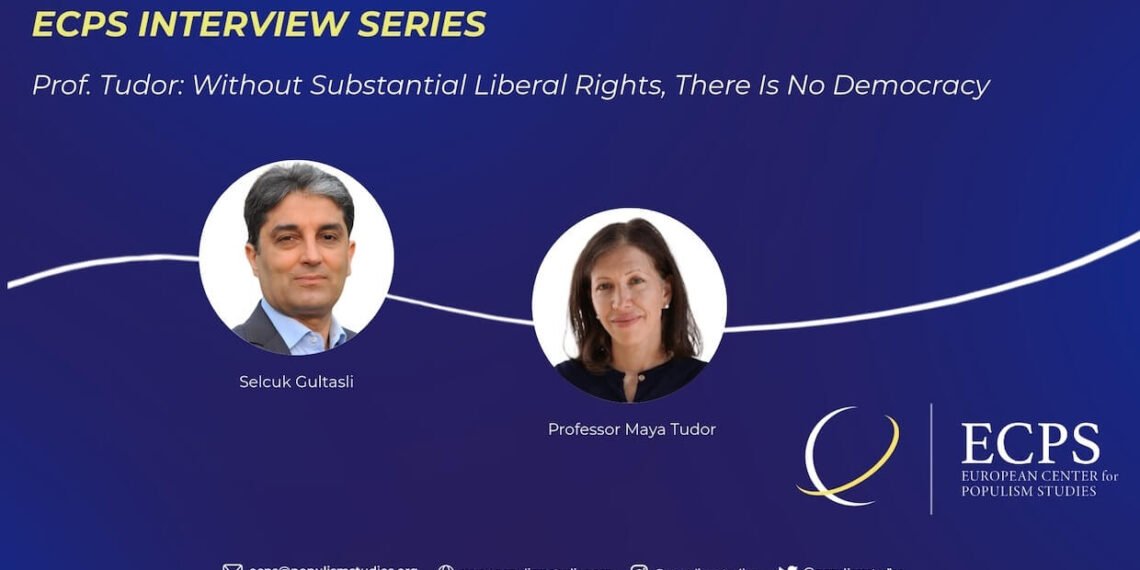
In an exclusive interview with the ECPS, Professor Maya Tudor, Professor of Politics and Public Policy at the University of Oxford, examines democratic backsliding, authoritarian resilience, and the challenges of democratic restoration across India, Hungary, Serbia, Brazil, the United States, and Pakistan. Challenging electoral-minimalist conceptions of democracy, Professor Tudor argues that “if you do not have substantial liberal rights, you don’t have a democracy.” She explains how elections can survive while political freedoms erode and warns that defeating authoritarian incumbents does not necessarily dismantle the systems sustaining their power. Emphasizing independent media, political equality, opposition coordination, and institutional safeguards, she concludes that democracy’s ultimate test is whether future opposition forces can compete freely.
Interview by Selcuk Gultasli*
As democratic institutions confront intensifying pressures worldwide, a fundamental question has returned to the center of scholarly debate: Can a political system remain democratic when elections survive but the liberal rights that make political competition meaningful are systematically undermined? In an in-depth interview with the European Center for Populism Studies (ECPS), Professor Maya Tudor, Professor of Politics and Public Policy at the Blavatnik School of Government and Fellow at St. Hilda’s College, University of Oxford, offers a compelling comparative assessment of democratic erosion, authoritarian resilience, and the conditions necessary for genuine democratic restoration.
The discussion unfolds against a paradoxical global backdrop. Recent electoral developments in Hungary, Serbia, Brazil, and the United States demonstrate the continuing potential for democratic resistance, even as authoritarian populism, institutional capture, and majoritarian nationalism remain formidable challenges. India’s democratic decline under Narendra Modi and Pakistan’s enduring military dominance further expose the fragility of democratic institutions. Together, these developments raise fundamental questions about the boundaries between democracy and autocracyand the prospects for reversing democratic backsliding.
Drawing on her research with Andrea Vaccaro, Professor Tudor challenges electoral-minimalist conceptions of democracy. Her central argument is unequivocal: “If you do not have substantial liberal rights, you don’t have a democracy.” As she explains, democracy concerns not merely elections but what citizens are entitled to do between them. India illustrates this distinction particularly clearly: “Democracy can be hollowed out without elections ever being abolished or becoming meaningless.” Restrictions on opposition mobilization, media independence, and minority rights can fundamentally undermine electoral competition without formally eliminating it.
Turning to Hungary, Professor Tudor cautions against conflating electoral victory with institutional transformation: “Defeating an authoritarian government is not the same as dismantling the authoritarian system the incumbent constructed.” Similar dilemmas emerge in Serbia and Brazil, where civic mobilization and opposition coordination must develop into durable political organization. As she emphasizes, “Power has to be organized before it can be used.”
The United States presents another critical test. Reflecting on Trump’s second presidency and the 2026 midterm elections, Professor Tudor warns that “Elections will certainly interrupt that process, but they cannot, by themselves, repair the institutions and norms weakened by democratic erosion.” Institutional checks, political pluralism, and the recovery of loyal opposition therefore remain indispensable.
Her policy recommendations emphasize independent media, freedom of association, political equality, transparent electoral procedures, and meaningful alternation in power. Ultimately, she argues, democratic restoration must be measured against a demanding standard: “The ultimate test is also whether tomorrow’s opposition will be allowed to compete freely.” Across these cases, Professor Tudor advances a central proposition: democracy’s resilience depends not simply on removing authoritarian incumbents, but on ensuring that their successors cannot monopolize power.