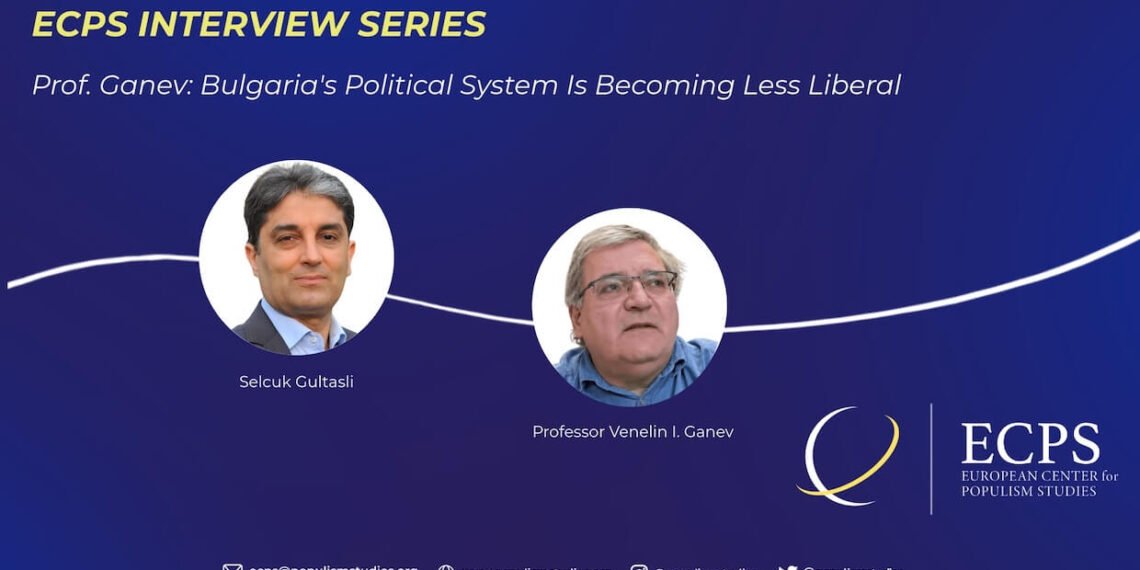
In an interview with the ECPS, Professor Venelin I. Ganev, Professor of Political Science at Miami University in Oxford, Ohio, examines Bulgaria’s political transformation following the 2026 elections. Warning that “the Bulgarian political system is showing a tendency to become less liberal,” he distinguishes electoral stability from the erosion of liberal-democratic institutions. Drawing on his scholarship on state predation and soft decisionism, Professor Ganev argues that Prime Minister Rumen Radev is consolidating power while taking over entrenched corrupt networks rather than dismantling them. He also explores mainstream populism, Russian influence, and the diminishing leverage of European integration. Despite these concerns, he emphasizes civil society’s resilience as a democratic counterweight and warns against Eastern Europe’s persistent preference for strong leadership over constitutional checks and balances.
Interview by Selcuk Gultasli*
Bulgaria is experiencing a significant political realignment following years of electoral instability, corruption controversies, and declining institutional trust. Iliana Iotova’s presidential victory on November 1, 2026, reinforces Prime Minister Rumen Radev’s parliamentary dominance, raising important questions about democratic consolidation, populism, institutional accountability, and Bulgaria’s geopolitical orientation. Yet exceptionally low electoral turnout suggests persistent problems of political representation and legitimacy.
In an interview with the European Center for Populism Studies (ECPS), Professor Venelin I. Ganev, Professor of Political Science at Miami University in Oxford, Ohio, offers a critical assessment of Bulgaria’s evolving political landscape, warning that electoral stabilization may coexist with the erosion of liberal-democratic institutions. Drawing on his influential scholarship on state predation, soft decisionism, and post-communist democratization, Professor Ganev argues that “the Bulgarian political system is showing a tendency to become less liberal.”
Distinguishing electoral democracy from its liberal foundations, Professor Ganev identifies democratic backsliding as Bulgaria’s central institutional challenge. “It’s not so much democracy itself—I don’t think democracy is endangered in Bulgaria—but rather the liberal component of liberal democracy that’s being assaulted,” he observes. Pointing to declining judicial independence, diminishing media freedom, and legislative efforts to restrict civil society, he expresses particular concern about proposals targeting nongovernmental organizations and narrowing public debate.
Professor Ganev also questions whether Radev’s anti-corruption agenda represents genuine institutional renewal. Rather than dismantling entrenched oligarchic structures, he argues, the new leadership is consolidating control over them. “What we are seeing right now is simply a takeover,” he states, suggesting that contemporary state predation increasingly depends on controlling public institutions and redistributing state-held resources rather than weakening the state itself.
Situating these developments within the broader resurgence of populism in Eastern Europe, Professor Ganev characterizes Radev’s political appeal as mainstream rather than radical populism. Nevertheless, he identifies troubling indications of centralized decision-making and the persistence of personalistic governance. His analysis also explores Bulgaria’s ambiguous relationship with Russia, emphasizing the distinction between pro-Kremlin rhetoric and concrete departures from Euro-Atlantic commitments.
Despite these concerns, Professor Ganev underscores the resilience of Bulgarian civil society, which he describes as a durable institutional counterweight capable of challenging governing elites through grassroots mobilization. He also maintains that European integration continues to impose meaningful, although diminished, constraints on domestic powerholders.
In sum, the interview exposes a fundamental tension between democratic consolidation and persistent popular expectations of strong leadership. As Professor Ganev concludes, “The cycle seems to be that we elect a strong leader, he disappoints us, and then we elect another strong leader.” This recurring pattern offers broader insights into the vulnerabilities and resilience of post-communist democracies across Eastern Europe.