

In this interview with the ECPS, Dr. Robert Butler, Senior Lecturer at the University of Lorraine, examines how far-right actors in France and the UK construct legitimacy amid crisis and geopolitical uncertainty. Drawing on critical and multimodal discourse analysis, Dr. Butler explores authorization, crisis narratives, and moral evaluation in the rhetoric of Marine Le Pen, Jordan Bardella, and Nigel Farage. Reflecting on Trump’s return to power, he cautions against simplistic readings of transatlantic influence, arguing that framing Europe as “weak and vulnerable” may have concrete political effects. As Dr. Butler strikingly notes, “non-intervention itself becomes a form of intervention,” reshaping sovereignty, responsibility, and counter-mobilization across Europe.
Interview by Selcuk Gultasli
Giving an interview to the European Center for Populism Studies (ECPS), Dr. Robert Butler, Senior Lecturer in the Faculty of Arts and Languages at the University of Lorraine (Nancy) and editor of Political Discourse Analysis: Legitimisation Strategies in Crisis and Conflict, offers a nuanced comparative analysis of far-right discourse in France and the United Kingdom. Drawing on critical discourse analysis and multimodal approaches, Dr. Butler examines how contemporary populist and far-right actors seek legitimacy in what he characterizes as a “de-legitimized political world.”
Across the interview, Dr. Butler emphasizes that far-right actors such as Marine Le Pen, Jordan Bardella, and Nigel Farage rely heavily on authorization as a legitimization strategy, combining appeals to the personal authority of leaders with increasing references to impersonal authority, particularly “the rule of law.” As he notes, “we see authorization at work: the personal authority of leaders, alongside reliance on impersonal authority.” This dual strategy allows far-right actors to distance themselves from overt radicalism while positioning themselves as credible governing alternatives.
A central theme of the interview is the discursive construction of crisis. In the UK context, Dr. Butler explains that Reform UK frames crisis as systemic collapse, encapsulated in the slogan “Britain is broken,” while in France, the National Rally (NR) increasingly portrays crisis through the lens of economic sovereignty, borders, and protection of domestic production. These crisis narratives are not only rhetorical devices but also serve to justify policy claims that move “beyond moral evaluation” toward what Dr. Butler calls “the realm of substance.”
The interview’s headline theme emerges most clearly in Dr. Butler’s reflections on international crises and Donald Trump’s return to power. Addressing whether Trump acts as a catalyst for far-right normalization in Europe, Dr. Butler cautions against linear assumptions. Instead, he highlights how Trumpian discourse increasingly frames European leaders as “weak and vulnerable,” raising fundamental questions about sovereignty, protection, and authority. Crucially, Dr. Butler argues that a politics of disengagement may carry unintended consequences, noting that “non-intervention itself becomes a form of intervention.”
This insight anchors the interview’s broader contribution: far-right legitimization does not rely solely on overt alignment with radical allies but often involves strategic distancing, ambiguity, and moral labeling. As Dr. Butler puts it, describing states as weak may function as “a form of moral evaluation” that lacks substance yet reshapes political expectations and responsibilities.
By combining close discourse analysis with comparative political insight, this interview sheds light on how far-right actors navigate legitimacy, crisis, and authority—both domestically and internationally—at a moment when the boundaries between intervention, sovereignty, and normalization are increasingly blurred.
Here is the edited transcript of our interview with Dr. Robert Butler, slightly revised for clarity and flow.
Delegitimizing Elites, Authorizing Leaders
Dr. Robert Butler, thank you so very much for joining our interview series. Let me start right away with the first question: From your perspective as editor of “Political Discourse Analysis: Legitimisation Strategies in Crisis and Conflict,” how would you characterize the dominant legitimization strategies used by Marine Le Pen and Nigel Farage when they present themselves as defenders of “the people” against distant elites? Do these strategies converge across France and the UK, or are they embedded in quite distinct national political cultures?
Dr. Robert Butler: I haven’t done specific research on the situation in France, so I’ve looked, to some extent, at developments in the UK, particularly Reform UK. What I would say is that there is a clear delegitimization of the establishment and the parties in power in both countries.
In terms of the actual legitimization strategies used, I think they do, in both contexts, draw on what Theo van Leeuwen refers to in his seminal 2007 article on legitimization and legitimation—namely, authorization. There is a strong emphasis on the personal authority of leaders: Marine Le Pen and Jordan Bardella in France, and Nigel Farage, the leader of Reform UK, in the UK.
There is an appeal to personal authority, but I also think there is a growing appeal to impersonal authority, particularly the rule of law—emphasizing the need to respect the law and to operate within its parameters.
So, very much in terms of legitimization strategies, and following Van Leeuwen’s approach, we see authorization at work: the personal authority of leaders, alongside reliance on impersonal authority, namely the rule of law.
Performing Insecurity Through Multimodal Authority
In your work on authority and multimodal discourse, you stress how gesture, intonation, and visual framing help construct political identity. How do you see these multimodal resources operating in the performances of Farage and Le Pen (and now Jordan Bardella) when they dramatize insecurity, crisis, or loss of control?
Dr. Robert Butler: I would say that, again, my focus has been on Reform UK rather than on the Rassemblement National in France, the National Rally. That said, what we can observe in both cases is a significant use of gesture, with gestures playing an important role alongside discourse.
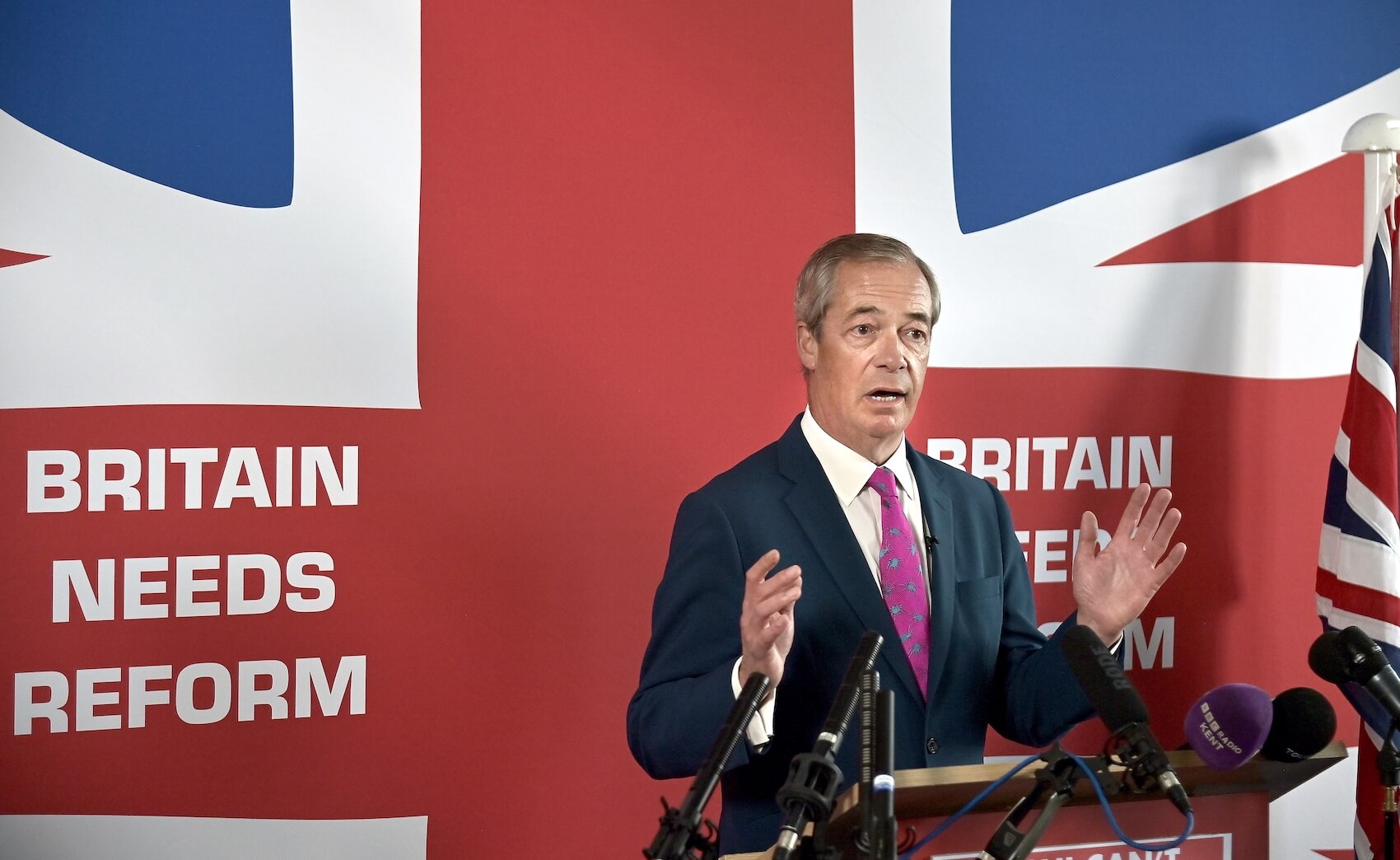
In particular, with Farage, we see frequent use of what we call open-hand supine gestures, where the hands are held with the palms facing upwards, often accompanied by outward and upward movements. These gestures can serve a pragmatic function, signaling uncertainty—conveying a sense of “I don’t know” or “what is there?”—and suggesting that the situation is difficult to interpret.
This is a significant gesture because it contributes to the audience’s impression that the situation is politically untenable, that there is a broader social situation that needs to be managed. Accordingly, open-hand gestures appear frequently, often with a wide space between the hands.
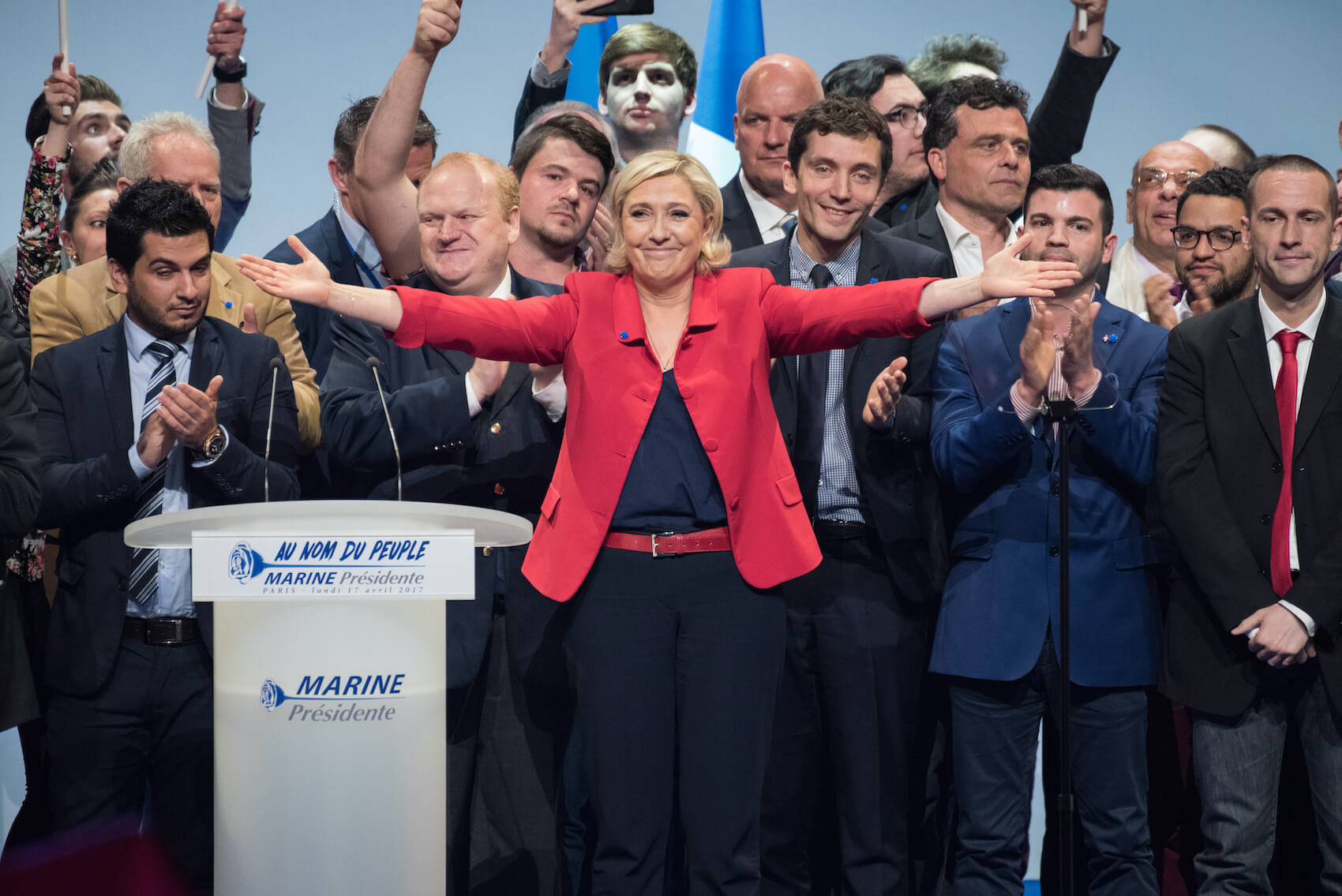
From what I have observed, we also see this with the National Rally in France: broader gestures and extensive use of the hands. Visually, this reinforces the audience’s impression that something needs to be done, that there is uncertainty about what that should be, and that the situation they face is untenable.
From Slogans to Substance in Far-Right Legitimation
One of the core themes of your edited volume is the challenge of sustaining legitimacy in a “de-legitimized political world.” To what extent has the far right in France and the UK successfully exploited this legitimacy deficit—especially the erosion of trust in parties, media, and expert authority—and what limits do you see to this strategy?
Dr. Robert Butler: There has been a significant challenge to the legitimacy of established political parties—particularly catch-all parties—in power in both the UK and France. Again, drawing on Van Leeuwen’s 2007 article on legitimization and legitimization strategies, the challenge has been to move beyond what he calls moral evaluation—that is, the use of words or slogans that carry little meaning beyond statements such as “we are democratic” or “we believe in freedom,” where values are not supported by substantive action. The parties—what we refer to as the far right—have themselves moved beyond moral evaluation and are increasingly operating in the realm of substance when justifying their positions.
This can be seen, for example, in an interview Bardella gave several months ago, in which he called out the Ministry of the Economy and Finance’s claims that businesses should be patriotic. He frames this as a form of moral evaluation—without stating it explicitly—suggesting that it amounts to little more than words. Here, we see something that can be assimilated to moral evaluation being directly challenged by the National Rally.
So, I think they are attempting to expose moral evaluation strategies, move beyond them, and instead rely on authorization.
In Power or In Office? Leverage Without Government
Comparative research has often treated the Rassemblement National (RN) in France as a party on the cusp of governmental power, and Reform UK—despite its recent surge in influence—as an “outsider” shaping the agenda from the margins. Using the distinction between being “in power” and “in office,” how would you assess the current leverage of Le Pen and Farage over mainstream parties and policy in their respective systems?
Dr. Robert Butler: In France, the National Rally has not obtained an absolute majority in the Assembly. There was some discussion about waiting and only seeking to govern with a majority; that is how I understood the situation. There has also been discussion about whether there might be a primary across the right in French politics. However, certain parties further to the left within the right have indicated that they do not share common ground with the RN, the National Rally. So, in terms of being in office and in power, the RN is seeking new elections in order to try to secure that majority.
In the UK, various opinion polls have suggested that Reform UK would, if an election were called today—even though one is not due immediately—emerge as the largest party. It might not secure an overall majority, and this could result in a hung parliament. There is a portrayal of Reform UK as being on the outside, looking in at a UK that is collapsing or imploding, reflected in the slogan “Britain is broken” and in its emphasis on public services being unable to cope and being overwhelmed. In terms of being empowered in office, Reform UK is neither in office nor in power, but it is positioning itself around what is needed to take power. However, it is doing so very much from the outside, observing those in power and a situation that it portrays as collapsing and imploding.
When ‘Britain Is Broken’ Meets Economic Sovereignty
Your work highlights how crisis narratives are central to legitimization. How do far-right actors in France and the UK differently construct “crisis”—migration, cost of living, Europe, Islam, climate—and what does this tell us about the socio-economic and historical specificities of each case?
Dr. Robert Butler: Following on from what I’ve just said, I think that in the UK, Reform UK frames crisis in terms of systemic failure, emphasizing that Britain is broken. At his conference last year, Mr. Farage, for example, asked the audience, “Who has an NHS dentist in the room?” So, the crisis is constructed around the idea that Britain can no longer cope and that the system is under strain.
By contrast, from what I have followed with the National Rally in France, and from what I have observed in their speeches and interviews over the past few months, the situation is portrayed more as one in which France is seen as a system that needs to change—particularly a system of exchange in which goods are produced abroad rather than in France, and which must be reoriented to favor domestic production. Accordingly, crisis is increasingly framed as the need for barriers, especially to protect French goods and their quality. In an interview, Marine Le Pen refers to frontiers or borders as a means of protecting the quality of products coming into the country.
Populism as Process, Not Outcome
In recent years, French and British political language has seen an inflationary use of the term “populist” as a weapon of de-legitimation. Building on contributions in your volume that ask “who calls whom a populist?”, how has this labelling battle shaped the public perception and normalization of Le Pen’s RN and Farage-style projects?
Dr. Robert Butler: The term populism is better understood as a process—a means rather than an end in itself. I see it as a way of working toward a different political outcome in the future, rather than as an end product. Populism, in this sense, is not the outcome but the process. It is a process of placing more people on the side of “us” as opposed to “them,” where elites—frequently identified as such in interviews given by the National Rally—are positioned as “them,” and “the people” are increasingly placed on the side of “us,” meaning those who support these political parties.
I also think—and this is something I may not have mentioned earlier—that the concept of moral outrage plays an important role. This is another legitimization strategy identified more recently. An article published about five years ago by Rebecca Williams addresses moral outrage, and I think populism is closely linked to a certain degree of social outrage, where particular actions can be justified by expressions of disgust or dissatisfaction with the current situation.
In this sense, the term populism functions as a means of bringing people onto “our” side, presenting the United Kingdom and France as countries that need to do better, while simultaneously associating the nation and the people with the party. Populism, then, is a process of mobilizing support by drawing people in, rather than aligning them with the opposing side, which is constructed as those currently in power or other parties seeking power.
Moral Outrage, Media, and Knowledge Claims
You emphasize “epistemic vigilance” and post-truth conditions in contemporary politics. How do far-right entrepreneurs in France and the UK negotiate this environment—do they primarily undermine factual authority (“fake news,” “media system”), or do they also try to re-establish alternative epistemic authorities such as patriotic experts, “common sense,” or online influencers?
Dr. Robert Butler: I haven’t done much work on influencers as such; my focus has been more on YouTube as a social media outlet. I think certain media outlets have popularized the idea of common sense, and this notion has, in effect, become a form of legitimization—legitimizing actions when they can be framed as common sense. This is an area where more work needs to be done and further research is required.
With Reform UK, in particular, it is less about the issue of fake news and more about adding a certain level of moral outrage to claims that the NHS, the National Health Service, cannot cope, and that certain social mechanisms appear to be broken. In terms of common sense, I am not entirely sure; I think there is still much more work to be done on this notion, and further research is needed.
Mainstream Right Parties in a Reactive Phase
Looking at internal party dynamics, what similarities and differences do you see between the ways in which the French Republicans and the British Conservatives have responded discursively to the rise of the far right? Have their legitimization strategies tended to contain, converge with, or further empower RN and Reform-style actors?
Dr. Robert Butler: Thank you for your question. There has been some splintering of the traditional right in French politics toward the far right. In the UK, there have been several defections, mainly of former Conservative MPs, to Reform. There has been a noticeable number of such defections. I think there has been quite a lot of delegitimization of the policies of Reform UK and the National Rally by both the French Republicans and the British Conservatives.
Reform UK is often seen as having an alternative agenda, whereas the National Rally is perceived as having little or nothing in common with other mainstream political parties. That appears to be the prevailing view. In recent days, there was discussion, as I mentioned earlier, of a large primary ahead of the 2027 elections—either presidential, legislative, or both—but this seems to have been ruled out, suggesting that there is limited common ground with the RN, the National Rally.
Overall, there has been a strong emphasis on delegitimization. However, over time—perhaps over the next year or two—I expect we will see both the Conservatives and the Republican Party develop alternative legitimization strategies to justify their own positions. At present, they appear to be in a reactive phase in response to the rise and growing success of the RN and Reform UK.
From Negation to Affirmation
In your multimodal analysis of Farage and Reform UK, you show how negation and modality help define what a party “is” and “is not.” If we apply this lens to Le Pen/Bardella, how do denial, distancing, and disavowal (“not extreme right,” “not racist”) function in their efforts to render the RN a credible party of government?
Dr. Robert Butler: Again, my work has focused on Reform UK rather than on the RN, the National Rally. However, based on what I have observed, I think there is a growing emphasis on asserting what the party stands for. There appears to be less focus on defining what the RN is not, and more on clearly articulating what it represents. In a recent interview, Le Pen acknowledged that for around 30 years there had been considerable emphasis on the negative way the party was treated by the media and by other parties. I think there is now a shift toward emphasizing what the party stands for, rather than relying on negation—denying that it is this or that. There is a reason for this shift.
The context is different from that of Reform UK, where Nigel Farage stepped back from mainstream politics for a period and then, over the last 12 to 18 months, had to explain why he was returning. This is why, in my recent article, I observed extensive use of negation by Farage, as he justified his return to mainstream politics by explaining what he could not do or why he rejected certain principles.
By contrast, the situation is somewhat different for Le Pen and Bardella. They appear to be in a phase of asserting, through affirmative terms, what they actually stand for.
Re-Legitimizing Europe: Borders, Sovereignty, and Reform
At the European level, how do you interpret the far right’s attempt to re-legitimize the EU not as a technocratic polity but as a vehicle for “civilizational” or “sovereigntist” politics? Do you see France and the UK as following parallel or diverging trajectories in this respect, given that one is inside and the other outside the Union?
Dr. Robert Butler: The notion of Frexit—France leaving the European Union—has been present in public debate over the last two or three years. More recently, the plight of farmers, allegedly linked to Mercosur, has become a topic of debate and is very much in the news in France this week. In contrast, the UK has focused more on controlling borders, particularly on who is coming into and going out of the country, and especially who is entering the UK. As a result, the European Union has become less of a direct feature in Reform UK’s discourse, with greater emphasis placed on fixing the UK’s infrastructure and protecting its borders. By contrast, the RN, the National Rally, appears more concerned with reforming the EU, first and foremost in ways that it argues would benefit France.
Your editorial work stresses the importance of multimodal critical discourse studies. How have social media formats—short clips, memes, influencer-style videos—transformed far-right communication in France and the UK, and are there noteworthy differences in platform use or visual rhetoric between Le Pen/Bardella and Farage/Tice?
Dr. Robert Butler: As I mentioned earlier, I haven’t focused specifically on the RN in my research, so it is difficult for me to provide a detailed answer with regard to the National Rally. However, if we take YouTube as an example, there are currently many clips of Mr. Farage commenting on the situation in the UK, for instance on immigration.
In some of his own clips, he also incorporates footage from other users’ videos to illustrate his points. This creates a kind of mise en abyme, if you like—a clip within a clip.
In several instances, the Union Jack flag is visible, either behind him in a car or on the screen, and there are also many clips of him seated at a desk. This produces a very formal, official setting, which again connects to the idea of being in power or in office—not actually holding office, but simulating a scenario in which one might be looking at a future leader in office.
By contrast, if we look at Marine Le Pen’s YouTube account—having discussed Farage’s account—you see many clips of her speaking in the Assemblée Nationale or being interviewed by mainstream media outlets. This is a key difference. There are many more clips of Le Pen in clearly official settings, such as major media interviews or parliamentary contexts. This points to a clear difference in the use of context.
From ‘Britain Is Broken’ to Paths to Power
Looking ahead to the next decade, what scenarios do you consider most plausible for the far right in France and the UK: full governmental incorporation, permanent “blackmail” power over center-right parties, or gradual demobilization as issues and generations change? What indicators should researchers monitor to distinguish among these trajectories?
Dr. Robert Butler: Thank you for asking this question, because one of the main slogans—or narratives—of Reform UK is “Britain is broken.” At some point, it will need fixing, and I think it is important to pay attention to metaphors related to rebuilding, fixing, and redoing. From a linguistic perspective, in addition to metaphors, we should also look for what are known as force-dynamic strategies, where interaction between entities involves overcoming difficulty and crisis, and observe whether these strategies are actually put into practice. In terms of language it will be particularly interesting in the UK to see how Britain is discursively framed as moving from being “broken” to being “fixed,” and how problems are presented as being overcome.
In France, the far right’s objective is to win the Assembly and secure a majority in 2027, as well as to win the presidential elections that year. It will also be important to observe the results of the municipal elections scheduled for 2026.
Focusing on the UK, a coalition involving Reform UK and another party—most likely the Conservatives, if it were to be any party—would probably be more attractive to Reform UK than holding an overall majority. We have a precedent for this in the Liberal Democrat–Conservative coalition from 2010 to 2015, in which the Liberal Democrats were the junior partner.
In that situation, the Conservatives were able to take advantage of certain Liberal Democrat policies, such as raising the tax threshold, while also seeking to maximize credit for the junior partner’s policy initiatives. At the same time, there was an abstention campaign for changes to the electoral system which was put forward. Meanwhile, the Liberal Democrats were largely left to deal with the fallout from the rise in tuition fees, which, as we can agree, was not a particularly popular policy.
If Reform UK were in a hung Parliament but emerged as the main coalition partner, it would be in a position to offload some responsibility for policy outcomes. Then, perhaps in ten years’ time, it could aim for full majority power.
Overall, I think we could see some very interesting political as well as discursive strategies. It is quite conceivable that Reform UK could be involved in a coalition arrangement similar to that of 2010, with both political and discursive strategies unfolding in parallel.
Legitimizing Authority Through Strategic Distancing

Given your interest in how authority is discursively constructed, how do international crises—Russia’s war in Ukraine, the US democratic crisis, or Middle East conflicts—influence the legitimization strategies of far-right actors in France and the UK? Are these crises used mainly to normalize their positions, or also to distance themselves from more radical allies?
Dr. Robert Butler: I think that at conferences held by Farage last year, in 2024, there was some clear distancing from the leader of Russia. This distancing was definitely observable in the discourse.
In France, more recently this year, interviews with the RN have reflected an acknowledgement of US sovereignty in relation to what is unfolding there, alongside an emphasis that US priorities are not necessarily France’s priorities. This again represents a defense of France’s national interest. There also appears to be support for the rule of law.
I’m not sure I have much more to add to this question, but I think there is an acknowledgement of other countries combined with a certain degree of distancing, allowing both the UK and France to assert and defend their own national policies.
Trump, Europe, and the Politics of Non-Intervention
In light of the recently released Trump National Security Strategy, to what extent has the Trump presidency provided ideological validation or strategic inspiration for far-right actors in France and the UK? Do you see Le Pen, Bardella, or Farage consciously drawing on Trumpian rhetoric, political style, or governing practices, or is the transatlantic influence more diffuse and symbolic?
Dr. Robert Butler: From what I have observed, there appears to be some distancing from Trumpian rhetoric. Again, this reflects what I have noted previously. In France, the emphasis is very much on defending national interests at the level of the nation-state and on asserting France’s sovereignty. The RN, in particular, places strong emphasis on the rule of law. In the UK, the picture is perhaps more complex. There does seem to be some aversion to the language used in the US context, but I am not sure I have observed enough to comment on this in greater detail.
And lastly, Dr. Robert Butler, looking beyond national cases, do you see that the Trump presidency accelerates a broader European shift toward sovereigntist and civilization-based politics, or do European systems remain resilient and path-dependent? In other words, might Trump act as a multiplier for far-right normalization across the EU—or does his return instead provoke counter-mobilization among mainstream parties and institutions?
Dr. Robert Butler: Thank you for your question. I think it is difficult to know and much depends on what the remainder of the Trump presidency offers to European leaders. If European leaders are framed as weak and vulnerable—and we have seen some of this in recent discourse—and if they continue to be framed in this way, then there may be a tendency to seek protection, perhaps in exchange for greater influence or possibly reduced sovereignty. The notion of weakness in European leadership does appear to be entering Trumpian discourse at the moment. Again, the question is whether this framing is simply a moral label—a form of moral evaluation—where countries are described as weak. What does that actually mean, and is it backed up by substantive claims?
In terms of counter-mobilization, I think it depends on what, exactly, is being countered. If the discourse emphasizes non-intervention—leaving countries alone and withholding the financial, logistical, or other forms of support that may be required—then it becomes difficult to mobilize against any particular actor or policy.
The question then becomes how other countries—such as Russia, China, or other states—respond in relation to Europe. There is therefore a broader issue of whether non-intervention itself becomes a form of intervention. If one ceases to intervene, even rhetorically, and frames this as “leaving countries alone,” there is a risk that such a stance could weaken or undermine potential counter-mobilization.
