
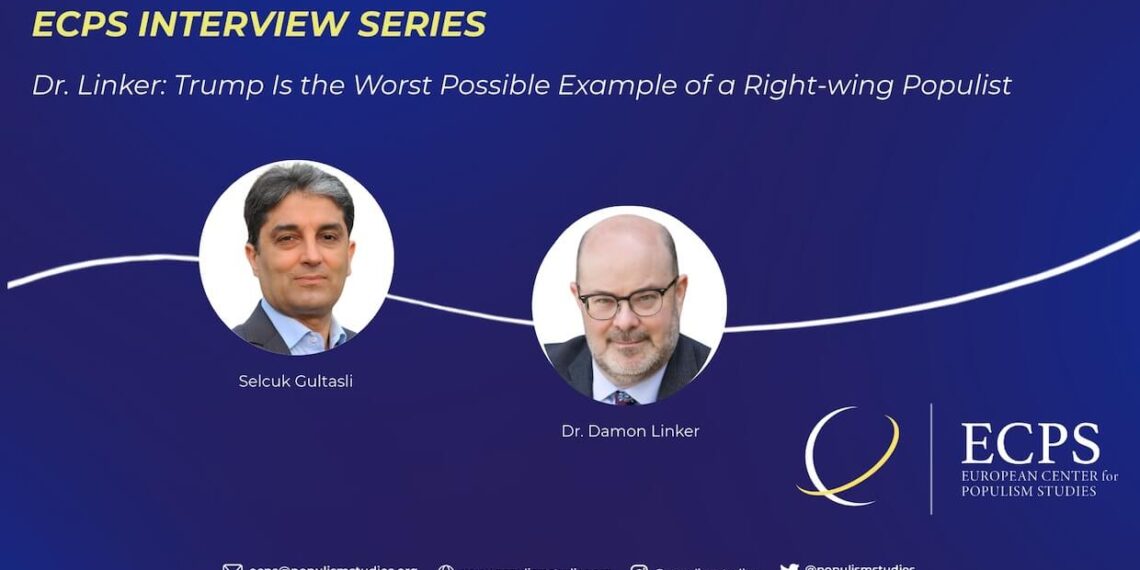
In this interview for the ECPS, Dr. Damon Linker delivers a stark assessment of Trumpism’s place in the global surge of right-wing populism. Dr. Linker argues that Donald Trump is “the worst possible example of a right-wing populist,” not only for his ideological extremism but for a uniquely volatile mix of narcissism, vindictiveness, and disregard for constitutional limits. Central to his warning is Trump’s assault on what he calls the democratic “middle layer”—the professional civil servants who “act as a layer of defense” against executive tyranny. By “uniting the bottom and the top to crush that middle layer,” Dr. Linker contends, Trumpism pushes the United States toward an authoritarian model unprecedented in its modern political history.
Interview by Selcuk Gultasli
In this wide-ranging interview with the European Center for Populism Studies (ECPS), Dr. Damon Linker—Senior Lecturer in Political Science at the University of Pennsylvania, Senior Fellow in the Open Society Project at the Niskanen Center, columnist, and author of The Theocons and The Religious Test—offers one of the clearest and most sobering analyses of Trumpism’s evolving place within the global wave of right-wing populism. Across the conversation, Dr. Linker advances a central contention: Donald Trump is “the worst possible example of a right-wing populist,” not only because of ideological extremism but because of a personally distinctive mix of narcissism, vindictiveness, and strategic opportunism that intensifies the authoritarian tendencies inherent in contemporary populist governance.
A recurring theme in the interview—and the one that speaks most directly to the headline—is Dr. Linker’s argument that Trumpism seeks to eliminate what he calls the “middle layer” of democratic states. In his formulation, liberal democracies depend on “informed, intelligent, educated… people in that middle layer of the state” who carry out laws, uphold norms, and prevent the executive from “acting like a tyrant.” Trump, by contrast, “tries to unite the bottom and the top in an effort to crush that middle layer—leaving only ‘the people’ and the strongman running the country.” This dynamic, Dr. Linker warns, places the United States closer to the logic of authoritarian rule than at any point in the modern era.
The interview situates Trumpism within both historical cycles and global patterns. Dr. Linker argues that the Republican Party is returning to an older “rejectionist” impulse rooted in its reaction to the New Deal. Yet Trump’s version is more expansive and more radical, because what the right now seeks to overturn is far larger: the post-war regulatory, administrative, and cultural state. At the same time, Dr. Linker stresses that while Trumpism shares features with “authoritarian populism” abroad, Trump himself stands out for being “personally irresponsible… rage-fueled… corrupt… [and] willing to use state power… to hurt his enemies and help his friends.”
The interview also maps the institutional consequences of this project. Dr. Linker shows how Trumpism simultaneously directs bottom-up grievance and top-down coercion to pressure universities, law firms, media, bureaucratic agencies, and cultural institutions. Some actors, he notes, resist, while others “capitulate” under threat of political or financial retaliation. The overall pattern reveals an increasingly fragmented institutional landscape marked by selective vulnerability rather than systemic resilience.
Finally, Dr. Linker reflects on the future of American party politics. If Democrats cannot adapt—by embracing a modestly populist reformism and distancing themselves from the “old, discredited establishment”—they risk long-term marginalization. Yet he remains cautiously optimistic: “As long as we have free and fair elections… my very strong suspicion is [the Democrats] will win again. We just have to be a little patient about it.”
This interview thus offers a penetrating, historically informed account of Trumpism as both a symptom and accelerant of democratic decay in the US—and a warning about what may come next.
