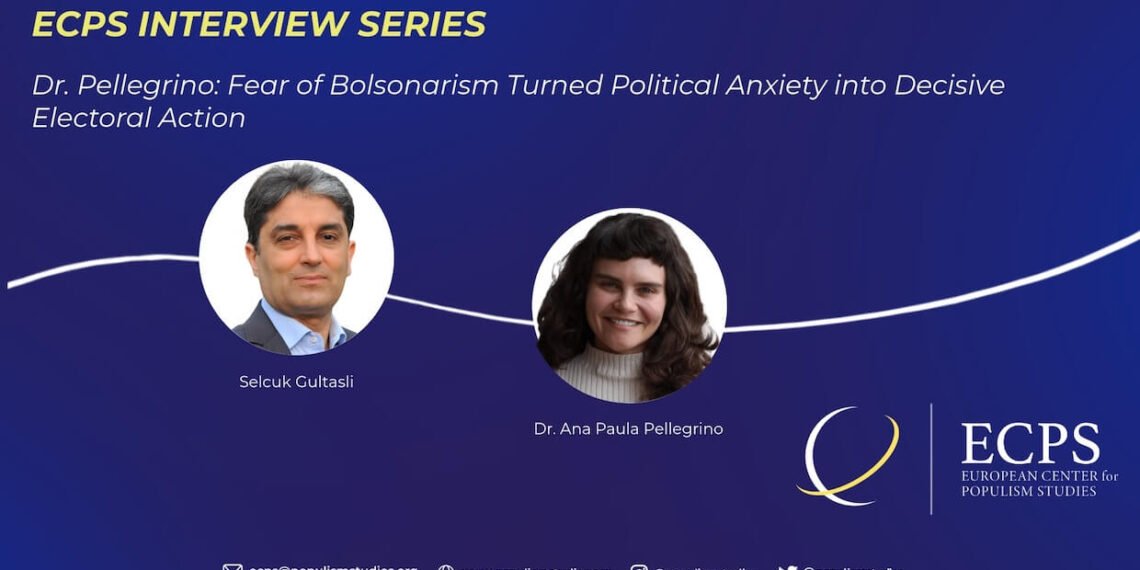
In an interview with the ECPS, Dr. Ana Paula Pellegrino, Assistant Professor at the Pontifical Catholic University of Chile, examines how fear of Bolsonarism fueled Lula’s extraordinary electoral comeback by transforming political anxiety into democratic mobilization. Drawing on her recent Journal of Democracy essay, she explores how decentralized progressive networks, digital activism, and grassroots engagement converted fear into electoral participation. As she argues, Lula’s campaign succeeded because “they were able to transform despair into hope.” Yet she cautions against the authoritarian risks of militarized political communication. Beyond the election, Dr. Pellegrino assesses Bolsonarism’s resilience, organized crime’s influence on democratic citizenship, and the institutional challenges facing Lula’s fourth presidency, emphasizing social media regulation, judicial reform, and coordinated public security policies.
Interview by Selcuk Gultasli
Brazil’s October 25 presidential runoff delivered a historic comeback for Luiz Inácio Lula da Silva, whose victory over Flávio Bolsonaro demonstrated the mobilizing power of progressive networks and the resilience of electoral competition. Yet Bolsonarism’s enduring strength, a conservative-dominated Congress, deep polarization, and organized crime continue to challenge democratic governance. Beyond the electoral outcome, Lula’s victory raises fundamental questions about the relationship between political emotions, digital mobilization, populism, and democratic resilience.
In an interview with the European Center for Populism Studies (ECPS), Dr. Ana Paula Pellegrino, Assistant Professor at the School of Government at the Pontifical Catholic University of Chile in Santiago, examines these tensions through her research on political mobilization, organized crime, public security, and democratic institutions. Her recent Journal of Democracy essay, “How Did Lula Pull Off the Biggest Political Upset in Modern Brazilian History?”, provides important insights into the decentralized digital and grassroots mobilization behind Lula’s electoral comeback.
Central to Dr. Pellegrino’s analysis is the political significance of fear. Reflecting on the campaign, she emphasizes that “Fear was what drove the mobilization, or what the mobilization was able to tap into and turn into decisive action.” Yet fear does not necessarily produce authoritarian outcomes. Drawing on social psychology and her research on crime and public security, she argues that political emotions can generate either disengagement or democratic participation. In Lula’s case, “they were able to transform despair into hope.”
This transformation was facilitated by decentralized progressive networks that connected digital activism with interpersonal persuasion and electoral participation. Dr. Pellegrino examines André Janones’s militarized communication strategies while acknowledging their democratic risks. She nevertheless emphasizes the enduring value of the “ladder of engagement,” through which digital mobilization becomes sustained political participation.
Beyond Lula’s victory, the interview explores Bolsonarism’s institutional resilience, the weakening of Brazil’s political center, and tensions between the executive and a conservative Congress. Dr. Pellegrino also examines how armed militias convert territorial domination into electoral influence and how punitive security policies can inadvertently reinforce criminal governance. As she warns, expanding imprisonment risks strengthening organizations that already use prisons as recruitment and operational bases.
Looking toward Lula’s fourth presidency, Dr. Pellegrino identifies social media regulation, Supreme Court and broader judicial reforms, and coordinated public security policies as priorities for democratic renewal. She argues that such reforms can help address polarization, institutional distrust, and organized crime’s influence over ordinary citizens. In sum, the interview illuminates a central paradox of contemporary democracy: fear can sustain authoritarian political projects, yet, when transformed into hope and collective action, it can also become a powerful resource for democratic engagement.