The final session of the ECPS Virtual Workshop Series offered a rich interdisciplinary reflection on democracy under conditions of deepening polarization. Bringing together legal, historical, and political perspectives, the panel illuminated how “the people” is constructed, contested, and mobilized across different contexts—from defamation law in the United States to institutional legitimacy in Israel, classical rhetoric in Athens, and emotional narratives in contemporary European populism. A central insight concerned the interplay of law, emotion, and symbolic representation in shaping democratic resilience and vulnerability. By foregrounding the cultural and affective dimensions of politics, the session underscored that democracy is not only institutional but deeply interpretive—sustained, challenged, and reimagined through competing narratives of identity, legitimacy, and belonging.
Reported by ECPS Staff
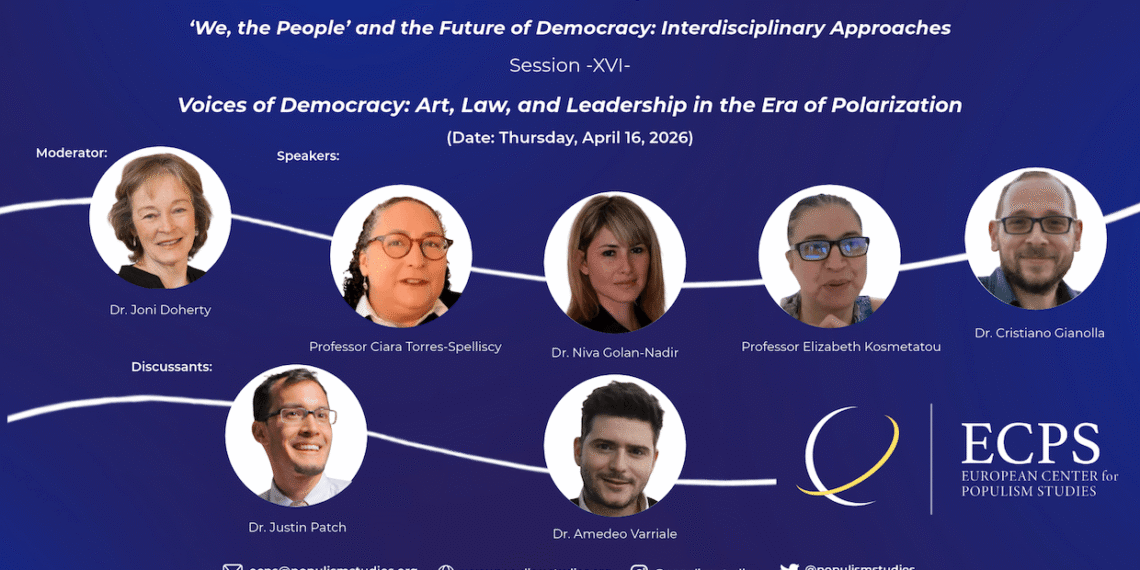
On Thursday, April 16, 2026, the European Center for Populism Studies (ECPS) convened the sixteenth and final session of its Virtual Workshop Series, “We, the People” and the Future of Democracy: Interdisciplinary Approaches, under the title “Voices of Democracy: Art, Law, and Leadership in the Era of Polarization.” Bringing together perspectives from legal studies, political science, history, and discourse analysis, the session examined how democratic life is shaped—and at times distorted—through struggles over representation, institutional legitimacy, collective identity, and the symbolic construction of “the people” in contexts marked by deepening polarization.
The participants of the session were introduced by ECPS intern Daniela Puggia, whose introductory remarks on behalf of ECPS set the stage for the discussion and helped situate the panel within the wider aims of the workshop series. Chaired by Dr. Joni Doherty (Kettering Foundation), the session was organized around a broad but urgent set of questions: how are democratic norms defended when truth itself becomes contested? In what ways do institutional arrangements persist under conditions of deep social division? How do political leaders transform grief, fear, or resentment into collective identity and consent? And what role do art, speech, and symbolic representation play in either sustaining or undermining democratic life?
The panel featured four intellectually rich and conceptually complementary presentations. Professor Ciara Torres-Spelliscy (Stetson University) examined the role of defamation law in defending democracy in the United States, focusing on the legal and political significance of the Freeman and Moss case in the aftermath of the 2020 election. Dr. Niva Golan-Nadir (Reichman University), co-authoring with Dr. Michael Freedman (Hebrew University of Jerusalem), explored how religious policy and balanced dissatisfaction shape institutional legitimacy within the Israeli military. Professor Elizabeth Kosmetatou (University of Illinois Springfield) offered a historically grounded reinterpretation of Pericles’ Funeral Oration as a rhetorically sophisticated form of populist mobilization in wartime Athens. Dr. Cristiano Gianolla (University of Coimbra), together with Lisete S. M. Mónico and Manuel João Cruz, analyzed the exclusionary identity of “the people” in radical right populism through a comparative study of emotional narratives in Portugal and Italy.
The session was further enriched by the interventions of its discussants, Dr. Justin Patch (Vassar College) and Dr. Amedeo Varriale (University of East London), whose comments drew connections across the presentations and raised broader questions concerning aesthetics, institutional resilience, populist rhetoric, and democratic contestation. Together, the contributions of chair, speakers, discussants, and moderator produced a wide-ranging interdisciplinary dialogue on the fragility, adaptability, and symbolic politics of democracy in an age of polarization.