
Please cite as:
Ferreira Dias, João. (2026). “Hegemony Without a Strategist? Agency, Identity Grammars and the Identitarian Left in Lars Erik L. Gjerde’s Hegemony and Woke Strategy.” ECPS Book Reviews. European Center for Populism Studies. September 16, 2026. https://doi.org/10.55271/br0027
In this book review, Dr. João Ferreira Dias examines Lars Erik L. Gjerde’s forthcoming “Hegemony and Woke Strategy: A Study of Cultural Warfare”, highlighting its contribution to debates on culture wars, hegemony, identity politics, and liberal democracy. While crediting Gjerde for moving beyond polemical treatments of “wokeism” and for illuminating how cultural norms acquire institutional force, Dr. Ferreira Dias questions whether the language of “strategy” can be sustained when agency, coordination, and intentionality remain analytically bracketed. Drawing on his own concept of “identity grammars,” he argues for a framework that preserves the relationship between structure and agency. The review concludes with a sharp distinction: cultural warfare may produce hegemonic effects without centralized direction—“hegemony does not require a strategist. Strategy does.”
Reviewed by João Ferreira Dias
Culture wars are often treated as political noise: symbolic disputes distracting attention from economics, institutions, inequality or public policy. Lars Erik L. Gjerde’s Hegemony and Woke Strategy: A Study of Cultural Warfare starts from the opposite premise. Culture is not peripheral to politics. It helps make political order possible.
That premise is difficult to dispute. Political systems do not survive through institutions and coercion alone. They depend on legitimacy, shared meanings and a sufficient degree of agreement about what society considers normal, acceptable and just. This is where Gramsci remains useful well beyond Marxism. Hegemony is also about making a particular understanding of the world appear natural.
Gjerde takes this insight seriously. Drawing on Gramsci, Marxist theory and, especially, Laclau and Mouffe’s post-structuralism, he examines what he calls wokeism as an identitarian force engaged in a struggle over language, morality, identity and institutional norms. His concern is not simply to define wokeism, but to ask what it does: how identity politics, cancel culture, language politics and woke capitalism operate within a wider struggle for cultural hegemony. This is, indeed, one of the book’s central contributions.
Culture as a Struggle for Hegemony
Gjerde is also careful not to reduce the culture war to a mechanical opposition between left and right. The identitarian left is shown to clash not only with conservatism but also with liberalism, socialism, universalist anti-racism and earlier forms of feminism. This matters. Contemporary culture wars frequently cut through political families rather than simply separating them. A Marxist, a liberal and a conservative may object to the same form of identity politics, although for entirely different reasons.
This is particularly relevant because Gjerde does not equate every progressive cultural victory with wokeism. His account distinguishes the historical expansion of anti-racist, feminist and gay-rights norms from what he sees as a later identitarian turn. Wokeism is therefore treated not as the established Western hegemony, but rather as a counter-hegemonic challenger to an older liberal-progressive order still anchored, however imperfectly, in Enlightenment universalism.
That distinction is important. The struggle for recognition and the extension of equal citizenship should not be retrospectively collapsed into contemporary identitarian ideology. One may defend anti-discrimination, minority rights or affirmative measures without accepting that identity should become the primary unit through which society distributes moral authority, political legitimacy or epistemic standing.
Here Gjerde comes close to Yascha Mounk’s notion of identity synthesis, even though he retains the term wokeism. He is also explicit that the phenomenon is internally contradictory, heterogeneous and unstable. This makes the book considerably more interesting than the usual polemical literature surrounding “woke culture.” It also opens what I consider one of its most productive theoretical questions. The difficulty lies in the word strategy.
Can There Be Strategy Without Agency?
Gjerde repeatedly describes identity politics, cancel culture, ideological subversion and linguistic change as tactics belonging to a wider strategy. Yet, for analytical purposes, he deliberately brackets the agency of the actors involved. Individuals are described as “pieces on the ideological chessboard” and treated primarily as vehicles of ideas rather than as actors in their own right. Whether they understand themselves as woke, or consciously intend to participate in the ideological process under examination, is analytically secondary.
The same question emerges in his analysis of cultural guerrilla warfare. Gjerde acknowledges that some actors consciously engage in ideological practices while others genuinely understand the norms they reproduce as common sense. For his analytical purposes, however, this distinction does not substantially alter the broader pattern. The politics of concealment may therefore be examined structurally regardless of whether particular actors participate willingly or unwillingly.
The methodological choice is understandable. Indeed, it is one of the reasons why the book succeeds in making broad ideological patterns visible across institutions, actors and national settings. But it also raises a question about how far the language of strategy can be stretched.
Strategy and agency are not synonymous. Yet strategy normally presupposes at least a minimal theory of agency: an actor pursuing an objective through a selection of means. If different actors in different institutions reproduce similar vocabularies for different reasons and without coordination, we may certainly have a pattern. We may even have a powerful hegemonic effect. But it is less clear that we have demonstrated an overarching strategy.
This is not merely a semantic distinction. A university administrator may adopt identitarian language because she is personally committed to it. A corporation may do so because managers perceive reputational or commercial incentives. A journalist may reproduce the same vocabulary because it has become professionally normal. An activist may consciously seek institutional transformation. The resulting discourse may converge. The motives need not. There may, therefore, be strategists without there being one strategy.
Gjerde’s structural perspective makes patterns visible, which is its considerable strength. Yet some of the processes he identifies might also be described through diffusion, institutional imitation, professional incentives, moral conformity or the gradual sedimentation of a common political language. None of these mechanisms makes the phenomenon less politically significant. In some respects, the opposite may be true. The ability of an ideological grammar to reproduce itself without constant conscious mobilization may itself be evidence of cultural power. This is where my own research on culture wars suggests a slightly different analytical route.
From Strategy to Identity Grammars
In my doctoral research on Portuguese culture wars, I use the concept of identity grammars to describe broader systems of categories, narratives, moral assumptions and political distinctions through which actors make sense of disputes over historical memory, racism, immigration and cultural belonging. The concept was developed precisely to preserve the relationship between structure and agency. Individual political sensibilities articulate with wider identity grammars, but actors do not simply disappear inside them. They may reproduce a grammar, radicalize it, combine it with elements of another, resist it or attempt to move beyond it. A grammar structures political speech without writing every sentence in advance.
This distinction helps avoid two opposite temptations. The first is excessive voluntarism: imagining cultural transformation as the execution of a coherent master plan. The second is excessive structuralism: imagining subjects as little more than carriers of discourse.
The latter problem is particularly interesting because it resembles one of the difficulties Gjerde himself identifies in some of the theories he analyses critically. Strong structural accounts of racism, coloniality or identity can grant social structures such causal autonomy that individual dissent risks becoming analytically irrelevant. My own research has therefore insisted on preserving room for agency, even within highly unequal structures, and on resisting approaches in which subjects appear entirely captured by the social systems in which they participate. The same concern appears in my discussion of decolonial theory, particularly where historical continuity risks becoming so strong that the present is read in excessively deterministic terms.
This is less a rebuttal of Gjerde’s framework than an invitation to extend it. A fuller account of agency might make it possible to distinguish more clearly between conscious strategy, institutional convergence and hegemonic effect. That distinction becomes particularly important when the analysis reaches liberal democracy.
When Cultural Conflict Becomes a Liberal-Democratic Question
Gjerde persuasively identifies tensions between identitarian politics and liberal principles such as individualism, universalism and freedom of expression. But disagreement with philosophical liberalism is not in itself identical to a challenge to liberal democracy.
The difference matters.
Liberal democracy is not simply the institutional embodiment of a single comprehensive liberal philosophy. It is a political and constitutional order capable of accommodating social democratic, Christian democratic, conservative and other traditions that do not share identical philosophical premises. From a political-legal perspective, the decisive question is therefore not merely whether identity politics departs from liberal individualism. It is whether particular practices begin to undermine pluralism, equal citizenship, freedom of expression, due process, political competition or other basic guarantees of the liberal-democratic order.
When Cultural Norms Acquire Institutional Force
Here Gjerde is especially persuasive when cultural contestation acquires institutional form. His discussion of cancel culture moves from moral disagreement towards speech codes, administrative procedures, sanctions, chilling effects and, in some settings, attempts to translate cultural norms into legal or bureaucratic mechanisms. At that point, the relationship between culture war and liberal democracy becomes more than metaphorical. Cultural norms acquire institutional force.
The same distinction also helps preserve what was emancipatory in the original politics of recognition. Anti-racism, women’s rights and minority protection are not foreign bodies within liberal democracy. They are among its historical achievements. The problem emerges when recognition hardens into an identity system in which individuals are primarily understood as members of fixed groups and where group position begins to determine moral or epistemic authority.
Hegemony Does Not Require a Strategist
Gjerde’s book is valuable precisely because it takes this debate beyond slogans. It applies analytical instruments associated with critical theory to a political current deeply influenced by critical theory itself. It also takes seriously a field of identitarian politics that academic research has sometimes examined primarily through the discourse of its opponents.
Its central argument also invites further work. If wokeism is, as Gjerde himself insists, decentralized, unstable and internally contradictory, then its hegemonic effects do not by themselves settle the question of strategy. Future research may profit from moving closer to actors: asking who acts, with what degree of awareness, through which institutions, under which incentives and towards what objectives.
The culture war is certainly a struggle for hegemony. But hegemony does not require a strategist. Strategy does.
Disclosure
The author received a review copy of Hegemony and Woke Strategy directly from Lars Erik L. Gjerde.
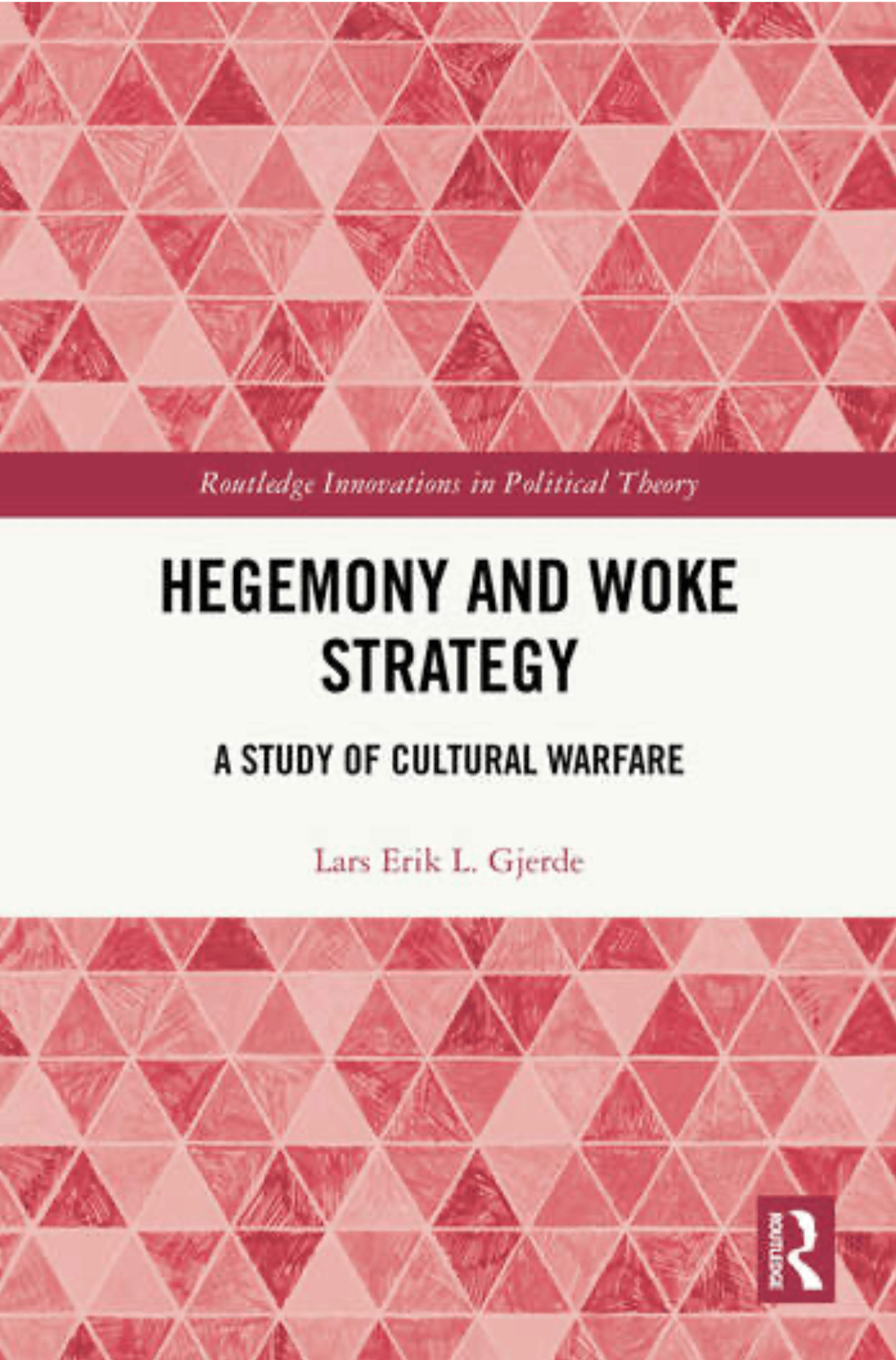
Lars Erik L. Gjerde, Hegemony and Woke Strategy: A Study of Cultural Warfare. Routledge, forthcoming 2027.
References
Ferreira Dias, J. (2025). Entre as Brumas da Memória: gramáticas identitárias, guerras culturais e direitos fundamentais em Portugal, no século XXI. Doctoral dissertation, Iscte – Instituto Universitário de Lisboa.
Gjerde, L. E. L. (forthcoming 2027). Hegemony and Woke Strategy: A Study of Cultural Warfare. Routledge.
Gramsci, A. (1971). Selections from the Prison Notebooks. International Publishers.
McWhorter, J. (2021). Woke Racism: How a New Religion Has Betrayed Black America. Portfolio.
Mounk, Y. (2023). The identity trap: A story of ideas and power in our time. New York: Penguin Press.