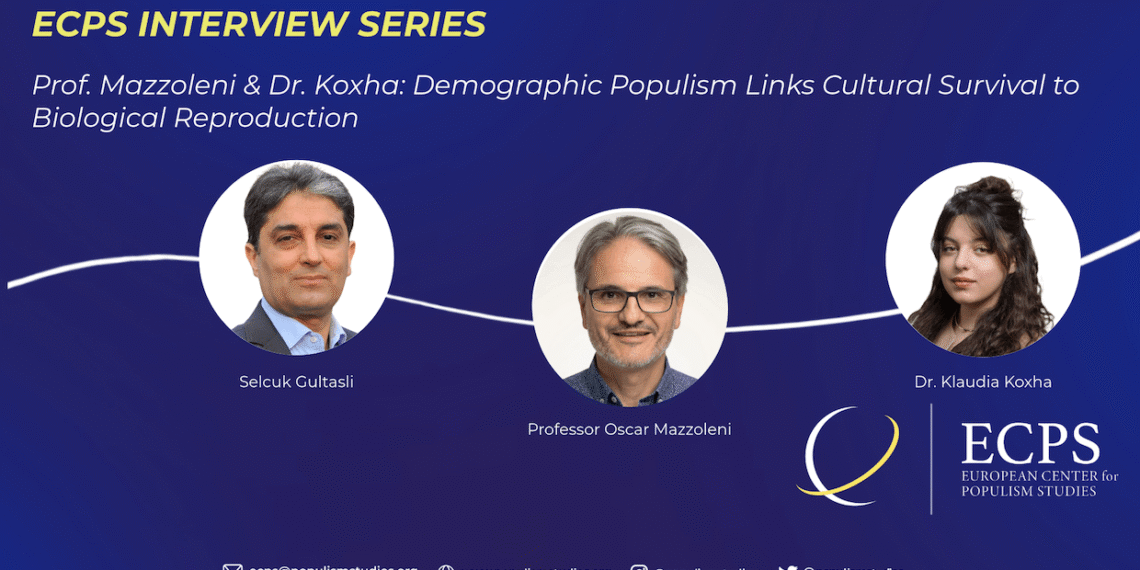
In this interview, Professor Oscar Mazzoleni and Dr. Klaudia Koxha, editors of the recently published volume ‘The Radical Right and Demographic Populism,’ examine how contemporary populist radical right politics increasingly connects immigration, fertility, gender, family, religion, and national identity through the politics of demographic survival. They conceptualize “demographic populism” as a framework linking cultural survival to biological reproduction and transforming demographic change into an existential political struggle. The discussion explores demographic weaponization, conspiracy narratives, Fratelli d’Italia’s calculated ambivalence, and generational adaptations within the Austrian Freedom Party’s youth organizations. Moving beyond Europe, Professor Mazzoleni and Dr. Koxha also address transnational diffusion, political sovereignty, aging, migration, labor shortages, and AI, highlighting how demographic transformations may create new opportunities for populist radical right mobilization while posing significant challenges to democratic resilience.
Interview by Selcuk Gultasli
Contemporary populist radical right (PRR) politics increasingly organizes questions of immigration, fertility, gender, religion, family, and national identity around a common concern: the demographic reproduction of “the people.” In this ECPS interview, Professor Oscar Mazzoleni of the University of Lausanne and Dr. Klaudia Koxha (a Postdoctoral Fellow at the University of Lausanne), editors of the recently published volume The Radical Right and Demographic Populism, explain how this convergence can be understood through the concept of “demographic populism.” As Professor Mazzoleni puts it, issues conventionally treated as separate increasingly converge on a fundamental political question: “Who is entitled to reproduce the true people?” Demographic populism, he argues, reveals how anti-immigration, anti-gender, and pronatalist claims can share “a single Manichean logic of demographic survival versus extinction.” Dr. Koxha sharpens this argument, explaining that “cultural survival” becomes tied to “the biological reproduction of a specific people with specific characteristics.”
The interview begins by developing this conceptual intervention and distinguishing demographic realities from their political weaponization. Aging, declining fertility, and migration are genuine policy challenges, Dr. Koxha stresses; what distinguishes populist radical-right politicization is the question of whose reproduction constitutes the desirable demographic future. This is how demographic change becomes “existential and moralized.” Professor Mazzoleni similarly identifies “demographic weaponization” as central to understanding how statistical and social transformations are reframed as political struggles over collective survival. Their approach consequently bridges populism studies and critical demography, treating demography simultaneously “as a set of conditions and as a political frame.”
The discussion then turns to how demographic populism operates in concrete political settings. Professor Mazzoleni examines Giorgia Meloni’s Fratelli d’Italia, arguing that governmental participation has encouraged not straightforward ideological moderation but “more sophisticated strategies.” Through calculated ambivalence, coded references to “demographic winter,” and a division of discursive labor, radical ideas can be maintained while communication is adapted to broader audiences. In this formulation, demographic populism shifts the perceived threat “from political and economic dispossession to biological and cultural survival,” while immigration becomes embedded within a wider master frame encompassing natality, family, welfare, and religion.
Dr. Koxha’s analysis of the Austrian Freedom Party’s (FPÖ) youth organizations then introduces a generational dimension. While youth branches reproduce core radical-right positions, they adapt them to young people’s concerns and can sometimes “radicalize it further.” Yet Dr. Koxha also identifies greater internal heterogeneity than might be expected, particularly regarding religion, abortion, and LGBTQ+ issues. Crucially, declining religiosity does not necessarily entail rejecting cultural Christianity, which can instead operate “as a marker of national or civilizational identity.”
Finally, the interview broadens comparatively to transnational diffusion, sovereignty, demographic decline, migration, labor shortages, and artificial intelligence. Professor Mazzoleni argues that these transformations “can create a structure of opportunities for radical-right populism,” while Dr. Koxha highlights the political contradiction whereby migration can simultaneously be a practical response to aging and be reframed as evidence of “demographic displacement.” The democratic challenge, she concludes, is to confront the material consequences of demographic transformation without accepting that demographic change necessarily entails “cultural extinction” or that “one group’s security requires another’s exclusion.”