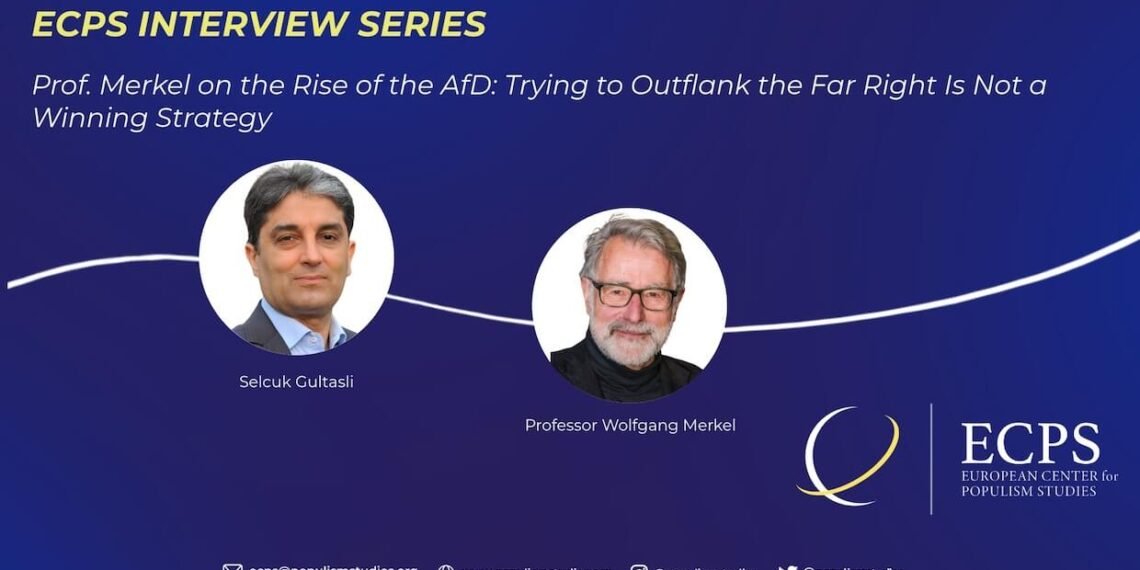
In this ECPS interview, Professor Wolfgang Merkel examines the rise of the AfD, the weakening of Germany’s traditional political center, and the broader crisis of representation reshaping the party system. He warns that mainstream parties risk strengthening the far right when they adopt its positions: “If mainstream parties try to outflank right-wing parties by adopting their positions, they risk legitimizing them.” Professor Merkel also criticizes the Brandmauer as “a political mistake” and rejects an AfD ban as an attempt “to save liberal democracy by illiberal means.” At the same time, he emphasizes the resilience of German democracy, urging greater confidence in institutions and civil society. His conclusion is clear: “We Democrats need to be more optimistic.”
Interview by Selcuk Gultasli
In this wide-ranging interview with the European Center for Populism Studies (ECPS), Professor Wolfgang Merkel, Director at the WZB Berlin Social Science Center and Professor of Political Science at Humboldt University Berlin, reflects on the transformation of Germany’s party system, the rise of the AfD, the weakening of the traditional political center, and the challenges these developments pose for democratic resilience. A leading scholar of democracy, polarization, political conflict, and institutional resilience, Professor Merkel situates recent electoral shifts within a broader erosion of the integrative capacity of Germany’s traditional Volksparteien and the growing centrifugal pressures affecting both the right and the left.
Our conversation comes at a moment of profound transformation in German politics. The far-right AfD has achieved major victories in Saxony-Anhalt and Mecklenburg-Western Pomerania, while Die Linke has emerged as the strongest party in Berlin, exposing growing pressures on Germany’s traditional political center and on Chancellor Friedrich Merz’s CDU. These developments raise fundamental questions about populism, representation, socioeconomic and cultural cleavages, the Brandmauer, militant democracy, and the resilience of liberal institutions.
At the heart of the conversation is the question of how mainstream democratic parties should respond to the rise of the far right. Professor Merkel is particularly skeptical of strategies that seek to neutralize radical-right competition by adopting parts of its political agenda. “If mainstream parties try to outflank right-wing parties by adopting their positions, they risk legitimizing them,” he argues. Such a strategy, in his view, effectively communicates that these parties “were right” and that mainstream parties are merely “correcting their own policies and following their lead.” His conclusion is unequivocal: “I do not think this is a winning strategy.” Instead, democratic parties, he insists, should remain firmly anchored in constitutional principles and clearly defend democratic red lines against racism, xenophobia, and anti-pluralism.
Professor Merkel nevertheless rejects a purely defensive conception of democracy. He describes the Brandmauer—the informal exclusion of the AfD from political cooperation—as “a political mistake,” arguing that it has allowed the party to remain comfortably in the role of protest opposition without having to demonstrate whether it can govern effectively. He is equally critical of proposals to ban the AfD, warning that such a move would amount to an attempt “to save liberal democracy by illiberal means” and could intensify rather than diminish political polarization.
The interview also examines the deeper social foundations of Germany’s changing political landscape. Professor Merkel discusses how socioeconomic insecurity, cultural conflict, migration, regional grievances, and weakened cross-cutting cleavages are increasingly reorganizing political competition into antagonistic camps. He distinguishes cosmopolitan, municipal-communitarian, and chauvinist conceptions of belonging, while emphasizing that the crisis of representation extends beyond the right and is also visible in the resurgence of Die Linke.
Yet Professor Merkel’s analysis ultimately resists democratic pessimism. Germany, he argues, should have greater confidence in its institutions, civil society, and decades of democratic development. “We Democrats need to be more optimistic,” he concludes. Democratic resilience requires not only resistance to anti-democratic pressures, but also the capacity to adapt, govern, rebuild trust, and actively shape political circumstances.