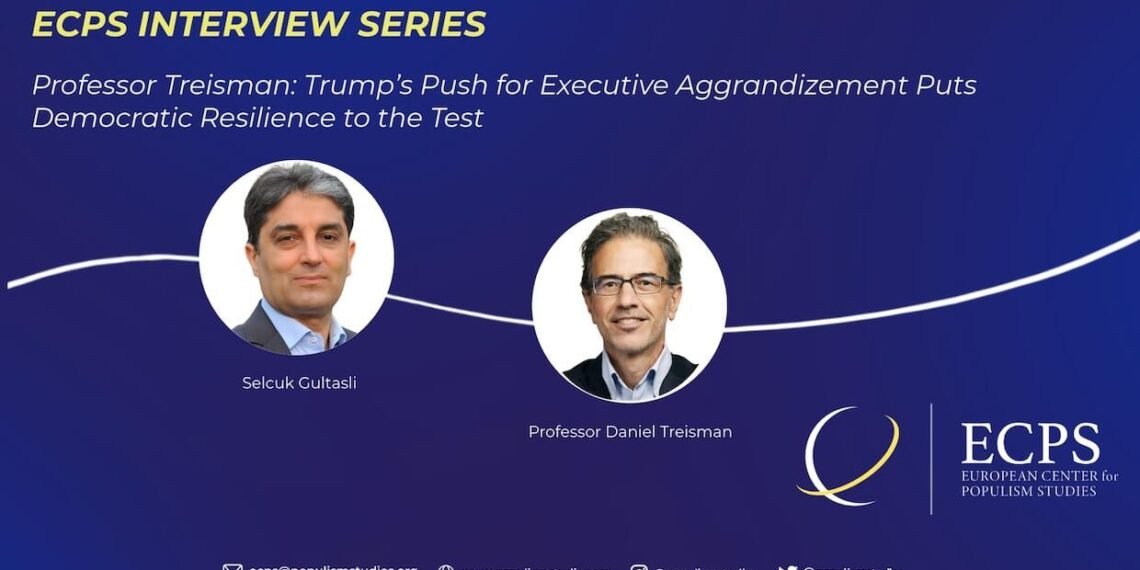
In this ECPS interview, Professor Daniel Treisman examines how Trump’s political style intersects with the logic of informational autocracy and democratic backsliding. Drawing on “Informational Autocracy,” he argues that contemporary authoritarianism often relies less on mass repression than on “controlling narratives, selective coercion, and performance legitimacy.” Trump’s pressure on comedians, broadcasters, universities, and law firms, Professor Treisman suggests, reflects a familiar “inclination” toward intimidation—yet “the outcome was different,” because democratic institutions can still generate pushback. The core issue, he stresses, is whether US checks and civil society can withstand “executive aggrandizement”—the drive to “go beyond the formal or traditional powers of the office and consolidate control.”
Interview by Selcuk Gultasli
In an era marked by democratic backsliding, populist leadership, and the reconfiguration of informational power, the resilience of liberal democracy has become a central concern for scholars and policymakers alike. In this wide-ranging interview with the European Center for Populism Studies (ECPS), Professor Daniel Treisman—Professor of Political Science at the University of California, Los Angeles, and Research Associate at the National Bureau of Economic Research—offers a nuanced and empirically grounded assessment of how Donald Trump’s political strategy intersects with the logic of informational autocracy, executive aggrandizement, and democratic fragility.
Drawing on his influential work Informational Autocracy (co-authored with Sergei Guriev), Professor Treisman situates Trump’s threats against comedians, journalists, universities, and other institutional actors within a broader global pattern in which contemporary autocrats rely less on mass repression than on “controlling narratives, selective coercion, and performance legitimacy.” While Trump’s behavior often resembles that of informational autocrats, Professor Treisman emphasizes a crucial distinction: “So, while the inclination is similar, the outcome was different.” Episodes such as the pressure placed on late-night comedian Jimmy Kimmel reveal Trump’s “tendency to expand his power and to overstep traditional limits,” but also the continued—if uneven—capacity of democratic institutions and civil society to push back.
At the core of the interview lies a central analytical question: whether Trump’s conduct represents a failed or incomplete attempt to translate informational autocracy into a still-competitive democratic system. As Professor Treisman puts it, “The real question… is how resilient democratic societies and civil societies in democratic settings can prove to be in response to a leader who seeks what is often called executive aggrandizement.” This concern animates Professor Treisman’s discussion of selective intimidation, signaling repression, and the targeting of elite institutions—strategies designed to “score some visible victories” and deter broader resistance without resorting to outright censorship.
The interview also explores how new media ecosystems and the rise of a tech “broligarchy” complicate classical models of informational control. Professor Treisman highlights the hybrid arrangements created by platform ownership, algorithmic amplification, and strategic alignment between populist leaders and tech elites, noting that these dynamics allow political actors to undermine epistemic authority “without overt censorship.” While Trump has aggressively pressured legacy media through litigation and regulatory threats, his relationship with major technology firms remains more transactional and indirect—distinct from the tightly coordinated media control characteristic of full informational autocracies.
Beyond the US case, Professor Treisman offers comparative insights into charismatic populism in Latin America, bureaucratized authoritarianism in Russia and Hungary, and the structural uncertainties surrounding democratic decline. Reflecting on Democracy by Mistake, he cautions against deterministic readings of democratic erosion, stressing that “mistakes can be forces for good” as well as for authoritarian empowerment. In closing, Professor Treisman urges analytical humility: distinguishing between cyclical stress and durable authoritarian transformation, he argues, remains inherently uncertain, as history “does not come with labels that are easy to read.”
Taken together, this interview provides a sober, theoretically informed reflection on Trumpism, informational power, and the fragile boundaries between democratic contestation and authoritarian drift.