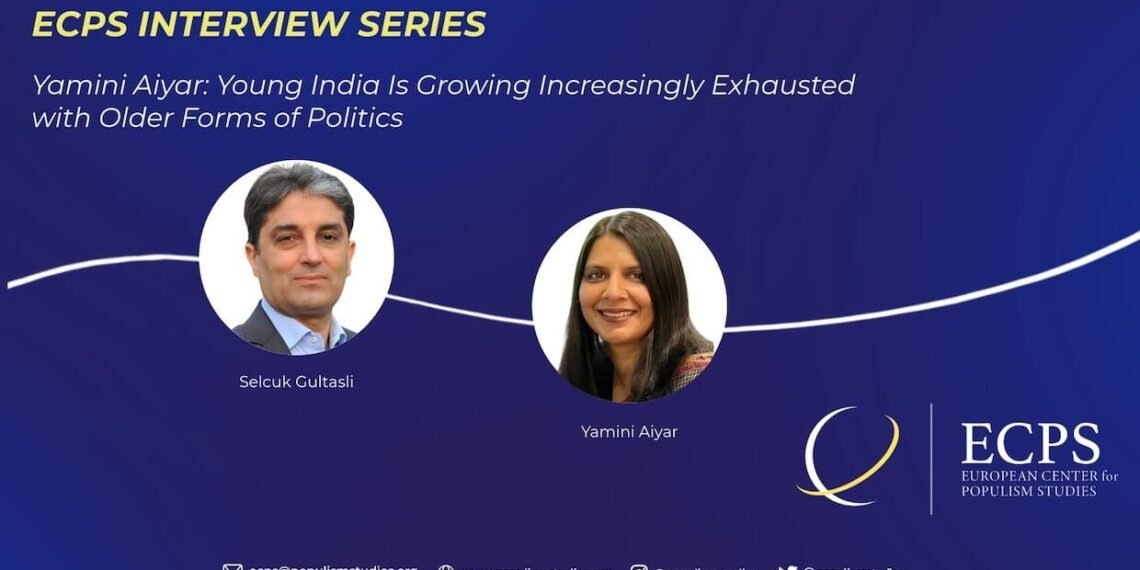
India’s 2026 state elections have reopened fundamental debates about democracy, federalism, and political representation in the world’s largest democracy. In this timely ECPS interview, Yamini Aiyar, Visiting Senior Fellow at Brown University’s Saxena Center for Contemporary South Asia, examines the tensions between the BJP’s centralizing “One Nation” project and India’s plural federal structure. Discussing the BJP’s breakthrough in West Bengal, the dramatic rise of Vijay’s TVK in Tamil Nadu, and the emergence of youth-led movements such as the “Cockroach Janta Party,” Aiyar argues that democratic resistance is increasingly emerging outside formal institutions and party structures. While warning of growing democratic backsliding, she maintains that India’s enduring “democratic sentiment” remains a powerful resource for challenging authoritarian tendencies and renewing democratic life.
Interview by Selcuk Gultasli
India’s 2026 state elections delivered some of the most consequential political surprises since Narendra Modi first came to power. The Bharatiya Janata Party (BJP) achieved a historic breakthrough in West Bengal, ending fifteen years of Trinamool Congress rule and extending its political reach into one of India’s most symbolically important states. At the same time, Tamil Nadu witnessed the extraordinary rise of actor-turned-politician C. Joseph Vijay and his Tamilaga Vettri Kazhagam (TVK), which shattered the long-standing dominance of the state’s established Dravidian parties. Together, these electoral outcomes have reignited fundamental debates about democracy, federalism, political representation, and the future of opposition politics in India.
To explore these developments, the European Center for Populism Studies (ECPS) spoke with Yamini Aiyar, Visiting Senior Fellow at the Saxena Center for Contemporary South Asia at Brown University and one of India’s leading public intellectuals on democracy, governance, state capacity, and democratic accountability. Drawing on her influential recent essay, “The Cracks in the India Model: Democracy Can Be Both Curse and Cure,” Aiyar offers a nuanced interpretation of India’s current democratic moment.
Rejecting both triumphalist and declinist narratives, Aiyar argues that India is experiencing a profound democratic dialectic. On the one hand, democratic institutions have increasingly been captured and instrumentalized by majoritarian political forces. On the other hand, democratic processes continue to generate unexpected forms of resistance and renewal. As she explains, India today is engaged in “a very important old-but-new conversation about what India is and who we are.”
A central theme of the interview is the growing tension between the BJP’s centralizing “One Nation” project and India’s deeply plural federal structure. Aiyar warns that the ruling party has increasingly used state institutions to consolidate power, while simultaneously noting that regional identities and democratic aspirations remain remarkably resilient. The unexpected success of Vijay’s TVK in Tamil Nadu, she argues, demonstrates that “young India is becoming exhausted with many of the older forms of politics.” Far from representing a rejection of Tamil subnational identity, the TVK’s rise illustrates how younger generations are seeking new political vehicles through which to express long-standing regional aspirations.
Indeed, one of the most original aspects of Aiyar’s analysis concerns the emergence of new forms of political mobilization beyond traditional party structures. She points to the recent appearance of the “Cockroach Janta Party,” a satirical youth-led movement that rapidly gained millions of followers after young Indians appropriated a derogatory label allegedly used by a senior public figure. For Aiyar, this phenomenon is not merely a social-media curiosity but evidence of deeper frustrations among younger generations facing unemployment, precarity, and declining faith in established political actors. As she notes, “there is a bubbling up of anxieties among young Indians for a variety of important reasons,” and these emerging forms of mobilization may become important sources of democratic resistance.
Reflecting on the broader political landscape, Aiyar observes that “the Constitution itself became almost a living political actor in the election,” while even within the BJP’s own support base “some voters started questioning the increasingly authoritarian methods being deployed.” These developments suggest that democratic sentiment remains deeply embedded within Indian society despite growing concerns about institutional erosion.
Yet Aiyar’s optimism does not rest primarily on formal institutions. While she is “deeply pessimistic” about the ability of party politics and institutional mechanisms alone to halt democratic backsliding, she remains “hugely optimistic” about the capacity of civic mobilization to generate democratic renewal. Ultimately, she argues that India’s most important democratic resource remains the enduring democratic instinct of its citizens—a “deep democratic sentiment” that will continue to find new avenues through which to challenge and resist authoritarianism.